
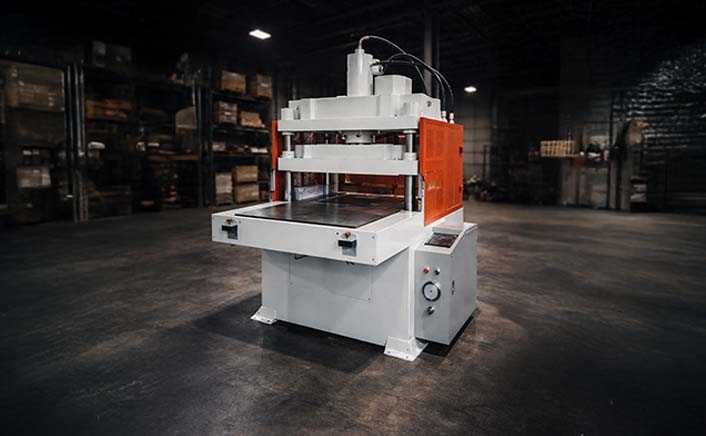
April 23, 2026 — The global die-cutting hydraulic press industry is charting a well-defined growth path, with demand anchored in some of the world’s most active manufacturing sectors. The Die Cutting Hydraulic Press Market recorded a sales volume of 350,000 units in 2025 and is estimated to reach 486,959 units by 2033, growing at a CAGR of 4.1% during the forecast period.
The market is evolving beyond its traditional heavy-industry roots, with non-metallic materials and precision-sensitive applications increasingly defining where growth is coming from and where it is headed.
Access the Full Report Here: https://marksparksolutions.com/reports/die-cutting-hydraulic-press-market
Packaging, Medical, and Flexible Materials Emerge as Core Growth Engines
One of the most compelling structural shifts taking place in this industry is the accelerating adoption of hydraulic presses for non-metallic processing. Packaging alone accounts for approximately 55% of global die-cutting press applications, underscoring just how central this sector has become to overall market demand. The continued expansion of e-commerce and retail logistics is a key force here, as precise die cutting is critical to optimizing packaging efficiency and scalability.
Foam, rubber, adhesive tapes, and multi-layer films are also gaining ground as materials for applications. In automotive and aerospace manufacturing, hydraulic presses in the sub-200-ton range are preferred for producing gaskets, seals, and insulation components that require controlled pressure and dimensional accuracy rather than brute force. Plastic and composite material processing already accounts for around 15% of total hydraulic press applications worldwide, reinforcing the broader industry’s migration toward lightweight, high-precision material handling.
Medical disposables represent another rapidly growing segment. As the healthcare manufacturing sector continues its shift toward sterile, single-use products, including diagnostic strips, wound care materials, and filtration media, demand for hydraulic presses capable of delivering clean, repeatable cuts with consistent pressure is intensifying. In these applications, precision and quality compliance are non-negotiable, and hydraulic systems are well-positioned to meet those requirements.
Consequently, the industry is seeing heightened demand for compact, energy-efficient presses in the 30T to 200T range, which are particularly well-suited for non-metallic die cutting across these diverse end-use segments.
Request for a Free Sample Report @ https://marksparksolutions.com/sample-reports?753&Download_Free_Sample
Pricing Trends Indicate a Stable, Moderately Rising Market
The pricing environment within the Die Cutting Hydraulic Press Market reflects a market in balance. Average unit prices are expected to rise from approximately $8,000 in 2024 to around $9,300 by 2033, a cumulative increase of roughly 16% over the decade, translating to a low single-digit CAGR of 1.5% to 2%.
Mid-tonnage presses in the 30T to 200T range typically fall within a $5,000 to $25,000 price band, depending on automation level and configuration. While technological upgrades, including servo-hydraulic systems, smart controls, and automation integration, contribute to incremental price increases, competitive manufacturing outside Asia continues to exert a stabilizing effect on overall pricing. Average hydraulic press import prices in some markets can be as low as $3,500 per unit, depending on specifications, underscoring the wide price range across the industry.
Rising input costs for steel and hydraulic components put upward pressure on manufacturers’ margins. Still, the overall pricing trajectory remains measured rather than volatile, which is a signal of a healthy supply-demand equilibrium.
Regional Dynamics: Asia-Pacific Leads, While Emerging Markets Gain Momentum
From a regional standpoint, the Asia-Pacific area is the most influential manufacturing and consumption hub. China holds a commanding position, accounting for nearly half of global production and maintaining a dominant share of export volumes. Its integrated supply chains, cost efficiencies, and large-scale manufacturing ecosystems allow it to serve both domestic and international demand simultaneously.
Japan and South Korea contribute to the region’s strength through their technological sophistication and precision engineering capabilities. India, meanwhile, is gaining traction as a high-growth market, driven by advancing industrialization, infrastructure investment, and domestic manufacturing policies. The country’s rising import demand signals a gap between local production capacity and consumption needs, a gap that presents opportunities for both domestic capacity expansion and foreign suppliers.
Finland is a notable example of how smaller, high-growth economies can punch above their weight in this market. Its strong consumption CAGR reflects a rapid transition toward automation and advanced manufacturing technologies, even if its overall scale remains limited.
Established industrial economies such as the United States and Germany maintain robust positions through advanced infrastructure, sustained demand, and leadership in automation and innovation, ensuring stable demand even where headline growth rates are more moderate.
Download Free Sample Report: https://marksparksolutions.com/sample-reports?753&Ask_for_Discount
Key Risks the Industry Must Navigate
High initial capital requirements for automated and high-tonnage systems remain a barrier for small and medium-sized manufacturers. Cyclical demand from end-use sectors such as automotive, where economic slowdowns can directly affect equipment procurement, adds another layer of uncertainty for press manufacturers.
Competition from alternative cutting technologies, including laser and digital die cutting systems, is a growing concern. These alternatives often offer faster setup times, reduced tooling costs, and greater flexibility for short production runs, making them appealing in packaging and electronics applications where customization and rapid prototyping are priorities.
Raw material price volatility, particularly for steel and hydraulic components, can inflate production costs and compress margins. Supply chain disruptions in sourcing precision components, hydraulic valves, sensors, and control systems present additional delivery and cost risks. A shortage of skilled labor to operate and maintain increasingly sophisticated systems, alongside growing regulatory requirements around energy efficiency and sustainability, adds further operational complexity for manufacturers across the value chain.
Competitive Landscape
The Die Cutting Hydraulic Press Market is shaped by a mix of globally established manufacturers and regionally dominant players competing across technology capability, tonnage range, automation integration, and after-sales support. Key companies evaluated in this space include Schuler Group, Komatsu Industries, AIDA Engineering, Macrodyne Technologies, Beckwood Press, Greenerd Press & Machine Company, and Gasbarre Products, among other notable participants.
Schuler Group brings deep engineering expertise across a broad range of press configurations, maintaining its significance in both high-tonnage industrial and precision-forming environments. Komatsu Industries and AIDA Engineering, rooted in Japan’s precision manufacturing tradition, are particularly strong in servo-hydraulic systems and high-speed operations capabilities well-aligned with electronics and automotive demand. Macrodyne Technologies holds a firm position in custom hydraulic press solutions, serving industries such as medical and aerospace, where application-specific configurations and stringent compliance requirements are standard. Beckwood Press and Greenerd Press & Machine Company are well-regarded in the North American market for their engineering depth and long equipment lifecycles. At the same time, Gasbarre Products brings cross-sector resilience through its diversified portfolio spanning compaction, sintering, and hydraulic pressing.
Competitive differentiation is increasingly tied to smart manufacturing integration, energy-efficient hydraulic circuits, and IoT-enabled monitoring. Simultaneously, pricing pressure from low-cost Asian manufacturers continues to challenge North American and European players, who must invest in both technological advancement and cost optimization to sustain market positioning through 2033.
Media Contact
Company Name: Mark & Spark Solutions
Contact Person: Sushil
Email: Send Email
Phone: 9158340999
Address:2nd Floor, Panchsheel Park, Aundh
City: Pune
State: Maharashtra
Country: India
Website: https://marksparksolutions.com