
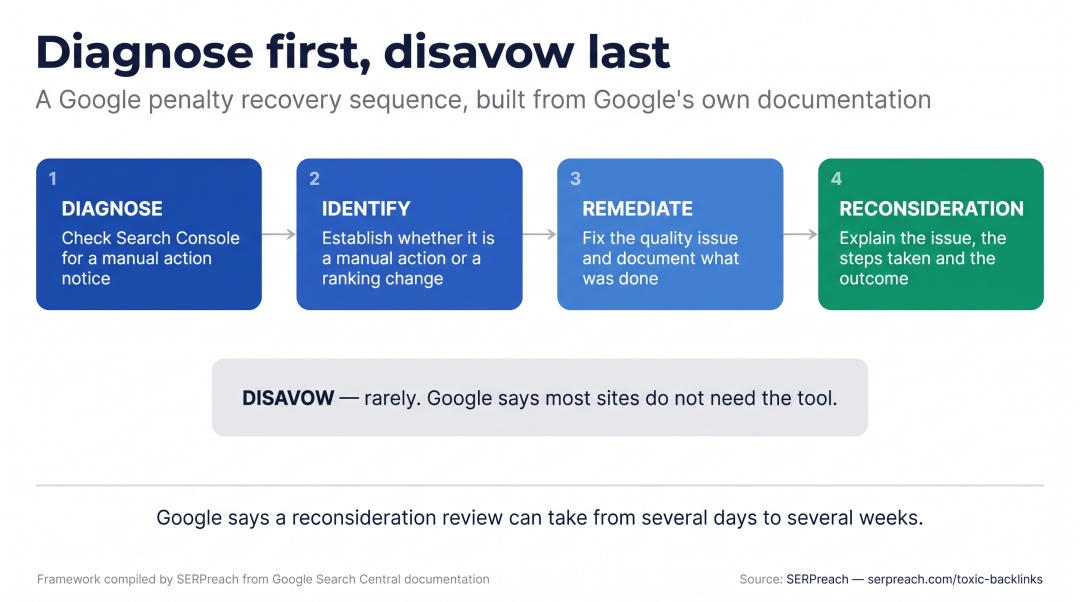
MELBOURNE, AUSTRALIA – October 05, 2026 – SERPreach today published an evidence-led search-penalty recovery framework based on Google’s official documentation. The framework helps site owners distinguish Search Console manual actions from algorithmic and technical ranking changes, then prioritizes diagnosis, complete remediation and accurate documentation over generalized “toxic link” scores or fixed recovery timetables.
Key Findings
-
Google notifies verified site owners of manual actions in Search Console, identifies affected issues and allows a reconsideration request after the problems are addressed. Source: Google Search Central, “Manual Actions Report”
-
A reconsideration request should explain the quality issue, the steps taken to correct it and the outcome of those steps. Google says review can take from several days to several weeks and that owners receive a message when it is complete. Source: Google Search Central, “Reconsideration Requests and Manual Actions”
-
Google says most sites do not need the disavow tool. Its documentation limits the tool to cases involving a considerable number of spammy, artificial or low-quality links together with a manual action, or a likely manual action, for unnatural links. Source: Google Search Console Help, “Disavow Links to Your Site”. SERPreach’s analysis of toxic backlinks provides related context for evaluating those link patterns.
-
Google’s spam policies classify buying or selling links for ranking purposes, excessive link exchanges and automated link creation as link spam. Paid links may be qualified with rel=”sponsored” or . Source: Google Search Central, “Spam Policies for Google Web Search”
The Recovery Path Starts With Diagnosis
Fast, disciplined recovery starts by identifying the type of problem. A sudden traffic decline can reflect a manual action, site outage, tracking failure, technical change, seasonality, competition or a broad algorithm update. The first diagnostic question is whether Search Console shows a manual action; if it does not, a reconsideration request is not the relevant process.
“Recovery work goes wrong when a label is chosen before the evidence is collected,” said Sabahat Ali, founder of SERPreach. “Confirm the dates, affected page groups, Search Console messages, technical releases and link history. Only then decide whether the issue is manual, algorithmic, technical or commercial.”
For a manual action, SERPreach’s interpretation of Google’s guidance is straightforward: identify the cited violation, stop the practice, correct the affected material across the site and keep a record of the work. A reconsideration request should describe what changed without overstating certainty or promising a recovery date.
The same restraint applies to disavowal. Third-party “toxicity” scores are not Google metrics, and Google’s documentation does not recommend exporting every flagged domain into a disavow file. Site owners should first attempt appropriate removal of links they created or commissioned and use the tool only within Google’s stated conditions. SERPreach’s guides to link-building scams and black-hat links describe additional risk signals.
SERPreach provides additional background in its guide to disavowing backlinks.
Methodology
SERPreach compiled and interpreted current Google Search Central and Search Console Help documentation on manual actions, reconsideration requests, disavowal and link spam. It did not conduct a survival study of penalized businesses and makes no recovery-rate or recovery-time claim. No client audit or confidential case is used.
About SERPreach
SERPreach is the SEO and link-building practice of Outreach Solutions Pty Ltd, an Australian company launched in 2021. It provides outreach-based link building for brands and agencies, including niche edits, link insertions and guest posting on third-party publishers. The practice is led by founder Sabahat Ali, who has worked in SEO since 2009 and has served more than 668 clients over his career. Its mission is to earn editorial placements on sites with real audiences and verifiable traffic, and to publish research on how search and AI citations actually behave.
For more information, visit https://serpreach.com.
Media Contact
Company Name: Outreach Solutions Pty Ltd
Contact Person: Sabahat Ali
Email: Send Email
Address:Unit 5 4 Lexgrove
City: VIC
Country: Australia
Website: https://serpreach.com/