
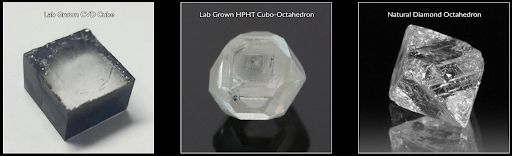
Houston, Texas – October 15, 2026 – CVD and HPHT are the two primary methods used to grow laboratory-grown diamonds. The growth method does not determine whether a finished diamond is beautiful, transparent, or the quality of its light performance. Those aspects depend on the individual stone’s color, clarity, transparency, treatment history, proportions, and the precision of it’s cut.
A growth method describes the conditions under which the crystal was created. It does not replace the grading report, gemological review, or visual light performance evidence attached to the stone. Both HPHT and CVD methods can produce high quality diamonds. But with some caveats.
Two Very Different Methods Create Laboratory-Grown Diamonds
HPHT stands for high pressure, high temperature. This method uses a carbon source, a diamond seed, a metallic flux, and controlled heat and pressure to grow diamond material. HPHT growth commonly uses pressures of roughly 5 to 6 gigapascals and temperatures of about 1,300 to 1,600 degrees Celsius, conditions similar to those that produce natural diamonds deep under the crust of the earth.
CVD stands for chemical vapor deposition. In this method, a diamond seed plate is placed in a vacuum chamber with a carbon-containing gas such as methane. Microwave energy creates a plasma, allowing carbon atoms to be deposited layer by layer on the seed. CVD growth can take place over a series of stages, while HPHT growth occurs within a single session in a high-pressure growth cell. CVD diamonds often need post growth treatment to decolorize them.
Both methods produce laboratory-grown diamonds with essentially the same chemical, physical, and optical properties as natural diamonds. The different growth environments leave characteristic patterns that allow gemological laboratories to identify laboratory-grown diamonds and distinguish them from natural diamonds.
Growth Method Can Influence Color and Transparency
The growth process can affect the characteristics found in the finished diamond. CVD diamonds may show brown or gray color, and interruptions during the growth cycle can create striations that affect transparency when they become prominent. HPHT diamonds can show blue nuance associated with boron or other characteristics related to the chemistry of the growth medium.
Neither result occurs in every diamond. Both CVD and HPHT can produce outstanding laboratory-grown diamonds. While CVD diamonds are characterized by higher levels of crystal strain, a buyer should evaluate the individual stone instead of treating one method as automatically superior to the other.
“In general, colorless and near-colorless HPHT-grown diamonds have low impurity concentrations and uniform pressure is applied during growth, resulting in high crystalline perfection and very weak or almost no strain levels” (GIA- Gems and Gemology Summer 2024)
Post-growth treatment is another part of the discussion. Some laboratory-grown diamonds receive HPHT, LPHT, annealing, irradiation, or other treatment after the initial growth process to change color or address characteristics created during growth. If the diamond is classified on a laboratory report as “As Grown”, no post-growth treatment has been detected. Treatment alone is not a complete quality judgment, but it is information that should be disclosed and considered when the diamond is evaluated.
“CVD and HPHT describe how a laboratory-grown diamond was created, but neither term tells the whole quality story. The buyer still needs to understand the diamond’s transparency, treatment disclosure, proportions, cut precision, and actual light performance,” said Bryan Boyne GG, VP at Whiteflash.
Cut Quality Remains Separate from Growth Method
Neither growth method can compensate for a diamond that has been cut without sufficient precision. The facet design and arrangement determines how light enters, travels through, and returns from the diamond to the eye of an observer. Every diamond requires close evaluation of its proportions, optical symmetry, transparency, face-up appearance and light performance.
This is why Whiteflash treats diamond cut quality as a separate question from origin and growth method. A grading report establishes the diamond’s identity and describes its color, clarity, carat weight, and other characteristics. Images, video, and gemological review provide important additional information about the quality of the individual stone.
What Shoppers Should Confirm Before Choosing a Lab-Grown Diamond
Shoppers comparing laboratory-grown diamonds can begin by confirming that the stone is identified clearly as laboratory-grown and accompanied by a report from a recognized gemological laboratory. They can then review the stated color, clarity, measurements, proportions, growth method, and any disclosed post-growth treatment.
Shoppers can learn more about CVD versus HPHT diamonds, including how the growth methods and post-growth treatments can affect the finished stone.
Precision Lab Applies a Cut-Quality Standard
Whiteflash’s Precision Lab Diamonds are laboratory-grown diamonds selected and cut for strong light performance. The line is evaluated according to a defined quality standard, with attention paid to the performance of each individual diamond.
The guide to lab-grown diamonds covers growth methods, identification, transparency, treatments, and the relationship between laboratory origin and diamond quality. Shoppers can also review diamond imaging and HD video when comparing the actual stones available for purchase.
About Whiteflash
Whiteflash is a modern jeweler specializing in precision cut diamonds, designer engagement rings, and fine diamond jewelry. As the exclusive home of A CUT ABOVE® Super Ideal natural diamonds, Whiteflash is internationally recognized for scientific light-performance analysis, including ASET, Ideal-Scope, and Hearts & Arrows imaging. Based in Houston, Texas, Whiteflash serves a global clientele and is an authorized retailer for the finest brand name designers including Tacori, Verragio, Simon G., A. Jaffe, and Vatche. Whiteflash offers the Lifetime Upgrade Program on all A CUT ABOVE® diamonds.
Media Contact
Company Name: Whiteflash Inc.
Contact Person: Tiffany Moore
Email: Send Email
Phone: 8322526770
Address:2150 Town Square Place Suite 330
City: Sugar Land
State: TX
Country: United States
Website: Whiteflash.com