
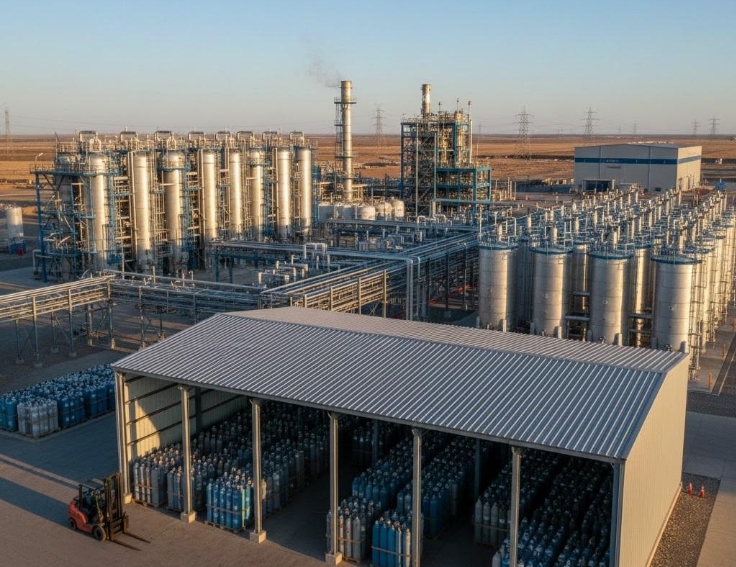
For years, the global rare gas market operated on an assumption that felt safe – concentration equals efficiency. Specialized production hubs supplied neon, krypton, and xenon to industries that valued precision more than redundancy. As long as those hubs functioned smoothly, the system appeared stable.
The events of recent years exposed how fragile that balance really was. Rare gases are not interchangeable commodities. Their purification requires specialized cryogenic infrastructure, tight quality controls, and highly tuned industrial processes. When production clusters face disruption, scaling alternatives isn’t immediate – it’s an engineering challenge measured in months or years.
This realization triggered a structural shift in how rare gas supply chains are designed. Geographic diversification is no longer viewed as optional insurance; it has become a core resilience strategy. Instead of relying on a single region to supply high-purity gases, the industry is moving toward distributed production ecosystems capable of absorbing shocks without compromising performance.
Diversification also changes investment priorities. Facilities must be designed with scalability, interoperability, and purification repeatability in mind. Rare gas production is evolving from a concentrated pipeline into a modular network.
Ukraine’s historical dominance and the post-disruption pivot
Ukraine played a central role in rare gas purification for decades, particularly as a high-volume neon producer serving semiconductor and advanced manufacturing sectors. This dominance grew from industrial gas recovery expertise and cryogenic purification infrastructure that few regions could match.
The disruption of those supply pathways revealed how deeply global production schedules were tied to regional specialization. It wasn’t merely a shortage – it was a reminder that efficiency without redundancy carries systemic risk.
Industries dependent on high-purity gases began rethinking procurement strategies. Instead of rebuilding the old model elsewhere, they focused on creating distributed capacity designed to operate independently yet maintain consistent quality standards. The goal wasn’t to replace Ukraine’s contribution – it was to prevent future bottlenecks from cascading through the supply chain.
This pivot toward distributed production demanded collaboration. Cryogenic engineering, purification technology, and quality frameworks had to move across borders without losing performance fidelity.
Joint venture engineering as a resilience framework
A joint venture in rare gas production isn’t just a business arrangement – it’s an engineering framework for continuity. Aligning purification standards, cryogenic handling protocols, and monitoring systems across regions ensures that gases processed in different facilities behave identically in downstream applications.
This is where organizations like Cryoin Engineering play a structural role. Their approach emphasizes system interoperability, allowing purification modules to integrate seamlessly into diverse industrial environments. Monitoring frameworks validate purity continuously, ensuring that distributed production does not introduce variability.
Joint venture engineering focuses on replication without compromise. Cryogenic staging, impurity targeting, and quality verification processes are standardized, yet flexible enough to adapt to regional feedstock conditions. The result is a distributed production network where each node reinforces overall stability.
Instead of centralizing risk, the architecture disperses it. Facilities operate autonomously while adhering to shared technical principles, creating redundancy that strengthens the entire supply chain.
The Korean expansion represents more than geographic growth – it demonstrates how rare gas infrastructure can evolve toward resilience by design.
The strategic logic behind Cryoin’s Korean expansion
The decision to establish a Korean production hub reflects a broader understanding of how rare gas ecosystems must function in a volatile global environment. South Korea offers industrial maturity, semiconductor proximity, and logistical connectivity – a foundation well suited for high-precision gas production.
The cryoin korea joint venture JI Tech initiative embodies this strategy. Rather than duplicating facilities blindly, the partnership focuses on creating a purification architecture aligned with international standards while leveraging regional strengths. Cryogenic processing, impurity targeting, and quality verification systems are designed to operate as extensions of a global network.
This expansion isn’t simply about volume. It’s about positioning purification capability closer to demand centers while maintaining compatibility with existing workflows. Distributed hubs reduce transport dependency, shorten response times, and allow localized recovery and refinement cycles.
The Korean facility becomes a node in a resilient supply architecture – capable of independent operation yet synchronized with broader production ecosystems.
Production scaling and regional purification ecosystems
Scaling rare gas production is not simply a matter of increasing output – it requires building purification ecosystems capable of sustaining precision under load. When a facility expands, impurity dynamics change, thermal behavior shifts, and throughput pressures expose weaknesses that smaller systems might never encounter, underscoring why global rare gas expansion depends on engineering resilience alongside capacity.
Modern regional hubs therefore prioritize ecosystem design over raw capacity. Cryogenic separation modules are layered so that each stage absorbs a predictable portion of the purification burden. Feedstock variability is anticipated rather than treated as an exception. Monitoring systems operate continuously, validating purity under fluctuating flow conditions.
In the Korean expansion model, production scaling is engineered as modular growth. Instead of building a single oversized purification line, facilities deploy synchronized modules that maintain six-nines consistency regardless of throughput. Each module reinforces the others, preventing localized strain from cascading across the system.
Engineering frameworks associated with Cryoin Engineering emphasize this ecosystem logic. Their approach treats scaling as a controlled multiplication of verified purification stages, ensuring that increased capacity does not dilute quality. The result is a production environment where growth strengthens stability rather than threatening it.
Regional purification ecosystems also reduce systemic vulnerability. By distributing processing capability closer to industrial demand, supply chains gain flexibility. Recovery cycles shorten. Transport risks diminish. Purity verification becomes local, immediate, and repeatable.
Technology transfer and standardized quality architecture
Distributed production only works if quality remains identical across regions. Rare gases used in semiconductor and high-precision applications cannot tolerate variability, even when sourced from different facilities. This is where technology transfer becomes an engineering discipline rather than a licensing exercise.
Standardized purification architectures ensure that cryogenic staging, adsorption behavior, and impurity verification protocols operate under shared technical principles. Facilities exchange more than equipment – they share calibration logic, monitoring thresholds, and contamination response strategies.
Technology transfer must preserve process fidelity while allowing adaptation to local conditions. Feedstock composition, environmental factors, and infrastructure constraints differ by region, yet purification outcomes must converge. Modular system design enables this balance: core purification stages remain consistent while peripheral adjustments account for local variables.
Systems influenced by Cryoin Engineering prioritize interoperability. Monitoring frameworks validate performance continuously, confirming that distributed facilities meet identical purity standards. This shared architecture allows gases processed in Korea to integrate seamlessly into global workflows without requiring downstream recalibration.
Standardization does not eliminate flexibility – it channels it. Facilities retain operational autonomy while adhering to a unified quality backbone, creating a network where consistency is engineered rather than assumed.
International partnerships and neon supply stability
Rare gas resilience is ultimately a collaborative achievement. No single facility can absorb global demand fluctuations alone. International partnerships distribute both production responsibility and technical expertise, forming a supply network capable of adapting to regional disruption.
The Korean joint venture functions as a stabilizing node within a broader framework of cryoin international partnerships neon initiatives. These collaborations align purification standards, recovery strategies, and quality verification practices across borders. Instead of isolated supply corridors, the industry gains a mesh of interconnected production pathways.
Neon supply stability benefits directly from this architecture. Semiconductor manufacturers rely on predictable purity and delivery schedules. Distributed purification hubs shorten logistics chains, enabling faster response to demand shifts. Recovery loops allow reclaimed neon to re-enter circulation without compromising performance.
Partnership-driven infrastructure also encourages shared innovation. Facilities exchange data on impurity behavior, cryogenic optimization, and energy efficiency, accelerating collective improvement. This feedback loop transforms partnerships into living engineering networks.
Organizations such as Cryoin Engineering contribute by bridging regional capabilities with unified purification logic. Their systems support interoperability across facilities, reinforcing the idea that resilience emerges from coordinated precision rather than isolated capacity.
The long-term outlook for distributed rare gas production
The evolution toward distributed rare gas production marks a structural shift in how industrial supply chains are engineered.Rather than piling all expertise and production into a single location, the industry is moving in a different direction-toward adaptive networks built to perform even when conditions get unpredictable. The goal isn’t efficiency at all costs anymore. It’s continuity.
Future facilities are likely to lean hard into modular growth, predictive monitoring, and energy-conscious cryogenic cycles. Purification won’t live in isolated units. It will operate as part of an intelligent infrastructure-one that anticipates contamination trends, adjusts parameters on its own, and stays ahead of problems instead of reacting to them. Regional hubs will be linked by shared quality standards, forming a distributed lattice of capability rather than a fragile chain.
The Korean expansion points to what this future looks like in practice. A distributed node, designed from the start for compatibility, scalability, and long-term continuity. As demand for high-purity gases continues to climb, similar architectures are likely to appear elsewhere, reinforcing the global network piece by piece.
At the center of all of this is a simple idea: resilience doesn’t happen by accident. It’s engineered. Distributed purification systems protect supply integrity while still leaving room to innovate. And when facilities operate as coordinated ecosystems instead of isolated sites, rare gas production becomes far less vulnerable to local disruptions-and far more prepared for what comes next.
The trajectory shaped by initiatives involving Cryoin Engineering reflects this philosophy. Their emphasis on interoperability, modular purification, and continuous validation signals a broader industry commitment to endurance over convenience.
Scaling rare gas production beyond a single geographic hub is more than an expansion strategy – it is an architectural redesign of supply resilience. Modular ecosystems, standardized quality frameworks, and international partnerships transform fragile pipelines into adaptive networks.
The Korean joint venture illustrates how distributed production can preserve precision while strengthening continuity. As rare gas demand intensifies, this model will increasingly define how global supply systems are built – engineered for stability, scalability, and shared performance.
Media Contact
Company Name: Linkyway
Contact Person: Alisa
Email: Send Email
Country: United States
Website: https://linkyway.co/