
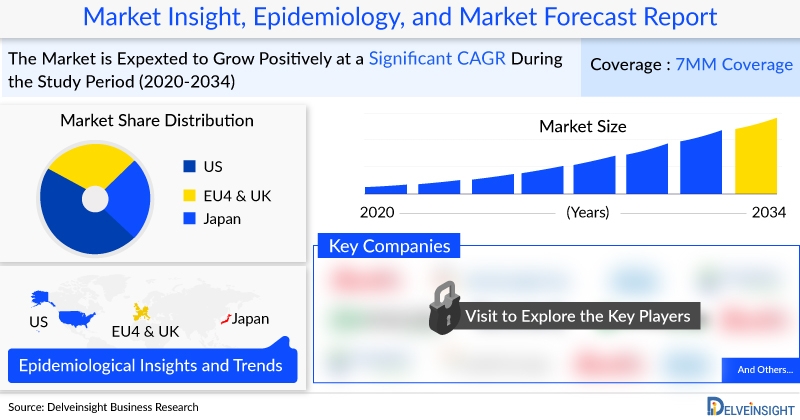
Crohn’s Disease market size was expected to grow at a significant CAGR of 4.3% by 2034, estimates DelveInsight
The Crohn’s disease market across the 7MM (US, EU4, UK, and Japan) is projected to grow from USD 11.37 billion in 2025 to USD 16.84 billion by 2034, expanding at a CAGR of 4.4%. The United States represents the largest share, with the market valued at around USD 8 billion in 2024 and expected to grow steadily.
Recent developments show strong activity in diagnostics and biologics. In 2025, ALPCO launched a calprotectin assay in Europe to help differentiate inflammatory bowel disease (IBD), including Crohn’s, from IBS. Several ustekinumab biosimilars entered the US market, including SELARSDI™ (Teva/Alvotech) and STEQEYMA® (Celltrion), increasing competition. Johnson & Johnson’s TREMFYA® (guselkumab) gained FDA approval as the first IL-23 inhibitor offering both subcutaneous and intravenous induction for moderate to severe Crohn’s disease. Additionally, the FDA approved OMVOH® (mirikizumab) in early 2025, further strengthening the IL-23 class.
Current treatment relies heavily on biologics and immunomodulators, with adalimumab holding the largest market share (about USD 4 billion in 2024 across the 7MM). Other mainstays include STELARA, infliximab, corticosteroids, immunosuppressants, and 5-ASA therapies. Around 10% of total market revenue comes from pediatric patients, where HUMIRA and REMICADE remain dominant due to established safety and physician familiarity.
Market growth will be driven by newly approved and late-stage emerging therapies such as RINVOQ, OMVOH, SKYRIZI, TREMFYA, ENTYVIO (pediatric), VELSIPITY, LITFULO, Tulisokibart, Duvakitug, AGMB-129, and others. Major pharmaceutical companies—including Takeda, Janssen, AbbVie, UCB, Eli Lilly, AstraZeneca, Gilead, Boehringer Ingelheim, Pfizer, Sanofi, and several biotechs—are actively advancing innovative pipeline treatments.
Overall, the Crohn’s disease market is set for steady expansion, supported by biologic innovation, biosimilar competition, expanding pediatric research, and new mechanisms such as IL-23 inhibitors, which are reshaping the treatment landscape.
DelveInsight’s “Crohn’s Disease Market Insights, Epidemiology, and Market Forecast-2034” report delivers an in-depth understanding of Crohn’s Disease, historical and forecasted epidemiology as well as the Crohn’s Disease market trends in the United States, EU5 (Germany, Spain, Italy, France, and United Kingdom), and Japan.
The Crohn’s Disease market report provides current treatment practices, emerging drugs, the market share of the individual therapies, and the current and forecasted Crohn’s Disease market size from 2020 to 2034, segmented by seven major markets. The Report also covers current Crohn’s Disease treatment practice/algorithm, market drivers, market barriers, and unmet medical needs to curate the best opportunities and assesses the underlying potential of the Crohn’s Disease market.
Request for a Free Sample Report @ Crohn’s Disease Market Forecast
Some facts of the Crohn’s Disease Market Report are:
- The Crohn’s Disease market size was valued ~USD 10,777 million in 2024 and is anticipated to grow with a significant CAGR of 4.3% during the study period (2020-2034).
- In November 2025, Gomab Therapeutics is advancing its lead candidate, ontunisertib, into a Phase IIb trial after positive results in fibrostenosing Crohn’s disease (FSCD). In the Phase IIa STENOVA study (NCT05843578), the oral activin receptor-like kinase 5 (ALK5) inhibitor demonstrated safety and tolerability over 12 weeks in patients with symptomatic ileal narrowing. Adverse event incidence and severity were comparable between the treatment and placebo groups, and no treatment-emergent cardiac toxicity or inflammation was observed.
- In November 2025, Sandoz’s Tyruko (natalizumab-sztn) is now available for prescription in the U.S. Tyruko is the first FDA-approved biosimilar to Tysabri (natalizumab), indicated for adult patients with relapsing multiple sclerosis and for those with moderate to severe Crohn’s disease. The FDA granted approval in August 2023, with a planned 2024 launch contingent on a second FDA approval for a test detecting anti-JVC antibodies. Natalizumab therapies carry a risk of progressive multifocal leukoencephalopathy (PML), a rare brain infection caused by the John Cunningham virus, which can occur in immunocompromised patients.
- In April 2025, Sanofi decided to discontinue the development of its oral tumour necrosis factor (TNF) inhibitor, balinatunfib, as a standalone treatment after it failed to meet the primary endpoint in a Phase II trial. Preliminary findings from the SPECIFIC-PSO Phase II study (NCT06073119) in psoriasis patients indicated that balinatunfib produced clinically meaningful improvements in the primary endpoint, PASI-75 response, with efficacy similar to other oral psoriasis treatments. However, it did not achieve statistical significance, which Sanofi attributed to “the nature of this limited Phase II study.” PASI-75 is a standard measure assessing whether a patient has achieved a 75% reduction in symptoms from baseline.
- In March 2025, Agomab Therapeutics reported positive interim findings from 44 patients who completed treatment in the ongoing STENOVA1 Phase IIa trial of AGMB-129, an oral gastrointestinal (GI)-restricted small molecule ALK5 (TGF-β RI or ALK5) inhibitor being developed as a potential therapy for Fibrostenosing Crohn’s Disease (FSCD).
- In March 2025, Celltrion announced the U.S. launch of STEQEYMA® (ustekinumab-stba), a biosimilar to STELARA® (ustekinumab), after receiving FDA approval in December 2024. STEQEYMA is authorized for the same indications as STELARA, ensuring reliable treatment options for both patients and healthcare providers.
- In March 2025, Johnson & Johnson announced that the FDA has approved TREMFYA® (guselkumab), making it the first and only IL-23 inhibitor offering both subcutaneous (SC) and intravenous (IV) induction options for adults with moderately to severely active Crohn’s disease (CD), a chronic inflammatory condition affecting the gastrointestinal tract.
- In February 2025, Eli Lilly shared findings from the VIVID-2 open-label extension study at the Crohn’s and Colitis Congress (CCC), revealing that most patients with moderately-to-severely active Crohn’s disease treated continuously with OMVOH for two years achieved sustained clinical and endoscopic outcomes, including 43.8% of patients who had previously failed biologic therapies.
- In January 2025, The FDA approved OMVOH (mirikizumab) for Crohn’s disease, reinforcing the role of IL-23 inhibitors. Demonstrating robust long-term effectiveness, OMVOH is also under investigation for use in pediatric patients, potentially fulfilling a critical unmet need in this group.
- In 2024, the Crohn’s disease market in the US held the largest share among the 7MM, reaching around USD 8,000 million, and it is projected to grow further at a CAGR of 4.5%.
- In 2024, Germany recorded the largest Crohn’s disease market size among European nations at approximately USD 670 million, while Spain had the smallest, with around USD 207 million.
- In 2024, Japan’s Crohn’s disease market size was estimated at around USD 423 million, representing about 4% of the overall 7MM market.
- In 2024, the United States reported approximately 1.1 million diagnosed prevalent cases of Crohn’s disease.
- In 2024, the United States accounted for the largest share of diagnosed prevalent Crohn’s disease cases, representing about 54% of the 7MM population, while EU4 and the UK made up roughly 42%, and Japan contributed around 4%.
- In 2024, Germany recorded the highest number of diagnosed Crohn’s disease cases among the EU4 countries, with 299,000 cases, followed by the UK with 234,000 cases, while Spain reported the fewest, at 93,000 cases.
- In 2024, the United States was estimated to have approximately 461,000 diagnosed prevalent cases of mild Crohn’s disease and around 755,000 cases classified as moderate-to-severe.
- Key Crohn’s Disease Companies: Merck, Eli Lilly and Company, RedHill Biopharma, Bristol Myers Squibb, Dr. Falk Pharma GmbH, Janssen-Cilag Ltd., AbbVie, EA Pharma Co., Ltd., Erasmus Medical Center, Takeda, Pfizer, Provention Bio, Inc., Mitsubishi Tanabe Pharma Corporation, and others
- Key Crohn’s Disease Therapies: OMVOH (mirikizumab/LY3074828), ENTYVIO (vedolizumab), Tulisokibart (MK-7240, PRA023), Mirikizumab, RHB-104, ZEPOSIA (ozanimod), budesonide, Guselkumab, Risankizumab SC, E6011, Infliximab, CDPATH™, Etrasimod, PRV-6527, MT-1303, and others
- In 2023, there were about 432,000 cases classified as mild, and approximately 708,000 cases classified as moderate to severe (including those that transitioned from mild to moderate to severe) in the United States.
- The Crohn’s Disease market is expected to surge due to the disease’s increasing prevalence and awareness during the forecast period. Furthermore, launching various multiple-stage Crohn’s Disease pipeline products will significantly revolutionize the Crohn’s Disease market dynamics.
Crohn’s Disease Overview
Crohn’s disease is a chronic inflammatory bowel disease (IBD) characterized by inflammation of the gastrointestinal tract, commonly affecting the small intestine and colon. Symptoms include abdominal pain, diarrhea (sometimes bloody), fatigue, weight loss, and fever. The exact cause is unknown but likely involves a combination of genetic predisposition, immune system dysfunction, and environmental factors. Diagnosis relies on a combination of medical history, physical examination, blood tests, imaging studies (such as endoscopy and colonoscopy), and sometimes biopsy. Treatment aims to reduce inflammation, relieve symptoms, and prevent complications, and may include medications like corticosteroids, immunosuppressants, biologics, and dietary changes. In severe cases, surgery to remove damaged portions of the intestine may be necessary. Crohn’s disease is a lifelong condition with periods of flare-ups and remission, requiring ongoing management and monitoring by healthcare professionals.
Learn more about Crohn’s Disease treatment algorithms in different geographies, and patient journeys. Contact to receive a sample @ Crohn’s Disease Prevalence
Crohn’s Disease Market Outlook
The Crohn’s disease market is a rapidly evolving segment in the healthcare industry, driven by increasing prevalence, advances in treatment options, and a growing focus on precision medicine. Crohn’s disease, a chronic inflammatory bowel disease (IBD), affects the gastrointestinal tract, causing symptoms like abdominal pain, diarrhea, weight loss, and fatigue. Its progressive nature often leads to complications, necessitating long-term management.
The market is dominated by biologics, including tumor necrosis factor (TNF) inhibitors such as infliximab and adalimumab, which remain the cornerstone of treatment. However, emerging therapies like interleukin inhibitors (ustekinumab) and Janus kinase (JAK) inhibitors (upadacitinib) are gaining traction due to improved efficacy and targeted mechanisms of action. Small molecule drugs and biosimilars are further expanding therapeutic options, offering cost-effective solutions.
Key players in the market include AbbVie, Janssen Pharmaceuticals, Takeda, UCB, and Gilead Sciences, among others. The pipeline for Crohn’s disease treatments is robust, with several novel agents focusing on enhancing efficacy, safety, and patient convenience.
Regional markets such as North America and Europe lead in revenue due to advanced healthcare infrastructure and higher awareness. The market’s future is shaped by increasing patient populations, innovative treatment approaches, and ongoing research into the disease’s underlying mechanisms.
Crohn’s Disease Epidemiology
The Crohn’s Disease epidemiology section provides insights into the historical and current Crohn’s Disease patient pool and forecasted trends for seven individual major countries. It helps to recognize the causes of current and forecasted trends by exploring numerous studies and views of key opinion leaders. This part of the Crohn’s Disease market report also provides the diagnosed patient pool, trends, and assumptions.
Crohn’s Disease Epidemiology Segmentation:
The Crohn’s Disease market report proffers epidemiological analysis for the study period 2020–2034 in the 7MM segmented into:
- Total Prevalence of Crohn’s Disease
- Prevalent Cases of Crohn’s Disease by severity
- Gender-specific Prevalence of Crohn’s Disease
- Diagnosed Cases of Episodic and Chronic Crohn’s Disease
Explore more about Crohn’s Disease Epidemiology @ https://www.delveinsight.com/sample-request/crohns-disease-cd-market
Crohn’s Disease Drugs Uptake
This section focuses on the uptake rate of the potential Crohn’s Disease drugs recently launched in the Crohn’s Disease market or expected to be launched in 2020-2034. The analysis covers the Crohn’s Disease market uptake by drugs, patient uptake by therapies, and sales of each drug.
Crohn’s Disease Drugs Uptake helps in understanding the drugs with the most rapid uptake and the reasons behind the maximal use of new drugs and allows the comparison of the drugs based on Crohn’s Disease market share and size, which again will be useful in investigating factors important in market uptake and in making financial and regulatory decisions.
Crohn’s Disease Pipeline Development Activities
The Crohn’s Disease report provides insights into different therapeutic candidates in Phase II, and Phase III stages. It also analyses Crohn’s Disease key players involved in developing targeted therapeutics.
Download the report to understand which factors are driving Crohn’s Disease market trends @ Crohn’s Disease Market Insights
Crohn’s Disease Therapeutics Assessment
Major key companies are working proactively in the Crohn’s Disease Therapeutics market to develop novel therapies which will drive the Crohn’s Disease treatment markets in the upcoming years are Takeda Pharmaceutical, Janssen Pharmaceuticals, UCB, Biogen, AbbVie, AstraZeneca, Tillotts Pharma (Zeria Pharmaceutical), Gilead Sciences and Galapagos NV, Boehringer Ingelheim, Celgene (Bristol Myers Squibb), Eli Lilly and Company, RedHill Biopharma, Arena Pharmaceuticals, Mesoblast, and others.
Learn more about the emerging Crohn’s Disease therapies & key companies @ https://www.delveinsight.com/sample-request/crohns-disease-cd-market
Crohn’s Disease Report Key Insights
1. Crohn’s Disease Patient Population
2. Crohn’s Disease Market Size and Trends
3. Key Cross Competition in the Crohn’s Disease Market
4. Crohn’s Disease Market Dynamics (Key Drivers and Barriers)
5. Crohn’s Disease Market Opportunities
6. Crohn’s Disease Therapeutic Approaches
7. Crohn’s Disease Pipeline Analysis
8. Crohn’s Disease Current Treatment Practices/Algorithm
9. Impact of Emerging Therapies on the Crohn’s Disease Market
About DelveInsight
DelveInsight is a leading Life Science market research and business consulting company recognized for its off-the-shelf syndicated market research reports and customized solutions to firms in the healthcare sector.
Media Contact
Company Name: DelveInsight Business Research LLP
Contact Person: Ankit Nigam
Email: Send Email
Phone: +14699457679
Address:304 S. Jones Blvd #2432
City: Albany
State: New York
Country: United States
Website: https://www.delveinsight.com/consulting/primary-research-services