
You spent three weeks arguing with your overseas supplier over the exact shade of matte black for your new cold-brew coffee maker. You spent another week agonizing over your Amazon backend search terms. You have beautifully formatted bullet points, flawless A+ content, and a 15-page PDF product manual that details every single technical specification of your item.
But here is the brutal, undeniable truth about e-commerce in 2026: absolutely no one scrolling TikTok, Instagram Reels, or YouTube Shorts is going to read your perfectly crafted paragraphs.
Attention spans have collapsed. Social media algorithms aggressively punish static text and reward dynamic, visually arresting motion that delivers a hook within the first 1.5 seconds. You know you need to drive external traffic to your listings to survive, but there is a massive translation gap between a dense, feature-heavy product description and a snappy, high-converting short-form video.
The Translation Bottleneck
For years, bridging this gap was the most painful part of a seller’s week. You had to sit down, stare at your Amazon listing, and manually extract the core selling points. Then, you had to rewrite those points into a script suitable for a human attention span. After that came the nightmare of sourcing stock footage, recording a voiceover (or paying someone on Fiverr to do it), and wrestling with a timeline editor to make the audio match the visuals.
This process could easily consume an entire Tuesday. And the worst part? After spending eight hours crafting this masterpiece, the algorithm might bury it after 200 views because the hook wasn’t punchy enough. When the name of the game is volume and rapid A/B testing, a manual text-to-video workflow is a death sentence for your ROI.
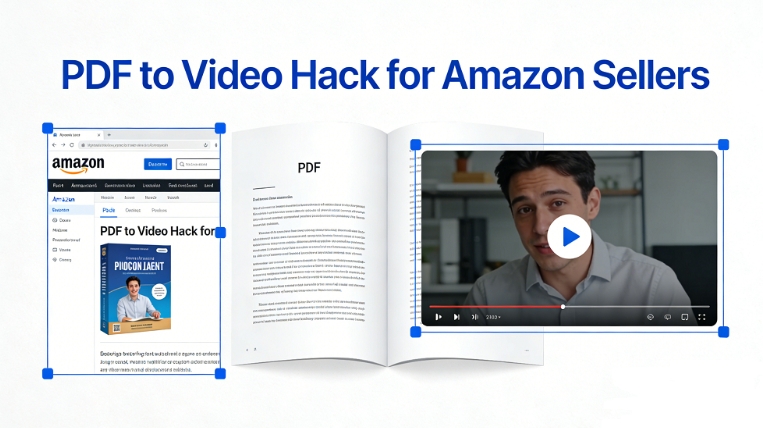
You don’t need to hire a scriptwriter, and you don’t need to shoot new B-roll. You just need to change how you view your existing assets. Your product manuals, pitch decks, and text-heavy listings aren’t just reading material; they are raw data waiting to be rendered. By uploading these exact documents directly into CrePal, you completely bypass the manual translation phase. The system automatically reads the dense logistical data, strips out the boring filler, and isolates the emotional, visual selling points to construct a broadcast-ready commercial.
Unpacking the “Document-Driven” Workflow
Let’s look at how this actually plays out in a real media buying scenario. Imagine you are selling an ergonomic, posture-correcting office chair. Your PDF manual is packed with biomechanical jargon about “lumbar curvature support” and “high-density memory foam resilience.” If you try to just put that text on a screen, your viewer will swipe away instantly.
Instead of starting from scratch, you drop that PDF into the agent’s workspace. But you don’t just hit a generic “generate” button. You provide a directorial angle. You tell the system: “Analyze this product manual. I need a 30-second vertical video. Ignore the assembly instructions. Focus entirely on the pain relief aspect for remote workers. Start with a visual hook of someone holding their lower back in pain.”
The AI doesn’t just read the words; it interprets them. It sees “high-density memory foam” and understands that it needs to generate a highly detailed, satisfying macro shot of a hand pressing into the cushion and the foam slowly bouncing back. It sees “lumbar support” and scripts a voiceover line that says, “Stop letting your cheap office chair ruin your spine,” while simultaneously generating a sleek, 3D-style rotation of the chair’s backrest.
In minutes, your dry, technical PDF has been hallucinated into a cinematic, problem-and-solution video ad.
The Power of Emotional Extraction
The reason this specific hack is dominating the e-commerce space right now is that it forces your marketing to be visual. Buyers don’t buy “BPA-free borosilicate glass”—they buy the feeling of pouring boiling water over ice without the fear of the cup shattering. They don’t buy a “10,000 mAh battery”—they buy the ability to hike from sunrise to sunset while blasting their favorite playlist.
When you feed text documents into an intelligent video agent, it performs semantic extraction. It looks for the utility behind the feature.
And because you are working within a conversational interface, you retain total control over the final output without ever touching a cut tool. If the AI generates a video that focuses a little too heavily on the dimensions of the product rather than its use case, you don’t have to start over. You simply type into the chat: “This is good, but cut the scene explaining the product dimensions. Replace it with a lifestyle shot of a woman using the product in a modern kitchen, and make the background music more upbeat.” The video updates instantly.
The Ultimate Repurposing Trick: The Review Aggregator
If you want to take this hack to the absolute limit, don’t just use your product manuals. Use your customers’ words.
Go to your Amazon listing (or your Shopify review app) and export your top 50 five-star reviews as a single PDF document. These reviews are pure, unfiltered marketing gold because they contain the exact language your target audience uses to describe their pain points and your product’s solution.
Upload that review PDF into the agent. Instruct it to analyze the text, find the three most common reasons people love the product, and generate a user-generated content (UGC) style video script based on those exact sentiments. The AI will spit out a video featuring relatable, realistic AI avatars (or faceless lifestyle shots) demonstrating the product while the voiceover highlights the exact praises your real customers sang.
You have just created a massive, high-converting social proof asset without having to beg a single buyer to record a video testimonial on their iPhone.
Wake Up Your Sleeping Assets
Your hard drive is currently full of sleeping video ads. Every pitch deck, every supplier specification sheet, every list of bullet points, and every customer review export is a viral video waiting to be unlocked.
The sellers who are scaling to seven and eight figures right now are not the ones spending 40 hours a week in Premiere Pro. They are the ones who have figured out how to leverage their existing data. Stop letting your best copywriting collect dust at the bottom of an Amazon listing. Feed your documents to an AI director, generate the creatives, launch the ads, and let the algorithm do the rest.
Media Contact
Company Name: CrePal
Contact Person: Media Relations
Email: Send Email
Country: United States
Website: https://crepal.ai
