
Yueqing City, Zhejiang Province, China.-October 19, 2026
Correcting Severe Angulations: Achieving Passive Fit and Biomechanical Balance with Custom Abutments
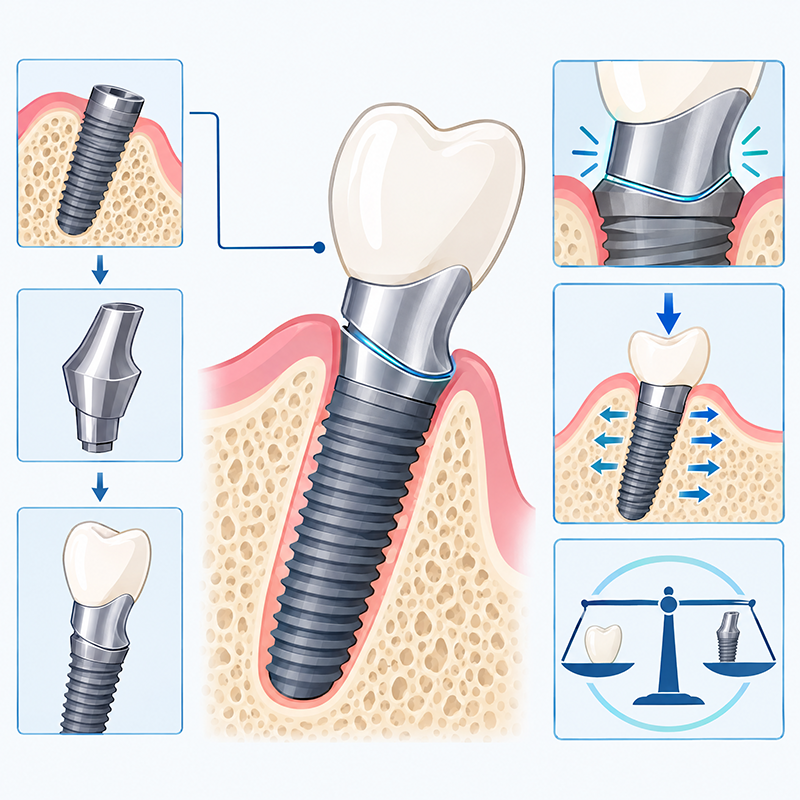
Dental Implantology has reached remarkable heights over the past decades, evolving from basic singular restoration procedures to sophisticated full-arch rehabilitations. Among the most challenging aspects of successful tooth implant therapy is managing severe angulation discrepancies. Such angulation issues can compromise not only the aesthetics and functionality of a restoration but also its long-term biomechanical stability. The use ofCustom Abutment solutions has revolutionized approaches to these challenging cases, supporting passive fit and biomechanical balance, and ensuring predictable outcomes. This article explores the core principles, modifications, and clinical protocols required for optimizing implant therapy in the presence of severe angulation, focusing on the key role played by custom abutments.
Understanding Severe Angulations in Dental Implantology
Implant placement is subjected to a range of anatomical limitations, such as bone density, residual ridge volume, and proximity to anatomical structures. Sometimes, surgeons are forced to place implants at non-ideal angulations to maximize available bone or avoid critical anatomies. Severe angulations, typically defined as deviations exceeding 20 degrees from the prosthetically ideal axis, create significant restorative challenges. These include difficulty in achieving proper emergence profile, misalignment with neighboring teeth, increased loading forces on the prosthesis, and risks of peri-implant bone loss.
Addressing these challenges requires a deep understanding of both prosthetic and surgical implications. Where stock abutments fall short, the application of custom dental abutments emerges as a critical solution, offering flexibility to correct trajectories, achieve proper soft tissue management, and ensure a passive fit of the superstructure. This is especially important for patients seeking optimal aesthetic outcomes and long-term treatment success.
The Importance of Passive Fit and Biomechanical Balance
Passive fit refers to the complete and stress-free adaptation of the prosthetic framework to the underlying abutments and implants. When a dental implant restoration exhibits a passive fit, it minimizes micro-movements and prevents deleterious forces from being transmitted to the bone-implant interface. This is crucial for longevity and the avoidance of implant or prosthetic failure.
Biomechanical balance is equally vital. The restorative solution must distribute functional loads evenly across all supporting structures. Implants placed at unfavorable angulations inherently increase the risk of non-axial loading, which can result in screw loosening, abutment fracture, or even implant failure. By customizing the abutment’s angle, emergence profile, and connection geometry, clinicians can harmonize prosthetic and occlusal forces, preserving both peri-implant tissues and prosthetic components over time.
Customization for Angulated Solutions: The Role of the Custom Abutment
A custom abutment is specifically fabricated for each patient, taking into account the precise angulation, gingival architecture, and spatial requirements of the intended prosthesis. While stock abutments are limited to preset angulations and heights, custom abutments can be digitally designed and manufactured with exact anatomical corrections in mind.
Modern custom abutment manufacturers utilize CAD/CAM technology to scan implant positions, design correctional features, and mill the abutments from biocompatible materials such as titanium or zirconia. Through this approach, clinicians can:
- Correct non-axial implant placement by providing an angled path compatible with the prosthetic envelope of function
- Enhance soft tissue support and aesthetic integration
- Reduce the need for invasive implant re-positioning or bone augmentation surgeries
- Support different retention protocols, whether screw-retained or cement-retained, to suit clinical requirements and patient expectations
A Modified Technique for Fabricating Customized Angled Dual Abutments for Implants with Severe Angulations
Conventional angulated abutments may not sufficiently correct extremely misplaced implants. Recent advances have focused on the fabrication of customized angled dual abutments—a two-piece design composed of an internal connection abutment and an external modifying sleeve. This technique enables fine corrections beyond what is achievable with monolithic stock components.
The modified protocol involves:
- Digitally scanning the angulated implant and adjacent dentition to create a 3D model of the working area
- Designing a correctional abutment with an internal angle that brings the prosthetic platform into alignment with the optimal loading axis
- Utilizing a separate customizable sleeve that is luted or connected to the primary abutment, allowing for further correction and ideal emergence through soft tissues
- Milling the components with high-precision machinery and performing in-situ try-ins to verify passive fit and stability before final cementation or screw-retention
This technique improves the biomechanical environment by reducing the net off-axis forces acting on the implant, minimizes the risk of joint complications, and dramatically enhances aesthetic outcomes, especially when the angulation correction required is beyond 25-30 degrees.
Clinical Protocols for Ensuring Passive Fit with Severe Angulations
Achieving a passive fit in cases with severe angulation starts with a comprehensive diagnostic phase. Proper digital or conventional impression taking is essential to capture the implant position accurately. Utilizing digital workflows through intraoral scanning and software modeling greatly enhances the predictability of the subsequent restoration steps.
The clinical workflow can be summarized as follows:
After initial healing of the implant site, a custom impression coping is fabricated to accommodate the extreme angulation. This allows for a precise transfer of the intraoral situation to either a physical or virtual model. Using CAD/CAM, the custom abutment is then designed, incorporating the necessary corrections to match the ideal prosthetic path. Verification jigs may be used to ensure that the abutment provides truly passive fit without inducing stress on the implants or framework. Only after ensuring passive adaptation should the definitive restoration be fabricated and delivered.
Follow-up protocols involve periodic assessment of screw stability, peri-implant tissue health, and prosthesis function to ensure the long-term success of the intervention. Collaboration between surgeon, restorative dentist, and the laboratory or custom abutment manufacturer is essential for optimal results.
Material Selection for Custom Abutments: Balancing Biomechanics and Aesthetics
Custom dental abutments can be fabricated from a variety of advanced materials, each with unique biomechanical and aesthetic properties. The most commonly used materials include:
Titanium: Known for its proven strength, biocompatibility, and osseointegration capacity, titanium is the material of choice for most posterior and multi-unit restorations, especially when handling significant occlusal loads or challenging angulations.
Zirconia: Increasingly preferred in the anterior region due to superior aesthetics and favorable soft tissue response, zirconia can also be layered with ceramics for an enhanced natural appearance. CAD/CAM-fabricated zirconia abutments can be milled with intricate angulations, provided the design does not compromise fracture resistance.
Hybrid Abutments: In certain complex cases, hybrid solutions combining a titanium base and a zirconia sleeve or crown are employed, balancing the mechanical stability of titanium with the translucent beauty of zirconia.
Material selection is dictated by the location of the implant, the level of angulation correction required, the patient’s occlusal patterns, and specific aesthetic demands. Collaboration with the custom abutment manufacturer ensures the abutment is not only the correct shape and angle but also possesses the optimal material properties for long-term success.
Digital Dentistry and the Future of Angulation Correction
The integration of digital workflows has profoundly impacted how dental professionals manage angulated implants. Digital planning allows clinicians to virtually position implants, predict angulation challenges, and pre-design corrective custom abutments before a single incision is made.
Advanced planning software, guided surgery protocols, and 3D-printed surgical guides enhance the predictability of implant placement. When severe angulation cannot be avoided, digital files are seamlessly shared with abutment manufacturers, facilitating the rapid and accurate production of custom solutions with pinpoint precision. This digital synergy reduces errors, shortens turnaround times, and improves clinical outcomes.
Furthermore, the adoption of digital communication between clinicians and laboratories enables immediate feedback, customized adjustments, and streamlined patient appointments—translating into superior patient experience and satisfaction.
Managing Complications: Common Failures and Corrective Strategies
Despite advances in custom abutment technology, managing severe angulation is not without potential complications. The most common failures encountered include:
Abutment Loosening or Fracture: Excessive angulated forces can cause repeated loosening or even fracture of the abutment screw, particularly in high-load regions. Ensuring proper fit and selecting a robust abutment design can mitigate these risks.
Poor Emergence Profile: Failure to adequately customize the emergence profile may result in unaesthetic restorations or compromised soft tissue outcomes. Digital design tools allow for previewing and adjusting emergence characteristics prior to fabrication.
Imprecise Fit: Errors in impression taking or model transfer can result in a non-passive fit, which over time jeopardizes the osseointegration and overall success of the dental implant. Verification jigs and meticulous clinical checkpoints are imperative to circumvent such failures.
When failures occur, a systematic diagnostic approach to identify and correct the underlying issue is critical. Replacement with a new custom abutment, screw tightening following proper torque protocols, or in severe cases, retreatment of the implant site may be required.
FAQ: Addressing the Challenges of Customized Angled Dual Abutments
Q: What is a modified technique for fabricating customized angled dual abutments for implants with severe angulations?
A: The modified technique involves digitally designing, milling, and assembling two interconnected components—a primary corrective abutment and an outer modifiable sleeve. This system provides greater flexibility in correcting extreme angulations, ensures direct control over emergence profiles, and secures a passive fit that would be impossible with traditional one-piece stock abutments.
Q: Does a custom abutment guarantee long-term success for severely angulated implants?
A: While a custom abutment dramatically increases the chances of aesthetic and functional success, clinical success is also dependent on proper surgical placement, robust material selection, precise verification of passive fit, and ongoing maintenance. No prosthetic solution can fully compensate for poor surgical technique or neglected aftercare.
Q: How do patients benefit from custom abutments compared to stock abutments in angled cases?
A: Patients enjoy superior aesthetic results, more comfortable hygiene and soft tissue contours, longer-lasting prostheses, and fewer complications due to a reduction in biomechanical stresses. Custom abutments also minimize the need for additional surgeries or invasive correctional procedures.
Q: What role does the custom abutment manufacturer play in complex angulation cases?
A: The manufacturer is crucial in translating clinical data (digital scans or physical impressions) into a precisely engineered solution tailored to the case’s unique challenges. They collaborate closely with dental teams to align material choice, abutment geometry, and correctional angles with the treatment goals.
Q: Are there limitations to how much angulation can be corrected using custom abutments?
A: Extreme angulations exceeding 30-35 degrees may present design or material limitations, even with advanced custom abutments. In such cases, staged surgical correction or additional prosthetic planning may be necessary. However, ongoing improvements in digital design and material science continue to push the boundaries of what is clinically feasible.
Patient-Centered Approach: Communication and Case Acceptance
Patient education is paramount when planning implant restorations involving severe angulation correction. Explaining the rationale for using custom abutments, the nature and benefits of advanced fabrication techniques, and the expected outcomes helps build trust and gain informed consent. Visual tools such as pre- and post-treatment digital simulations are invaluable for setting realistic expectations and fostering patient engagement throughout the treatment cycle.
Moreover, involving patients in decision-making by discussing alternative options, such as orthodontic correction, bone augmentation, or alternative prosthetic solutions, empowers them and strengthens the therapeutic alliance. Comprehensive communication bridges the gap between complex clinical procedures and patient understanding, ultimately leading to greater satisfaction and referral growth.
Conclusion
Correcting severe angulations in dental implant therapy stands as one of the greatest challenges in advanced prosthodontics. The integration of custom abutment technology, digital workflows, and patient-focused communication has transformed the predictability, functionality, and aesthetics of implant restorations under these demanding conditions. By achieving a true passive fit, ensuring biomechanical balance, and leveraging modified abutment fabrication techniques, clinicians can now offer their patients optimal outcomes even in cases previously deemed unmanageable. As digital tools and manufacturing processes further evolve, custom abutments will continue to set the standard for excellence in modern implant dentistry and expand the boundaries of patient care.
About us
Zhejiang Trusyou Medical Instruments Co., Ltd. was founded in 2012. It is a modern high-tech enterprise integrating R&D, design, production and sales. It focuses on providing dental implant systems, surgical tools and instruments, advanced biomaterials and all-round digital solutions to global users. Product sales cover more than 50 countries and regions including North America, Europe, the Middle East, and Southeast Asia, and are widely recognized.
Media Contact
Company Name: Zhejiang Trusyou Medical Instruments Co., Ltd.
Contact Person: Media Relations
Email: Send Email
Phone: +86 15158460117
Country: China
Website: https://www.trusyou.com/