
In the last decade, the cultural conversation around mental health has shifted dramatically. What was once hidden, stigmatized, or whispered about is now discussed openly across social media platforms, schools, workplaces, places of worship, and public institutions. This openness represents meaningful progress. People who once suffered in silence now have language for their experiences, access to support, and—in many cases—the courage to seek help.
This shift did not happen by chance. Public awareness campaigns challenged stigma. Public figures shared personal struggles. Employers introduced mental health days, therapy stipends, and wellness initiatives. Faith-based communities, once hesitant to address psychological struggles, launched support groups and partnerships with counseling centers.
According to a 2019 study by the American Psychological Association, 87% of American adults agree it is no longer taboo to say they are seeing a therapist or living with anxiety or depression.
This progress matters. But progress, if left unexamined, can bring unintended consequences.
One emerging concern is the growing tendency to treat diagnostic labels not as tools for understanding, but as identity markers that excuse harmful behavior. When understanding replaces responsibility, the very compassion meant to promote healing can quietly undermine growth and accountability.
The Power—and Risk—of Naming
There is real relief in finally naming what one has been experiencing. A diagnosis can bring clarity and validation: I’m not lazy; I’m depressed. I’m not “too sensitive”; I live with PTSD. Naming can be a crucial first step toward healing because it reframes suffering from moral failure to lived reality.
Psychotherapist Moya Sarner notes that receiving a diagnosis often reduces distress because it validates experience—assuring individuals they are not imagining their pain. In many cases, that validation is life-saving.
In my own experience, learning my diagnosis provided clarity. It helped me understand my reactions and motivated me to grow, learn, and develop healthier ways of managing my thoughts and impulses.
But the issue is not naming itself—it is what happens afterward.
A diagnosis should be a starting point for treatment, support, and growth, not a permanent label that freezes a person in one version of themselves. When we stop at naming, we risk bypassing the difficult, ongoing work of healing.
When the Label Becomes the Limiter
As mental health awareness has expanded, the line between explanation and excuse has increasingly blurred.
An explanation says: This is why I struggle—and here’s what I’m doing about it.An excuse says: This is why I struggle—so don’t expect more from me.
The difference is subtle but significant.
When diagnoses become shields against accountability, relationships suffer. Friends, family members, and coworkers may feel uncertain about addressing harmful behavior, fearing they will be perceived as dismissive or insensitive.
Saying, “I was short with you because I had a panic attack this morning, and I’m working on better coping strategies,” invites growth.Saying, “I have anxiety—that’s just how I am,” shuts it down.
The Social Media Effect
Social media platforms have made mental health information more accessible than ever. In seconds, users can find content explaining burnout, ADHD routines, or coping strategies.
Yet accessibility does not guarantee accuracy.
Research shows a significant portion of mental health content online is misleading or oversimplified. Quick videos and viral memes can flatten complex realities into rigid self-definitions, subtly suggesting that diagnoses determine capacity.
More concerning is the rise of what some describe as competitive suffering—online environments where extreme experiences receive the most validation. In these spaces, improvement can feel like betrayal, and healing can require leaving behind communities built around shared struggle rather than shared growth.
When vulnerability becomes performative, it ceases to serve healing and becomes another mask.
Compassion and Accountability Are Not Opposites
The path forward requires a cultural middle ground—one that preserves empathy while maintaining responsibility.
That means:
-
Recognizing that mental illness can explain behavior without erasing its impact
-
Encouraging treatment, self-awareness, and coping strategies rather than resignation
-
Creating environments where people are supported in both struggle and progress
True compassion does not remove expectations indefinitely. It provides tools and support that help people rise to them.
Why This Conversation Matters
This issue extends beyond individual experience. Workplaces, schools, churches, and institutions are grappling with how to respond to mental health in ways that are humane and practical. Lowering expectations indefinitely risks limiting opportunity, confidence, and contribution. Ignoring mental health altogether returns us to stigma and silence.
The challenge is balance: understanding without enabling, support without surrendering hope for growth.
A Culture That Honors Both Truths
We can hold two truths at once:
-
Mental illness is real, complex, and deserving of compassion.
-
People remain capable of responsibility, growth, and resilience.
A diagnosis should neither be a life sentence nor a free pass. It should be a tool that helps move individuals toward wholeness.
If understanding becomes the end of the story, healing stalls. When understanding becomes the beginning, growth remains possible.
About the Author’s Work
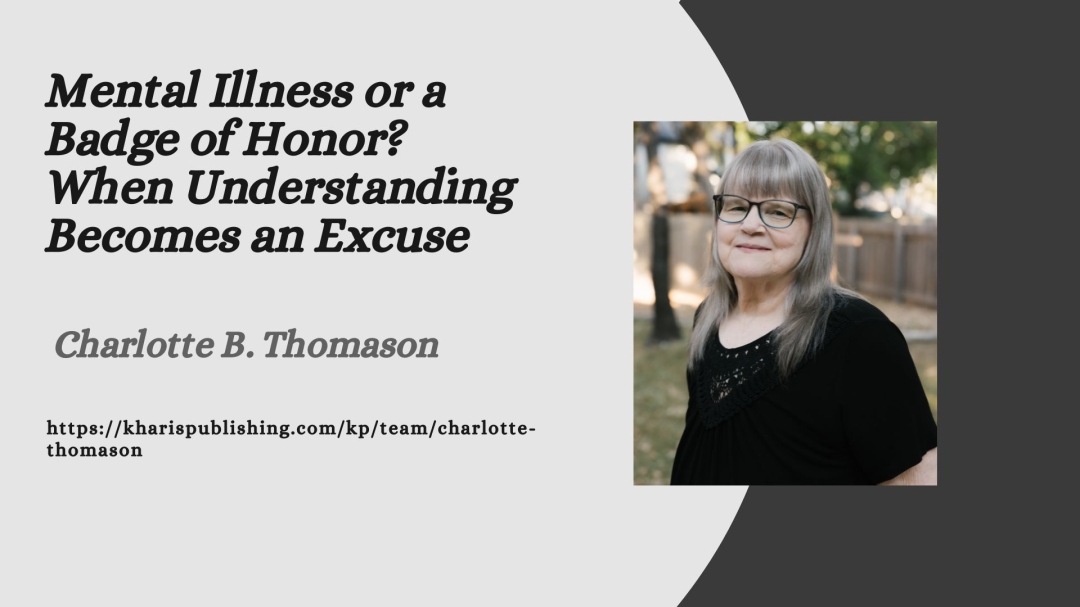
These themes are explored more deeply in Faith in the Fog: A Workbook for Healing When the Path Isn’t Clear, where Charlotte B. Thomason offers reflective, faith-informed tools for navigating uncertainty without rushing the healing process.
The workbook is designed not to fix people, but to create space for honesty, reflection, and steady growth—one step at a time.
Media Contact
Company Name: Kharis Media LLC
Contact Person: Rufus Philip
Email: Send Email
Phone: (630) 423-6309
City: Aurora, Chicago
State: IL
Country: United States
Website: https://kharispublishing.com/kp/product/faith-in-the-fog/