
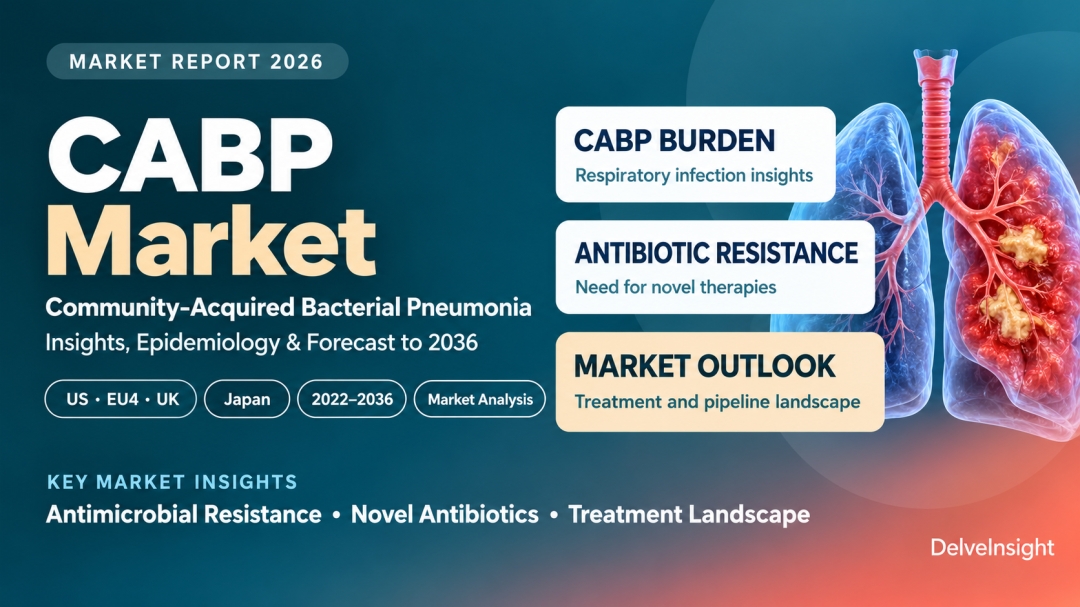
(Albany, US) On October 29, 2026, DelveInsight’s “Community-Acquired Bacterial Pneumonia Market Insights, Epidemiology and Market Forecast – 2036” report provides comprehensive insights into the Community-Acquired Bacterial Pneumonia (CABP) market and pipeline landscape across the 7MM. It covers marketed and emerging drug profiles, including clinical and nonclinical stage products. It also covers the therapeutics assessment by product type, stage, route of administration, and molecule type, and examines the market drivers and barriers shaping the space.
Discover the latest drugs and treatment options in the Community-Acquired Bacterial Pneumonia Pipeline @ https://www.delveinsight.com/report-store/community-acquired-bacterial-pneumonia-cabp-market
Key Takeaways from the Community-Acquired Bacterial Pneumonia Report
-
In January 2026, the international Phase II ADCAP trial of AON-D21 in severe community-acquired pneumonia completed enrollment.
-
In March 2025, the US IND for the ADCAP trial was extended to 150 patients.
-
Around 80% of the nearly 4 million community-acquired pneumonia cases in the US are classified as CABP, and the US accounted for about 55% of CABP incident cases across the 7MM in 2025.
-
Approved CABP therapies include lefamulin (XENLETA, Nabriva Therapeutics), approved by the FDA in August 2019, and omadacycline (NUZYRA, Paratek Pharmaceuticals), approved in October 2018.
-
DelveInsight’s report depicts a space where the emerging pipeline is relatively limited but increasingly focused on host-directed and anti-virulence approaches for severe CABP.
-
Leading Community-Acquired Bacterial Pneumonia companies include Nabriva Therapeutics, Melinta Therapeutics, Wakunaga Pharmaceutical, Forest Pharmaceuticals, Pfizer, Paratek Pharmaceuticals, Cumberland Pharmaceuticals Inc., Theravance Biopharma, Merck Sharp & Dohme Inc., Cubist Pharmaceuticals LLC, Shionogi Inc., Allergan, Eagle Pharmaceutical Inc., Combioxin SA, Takeda, TiGenix, and others.
-
Promising therapies include lefamulin (XENLETA), omadacycline (NUZYRA), CAL02, AON-D21, and others.
Get insights into clinical trials, emerging therapies, and leading companies with DelveInsight @ Community-Acquired Bacterial Pneumonia Treatment Drugs
Community-Acquired Bacterial Pneumonia Overview
CABP is an acute infection of the lung parenchyma acquired outside hospital settings. It is most commonly caused by Streptococcus pneumoniae, Haemophilus influenzae, and Staphylococcus aureus, as well as atypical organisms such as Mycoplasma pneumoniae and Legionella pneumophila. Severity ranges from mild illness to life-threatening disease, particularly in older adults and people with comorbidities. Lower respiratory tract infections, of which pneumonia is a major component, are ranked by the Global Burden of Disease Study as the second leading cause of death and years of life lost. Diagnosis relies on clinical evaluation, chest imaging, microbiological testing, and severity scoring such as CURB-65. Treatment involves prompt empiric antibiotics tailored to severity and risk factors, including amoxicillin, doxycycline, macrolides, β-lactam plus macrolide combinations, or respiratory fluoroquinolones.
Common symptoms include:
-
Fever
-
Cough and sputum production
-
Shortness of breath (dyspnea)
-
Chest pain
Community-Acquired Bacterial Pneumonia Emerging Drugs Profile
CAL02: Eagle Pharmaceutical/Combioxin CAL02 is a liposomal anti-virulence therapy made of cholesterol- and sphingomyelin-containing liposomes, designed to treat severe infections, particularly CAP in ICU patients. It works by neutralizing bacterial virulence effectors that drive organ failure and fatal complications. It has received FDA Fast Track and Qualified Infectious Disease Product (QIDP) designations. Currently, the drug is in Phase II.
AON-D21 (anti-C5a): APTARION Biotech AG AON-D21 is a PEGylated L-configured aptamer that binds to and neutralizes C5a, a central regulator of the immune system’s complement response. By modulating this host response, it aims to improve outcomes in severe community-acquired pneumonia. Enrollment in the Phase II ADCAP trial was completed in January 2026. Currently, the drug is in Phase II.
Explore groundbreaking therapies and clinical trials in the Community-Acquired Bacterial Pneumonia Pipeline @ New Community-Acquired Bacterial Pneumonia Treatment Drugs
Community-Acquired Bacterial Pneumonia Market Drivers
-
Growing disease burden: Aging populations, comorbidities, and environmental risk factors are increasing the number of CABP cases, with US cases projected to rise through 2036 across major pathogens.
-
Rising antimicrobial resistance: Resistance among respiratory pathogens is creating strong demand for novel, effective antibiotics.
-
Recently approved options: Lefamulin and omadacycline have broadened the treatment arsenal, with new mechanisms and activity against resistant pathogens.
-
Shift toward targeted therapy: Pathogen-specific, host-directed, and anti-virulence approaches are expanding beyond broad-spectrum antibiotics.
-
Better diagnostics and stewardship: Rapid diagnostic tools, improved disease recognition, and stewardship programs strengthen the treatment landscape and widen the treated population.
-
Regulatory incentives: Designations such as Fast Track and QIDP, with extended exclusivity, support investment in new anti-infectives.
Community-Acquired Bacterial Pneumonia Market Barriers
-
Antimicrobial resistance: Resistance can reduce the effectiveness of established and newer antibiotics alike.
-
Diagnostic limitations: The causal pathogen is often unknown when therapy must start, and respiratory viruses are detected more often than bacteria, complicating targeted treatment.
-
Limited emerging pipeline: The pipeline for new CAP therapies remains relatively small.
-
Low-cost generic competition: Established generics such as amoxicillin, doxycycline, and macrolides are entrenched as first-line options.
-
Stewardship restrictions: Efforts to preserve new antibiotics limit their use and can constrain commercial uptake.
-
Mostly mild disease: About half of US cases are mild and managed with inexpensive outpatient therapy, limiting the market for premium agents.
-
Difficult trials in severe disease: Enrolling and demonstrating benefit in severe, ICU-level CABP is challenging.
Scope of the Community-Acquired Bacterial Pneumonia Report
-
Coverage: 7MM (US, EU4, UK, Japan)
-
Companies: As listed above
-
Therapies: Lefamulin (XENLETA), omadacycline (NUZYRA), CAL02, AON-D21, and others
-
Assessment by Product Type: Mono, Combination, Mono/Combination
-
Assessment by Clinical Stage: Discovery, Pre-clinical, Phase I, Phase II, Phase III
Download DelveInsight’s in-depth Community-Acquired Bacterial Pneumonia report today! @ Community-Acquired Bacterial Pneumonia Companies
Table of Contents
-
Introduction
-
Executive Summary
-
Community-Acquired Bacterial Pneumonia: Overview
-
Pipeline Therapeutics
-
Therapeutic Assessment
-
DelveInsight’s Analytical Perspective
-
Late Stage Products (Phase III): None currently
-
Mid Stage Products (Phase II): CAL02 (Eagle Pharmaceutical/Combioxin), AON-D21 (APTARION Biotech)
-
Early Stage Products (Phase I): None currently
-
Preclinical and Discovery Stage Products
-
Inactive Products
-
Key Companies
-
Key Products
-
Unmet Needs
-
Market Drivers and Barriers
-
Future Perspectives and Conclusion
-
Analyst Views
-
Appendix
-
About Us
About DelveInsight
DelveInsight is a leading healthcare-focused market research and consulting firm that provides clients with high-quality market intelligence and analysis to support informed business decisions. With a team of experienced industry experts and a deep understanding of the life sciences and healthcare sectors, we offer customized research solutions and insights to clients across the globe.
Media Contact
Company Name: DelveInsight Business Research LLP
Contact Person: Mehul Malhotra
Email: Send Email
Phone: 09650213330
Address:63, M3M 113 Market, Sector 113 NV 89107
City: Gurugram
State: IN – Indiana
Country: India
Website: https://www.delveinsight.com/consulting