
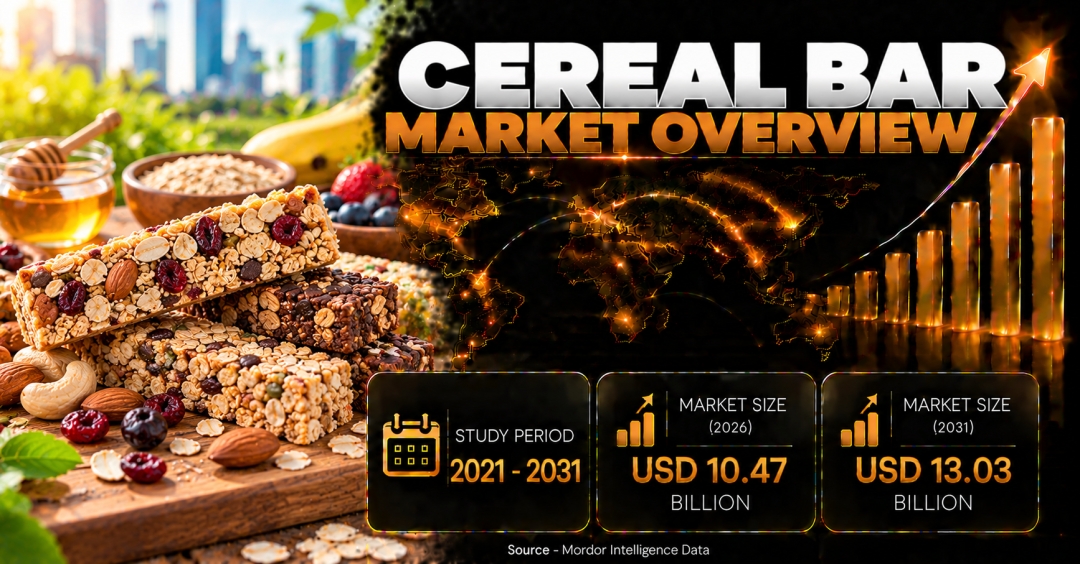
Hyderabad, October 16, 2026: According to Mordor Intelligence, the global cereal bar market size was valued at $10.01 billion in 2025 and is estimated to grow from $10.47 billion in 2026 to reach $13.03 billion by 2031, at a compound annual growth rate (CAGR) of 4.46% during the forecast period (2026-2031). The market continues to expand as consumers transition toward convenient, portable food formats that support busy daily routines, active fitness regimes, and structured meal replacement habits. Rising consumer awareness of macronutrient intake, growing numbers of single-person households, and the steady replacement of traditional sit-down breakfasts with on-the-go grain bars continue to support demand across supermarket, convenience, and digital retail channels worldwide.
The cereal bar market growth is also influenced by changing nutritional labeling policies and evolving consumer expectations regarding clean-label authenticity and reduced added sugars. Food formulators and snack manufacturers are investing in specialized binder solutions, alternative plant proteins, and nutrient-dense inclusions like chia, quinoa, and ancient grains. These recipe developments are helping businesses respond to front-of-package nutritional warning guidelines and consumer demand for functional vitality while maintaining chewy texture, moisture retention, and structural stability. Together, these factors continue to strengthen the integrated cereal bar market forecast across developed and emerging snack food markets.
Cereal Bar Market Trends
High-Protein and Fiber-Dense Formulations Drive Functional Snacking
One of the leading cereal bar market trends is the consumer shift toward bars that offer targeted functional wellness benefits beyond simple carbohydrate calories. While standard grain bars provide quick morning energy within the cereal bar market share, health-conscious shoppers actively seek options with elevated dietary fiber, plant-based proteins, and fortified micronutrients to support satiety and digestive wellness. Snack food brands are reformulating product decks to incorporate pea protein crisps, chicory root fiber, and sprouted grains while minimizing artificial preservatives. This steady consumer transition toward nutrient-dense snacking continues to support the cereal bar industry.
Ancient Grains and Superfood Inclusions Anchor Clean-Label Premiumization
While conventional oat and corn bars maintain high volume across mainstream grocery aisles, premium product lines featuring ancestral grains represent the fastest-growing development space. Ingredient developers are utilizing ancient grains such as amaranth, millet, and buckwheat alongside nuts, seeds, and superfood berries to enhance nutrient density and natural crunch. Food formulators are replacing synthetic binding syrups with natural honey, dates, and agave, aligning with broader formulation standards seen across the integrated food ingredients industry for clean-label formulation and allergen control.
Multi-Pack Packaging and Portable Single-Serve Pouches Expand Household Reach
Packaging formats continue to play an important role in cereal bar market growth. Individual metallized film wraps and flexible multi-pack paperboard cartons account for the vast majority of volume sales, protecting delicate grain clusters from moisture loss and air exposure while providing grab-and-go convenience for school lunchboxes and office commuters. Concurrently, snack bar brands are adopting recyclable mono-material films and compact multipack formats to reduce plastic waste and optimize shelf space. These functional packaging formats help brands balance consumer convenience with corporate sustainability commitments.
Supermarkets Lead Category Revenue While Online Channels Advance Fastest
Distribution channels continue to play a significant role in market deployment. Supermarkets and hypermarkets account for the largest share of retail volume, capturing more than half of global category revenue through organized snack aisles, bulk promotional displays, and private-label variety packs. Concurrently, digital commerce platforms and quick-commerce grocery delivery apps are demonstrating the quickest expansion. Online channels provide direct-to-consumer snack brands with an efficient platform to showcase niche dietary formulations, including keto, paleo, and certified gluten-free options, supported by recurring subscription bundles.
North America Retains Revenue Leadership While Asia-Pacific Expands Fastest
Regional consumption dynamics continue to influence the cereal bar market forecast. North America commands the largest regional market share, supported by high per capita consumption of packaged breakfast items, well-established grocery retail chains, and active fitness lifestyles. Meanwhile, the Asia-Pacific region represents the fastest-growing market, propelled by rapid urbanization, rising middle-class disposable incomes, expanding modern retail infrastructure, and increasing adoption of Western breakfast habits across China, India, and Southeast Asia. Evolving urban consumer lifestyles continue to create new opportunities for producers expanding their regional presence.
Check out more details and stay updated with the latest industry trends, including the Japanese version for localized insights: https://www.mordorintelligence.com/ja/industry-reports/cereal-bar-market?utm_source=abnewswire
Cereal Bar Market Segmentation
By Product Type
- Breakfast/Granola Bars
- Other Bars (Energy, Nutrition, and Meal Replacement Bars)
By Functional Claim
- Organic
- Conventional
By Distribution Channel
- Supermarkets/Hypermarkets
- Convenience/Grocery Stores
- Specialty Stores
- Online Retail
- Other Distribution Channels
By Geography
- North America
- Europe
- Asia-Pacific
- South America
- Middle East and Africa
Competitive Landscape of the Cereal Bar Industry
The cereal bar industry exhibits a moderately consolidated structure, with multinational packaged food conglomerates, legacy breakfast cereal corporations, and agile health food specialists competing across ingredient quality, brand recognition, and retail shelf distribution. Market leaders are strengthening their market presence by expanding certified non-GMO and organic lines, upgrading automated bar-extrusion and slab-forming lines, and acquiring emerging functional snack start-ups to satisfy changing dietary preferences and strict labeling standards.
Texture stability, shelf-life preservation, and flavor masking continue to be critical areas of differentiation as processors invest in advanced moisture-barrier coatings and natural sweetness enhancers to replicate indulgent confectionery profiles without high sugar levels. Businesses are also refining distribution partnerships with national supermarket grocers, convenience chains, and mass merchandisers to secure prime shelf visibility. These initiatives are helping companies protect their cereal bar market share while maintaining quality consistency across global distribution networks.
Regional expansion also remains an important business strategy. Leading cereal bar manufacturers continue to build strategic commercial alliances with regional ingredient suppliers, establish localized packaging facilities, and adapt flavor profiles to match regional culinary tastes. As global commercial demand for convenient, wholesome snack foods continues to rise, the cereal bar market forecast remains supported by ongoing investments in whole-grain processing technologies, sustainable packaging materials, and international brand development.
Key Players
Major companies operating in the cereal bar market include:
- PepsiCo, Inc.
- General Mills Inc.
- Mondelēz International Inc.
- Mars Inc.
- WK Kellogg Co.
Conclusion
The cereal bar market forecast remains positive as consumers worldwide continue choosing wholesome, convenient grain snacks that fit on-the-go schedules and support daily nutritional wellness. Food manufacturers and brand owners are responding by expanding high-protein and reduced-sugar recipes, improving binder technologies, and incorporating ancient grains and superfoods that balance nutritional integrity with indulgent sensory appeal. These developments are expected to support continued demand across multiple retail and digital commerce channels.
Strategic regulatory alignment and clean-label integrity are becoming increasingly vital as companies adapt to front-of-package nutritional warning guidelines and evolving consumer expectations regarding real food ingredients. At the same time, specialized single-serve pocket formats and expanded direct-to-consumer online subscription models are helping businesses enhance overall brand loyalty while supporting long-term commercial goals. These structural developments continue to guide modern cereal bar market trends.
Regional opportunities also remain strong. North America provides a dependable, high-volume commercial baseline, while Asia-Pacific offers attractive growth pathways as urbanization and exposure to convenient breakfast alternatives accelerate daily snack bar consumption. This shift is expected to create new commercial avenues for snack bar manufacturers expanding their operational footprint in developing markets.
Overall, the cereal bar market size is expected to benefit from changing consumer dietary habits, growing demand for portable and wholesome meal solutions, wider availability across digital and brick-and-mortar retail channels, and an ongoing commitment to recipe engineering. Together, these factors are expected to support sustained cereal bar market growth while strengthening the long-term outlook for the global cereal bar industry.
Industry Trending Reports
Doughnut Market: The global doughnut market is projected to expand from USD 10.82 billion in 2026 to USD 13.95 billion by 2031, achieving a 5.22% CAGR. Revenue momentum is driven by artisanal glaze recipes, limited-time co-branded drops, and channel diversification across forecourt convenience stores and on-demand delivery apps. To satisfy evolving labeling mandates and dietary sensitivities, bakeries are formulating clean-label, vegan, and allergen-controlled options while scaling automated frying and dispensing hardware to protect margins against raw ingredient price shifts.
Biscuit Market Size: The global biscuit market is estimated at USD 142.05 billion in 2026 and is forecast to climb to USD 181.83 billion by 2031, advancing at a 5.05% CAGR. Expansion is supported by daily snacking routines across growing urban middle-class populations, alongside rising demand for portable, single-serve formats. Major packaged food producers are bifurcating brand portfolios—scaling fiber-rich, low-sugar lines for nutrition-minded demographics while using vertical supply integration and automated high-speed baking lines to offset core commodity cost pressures.
Cakes Market Share: The global cakes market is expected to grow from USD 102.36 billion in 2026 to USD 125.38 billion by 2031, registering a 4.14% CAGR. Demand continues to benefit from ceremonial gifting occasions and the routine consumption of individually wrapped, portion-controlled slices. Commercial bakeries and specialty retailers are driving category value through bespoke visual aesthetics, experiential dessert concepts, and extended shelf-life packaging designed for modern omnichannel retail distribution.
About Mordor Intelligence:
Mordor Intelligence is a global market intelligence firm, founded in 2014, helping businesses make informed decisions through data-driven insights, industry expertise, and advanced analytics. With 550+ domain experts and on-ground specialists across 150+ countries, the company delivers comprehensive intelligence across aerospace & defense, agriculture, automation, automotive, chemicals & materials, consumer goods & services, electronics, energy & power, financial services, food & beverages, healthcare, hospitality & tourism, information & communications technology, and logistics.
Its offerings include syndicated industry reports, custom research and advisory, and subscription platforms such as Synapse, Data Center Intelligence, and Robotics Intelligence. Mordor Intelligence is ISO 9001:2015 and ISO/IEC 27001:2022 certified, a member of ESOMAR and the Market Research Society of India, and a four-time Great Place to Work® honoree.
Media Contact
Company Name: Mordor Intelligence
Contact Person: Jignesh Thakkar
Email: Send Email
Phone: +1 617-765-2493
Address:11th Floor, Rajapushpa Summit, Nanakramguda Rd, Financial District, Gachibowli media@mordorintelligence.com
City: Hyderabad
State: Telangana 500008
Country: India
Website: https://www.mordorintelligence.com/industry-reports/cereal-bar-market?utm_source=abnewswire