
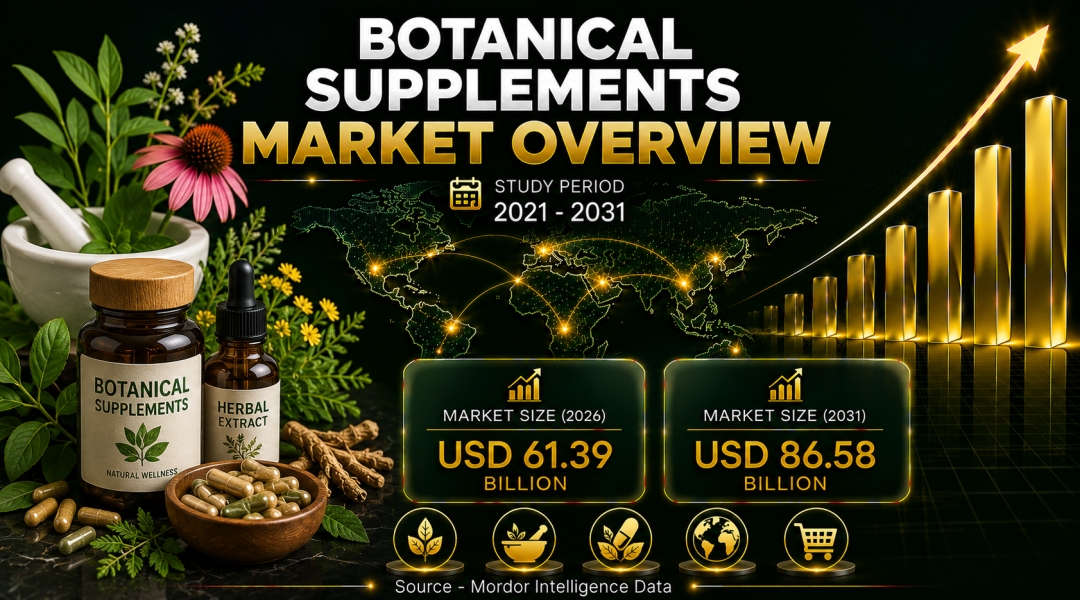
According to Mordor Intelligence, the botanical supplements market size is expected to grow from $61.39 billion in 2026 to $86.58 billion by 2031, registering a CAGR of 7.12% during the forecast period (2026-2031). The market continues to expand as consumers increasingly seek plant-based health formulations that combine traditional wellness practices with modern scientific backing. Growing awareness of preventive healthcare, changing lifestyle routines, and the rising popularity of clean-label and non-synthetic products continue to support demand across retail, pharmacy, and digital channels worldwide.
The botanical supplements market growth is also influenced by changing international regulatory oversight and evolving consumer expectations regarding ingredient transparency and batch consistency. Supplement manufacturers are investing in advanced cultivation methods while adopting artificial intelligence in extraction workflows. These developments are helping businesses respond to stricter safety mandates and regional compliance rules while maintaining active compound stability and verified therapeutic quality. Together, these factors continue to strengthen the integrated botanical supplements market forecast across developed and emerging healthcare markets.
Key Trends Driving Botanical Supplements Market
Integration of Traditional Medicine and Clinical Studies Supports Volume Sales
One of the leading botanical supplements market trends is the growing consumer preference for herbal remedies supported by peer-reviewed clinical research. Formulations combining age-old botanical knowledge with validated clinical trials continue to gain popularity among wellness-oriented demographics looking for targeted health benefits. The increasing use of single herbs and standardized multi-herb combinations in digestive wellness and immune health routines has expanded consumption across broad age groups. This steady shift toward evidence-based plant health choices continues to support the botanical supplements industry.
Digestive and Gut Health Formulations Maintain Core Category Demand
While general wellness products hold a significant presence within the botanical supplements market share, specialized digestive and gut health formulations are emerging as major growth areas. Formulators rely on standardized botanical extracts to support gastrointestinal balance and metabolic performance. Supplement brands are expanding their targeted wellness portfolios to satisfy consumer demands without compromising on formula safety or clean-label integrity, aligning with broader quality standards seen across the integrated food ingredients industry for raw material purity.
Advanced Cultivation and Extraction Technologies Shape Batch Quality
Another important botanical supplements market trend is the adoption of indoor vertical farming and plant-cell culture technologies. As climate variability impacts wild harvesting and traditional farm yields, producers are utilizing controlled agricultural setups to secure raw material supplies. These efforts reflect broader commercial demand for consistent active compound concentrations across production batches. Strategic raw material sourcing agreements are becoming an essential area of technical differentiation across the botanical supplements industry.
Retail Curation and Certified Formulations Drive Modern Consumer Trust
Retail strategies continue to play a significant role in the botanical supplements market growth. Specialty health stores and curated retail aisles remain widely adopted because they offer verified, practitioner-backed product selections to discerning shoppers. At the same time, certified organic and non-synthetic formulations are attracting greater interest as consumers scrutinize ingredient origins and avoid synthetic fillers. These merchandising developments help brands balance high product standards with consumer trust while meeting international retail benchmarks.
Asia-Pacific and Latin America Create Rapid Regional Growth Pathways
Regional consumption patterns continue to influence the botanical supplements market forecast. North America and Europe remain major consumption hubs due to high consumer spending on preventive health, established retail networks, and clear regulatory oversight. Meanwhile, Asia-Pacific and Latin America represent fast-growing regional markets as regulatory harmonization and cross-border digital commerce facilitate international product access. Evolving consumer awareness and expanding wellness distribution networks continue to create new opportunities for producers expanding their global market presence.
Check out more details and stay updated with the latest industry trends, including the Japanese version for localized insights: https://www.mordorintelligence.com/ja/industry-reports/botanical-supplements-market?utm_source=abnewswire
Botanical Supplements Market Segmentation Insights
By Type
- Single Botanical
- Combination Botanical
By Form
- Tablets
- Capsules/Softgels
- Powders
- Gummies and Chews
- Liquids
- Others
By Functionality/Health Benefit
- Digestive and Gut Health
- Stress, Sleep, and Cognitive Health
- Immune Support
- Bone and Joint Health
- Energy and Weight Management
- Others
By Distribution Channel
- Supermarkets/Hypermarkets
- Specialty and Health Stores
- Online Retail Channels
- Direct Selling
- Others
By Geography
- North America
- Europe
- Asia-Pacific
- South America
- Middle East and Africa
Competitive Landscape of the Botanical Supplements Industry
The botanical supplements industry remains moderately concentrated, with leading international nutraceutical corporations and specialized herbal medicine producers holding a significant share of global retail value. Companies are strengthening their market presence by expanding clinically validated product offerings while optimizing extraction efficiency to address changing regulatory guidelines and consumer expectations.
Extraction capability and raw material consistency continue to be an important area of competition as manufacturers invest in controlled agricultural technologies to prevent batch-to-batch variation. Businesses are also refining distribution partnerships to ensure immediate product access across specialized health outlets and e-commerce platforms. These initiatives are helping companies strengthen their botanical supplements market share while maintaining quality consistency across international retail pathways.
Regional expansion also remains an important business strategy. Leading brand owners continue to build partnerships with certified growers, expand local extraction facilities, and improve supply chain traceability to meet growing demand across both mature and high-growth markets. As consumer demand for clean-label, certified botanical solutions continues to rise, the botanical supplements market forecast remains supported by ongoing investments in clinical research, sustainable farming, and global brand activation.
Key Botanical Supplements Market Players
Major companies operating in the botanical supplements market include:
- Nestle SA
- Dr. Willmar Schwabe GmbH & Co. KG
- NOW Foods
- Himalaya Global Holdings Ltd.
- Dabur India Ltd.
Conclusion
The botanical supplements market forecast remains positive as consumers worldwide continue choosing natural, plant-derived health solutions that fit modern wellness routines. Manufacturing entities and brand owners are responding by expanding clinically substantiated product lines, improving ingredient transparency, and investing in advanced cultivation techniques that balance active ingredient potency with environmental sustainability. These developments are expected to support continued demand across multiple distribution channels.
Strategic compliance management is becoming increasingly vital as companies adapt to changing international safety regulations and consumer expectations regarding clean-label authenticity. At the same time, standardized extraction methods and expanded digital retail access are helping businesses enhance overall product value while supporting long-term commercial goals. These structural improvements continue to guide modern botanical supplements market trends.
Regional opportunities also remain strong. North America and Europe provide a stable commercial baseline, while Asia-Pacific and Latin America offer attractive growth opportunities as regulatory harmonization makes high-quality botanical products accessible to broader consumer groups. This shift is expected to create new value pathways for producers building their footprint in key global markets.
Overall, the botanical supplements market size is expected to benefit from changing consumer dietary habits, growing demand for preventive wellness options, wider availability through modern digital and physical retail channels, and an ongoing commitment to scientific validation. Together, these factors are expected to support sustained botanical supplements market growth while strengthening the long-term outlook for the global botanical supplements industry.
Industry Related Reports
Indian Energy Bar Market: The Indian energy bar market is projected to reach USD 54.36 million by 2031, growing at a rapid 13.74% CAGR from its 2026 valuation of USD 28.57 million. Market acceleration is driven by rising fitness lifestyles, modern retail expansion, and growing consumer demand for protein-rich solutions to bridge dietary gaps. Large FMCG firms and value-oriented regional brands are introducing clean-label, cost-effective formulations to transition energy bars from niche sports nutrition into mainstream convenience snacking.
Fish Protein Hydrolysate Market Size: The global fish protein hydrolysate market is expected to expand from USD 611.37 million in 2026 to USD 791.46 million by 2031, tracking a steady 5.30% CAGR. Demand is propelled by circular economy waste-to-value initiatives in the seafood sector and the need for bioavailable, easily digestible proteins across aquaculture and pet nutrition. Processors are increasingly adopting enzymatic hydrolysis to produce high-purity bioactive peptides for premium dietary supplements and hypoallergenic animal feeds.
Glucose Market Share: The global glucose market size is forecast to reach USD 33.26 billion by 2031, advancing at a 3.6% CAGR over the forecast period from its 2026 valuation of USD 27.88 billion. Broad-based utilization across confectionery, bakery, and beverage processing anchors steady volume growth, where glucose delivers functional bulking, crystallization control, and balanced sweetness. To mitigate corn feedstock price swings and meet clean-label requirements, manufacturers are diversifying into wheat and alternative starch processing streams.
Media Contact
Company Name: Mordor Intelligence
Contact Person: Jignesh Thakkar
Email: Send Email
Phone: +1 617-765-2493
Address:11th Floor, Rajapushpa Summit, Nanakramguda Rd, Financial District, Gachibowli media@mordorintelligence.com
City: Hyderabad
State: Telangana 500008
Country: India
Website: https://www.mordorintelligence.com/industry-reports/botanical-supplements-market?utm_source=abnewswire