
Dezhou, Shandong, China – October 15, 2026
Picking a Boring Hole Machine isn’t just about who has the biggest spindle power or the boldest advertised depth numbers. In real workshops, what usually matters is repeatable accuracy, stable cutting, maintenance that doesn’t become a headache, and solid support after the machine is installed. That’s what this guide is here for: a look at the Top 10 Boring Hole Machines for Sale Worldwide, including machines from well-known builders like TOS VARNSDORF, PAMA, Hyundai WIA, and FERMAT.Dr. John A. Schey, a respected specialist in manufacturing processes, once put it this way: “Manufacturing quality depends on controlling the process, not merely inspecting the result.” That idea is worth keeping in mind when you’re sizing up horizontal boring mills, CNC boring systems, and deep-hole equipment. A machine can advertise all sorts of impressive capacity, but if alignment is off, you may end up with tapered holes, rough walls, or bores that just won’t hold a consistent diameter. Small details can make or break the job.The selection also includes the Drill Collar Hole Deep Hole Drilling And Boring Machine, built for demanding cylindrical parts and long, tightly controlled bores. Before deciding, it’s smart to look at boring diameter, table load, axis travel, spindle torque, tooling compatibility, coolant delivery, and measurement systems. Those specs stop being abstract pretty fast when you’re machining heavy steel housings or oilfield components.No ranking gets it perfect, of course. A compact machine might fit a repair shop better than some big industrial model. Regional service coverage, operator training, spare-part availability, and total ownership cost can all shift the final call. Some listings don’t give much technical data either, so buyers should confirm tolerances and test-cut results directly with the supplier. It’s an easy step to skip. It shouldn’t be. This overview is meant as a practical comparison—while keeping in mind that the best Boring Hole Machine really comes down to material, production volume, hole geometry, and how disciplined the whole machining process is.
 Define Boring-Hole Machines by Diameter, Depth, Torque, and Feed ForceTop 10 Boring Hole Machines for Sale Worldwide
Define boring-hole machines by four working figures: diameter, depth, torque, and feed force. Diameter shows the practical hole range, not merely the largest advertised opening. Depth depends on ground stability, rod stiffness, flushing, and access space. Torque, measured in Nm or kNm, controls resistance from dense rock, clay, or fractured formations. Feed force, measured in kN, pushes the cutting tool into the face. A machine with high torque but weak feed force may stall in hard ground.
The 2024 IMARC Group report estimates the global tunnel boring machine market reached approximately USD 7.5 billion in 2023. This growth reflects wider infrastructure demand, but market size does not identify the right machine. Compare rated values under working conditions. Peak torque can look impressive and remain unavailable during continuous operation.
For a top-10 comparison, record bore diameter, maximum recommended depth, continuous torque, and usable feed force in one table. Also check power supply, mast travel, rod length, and spoil-removal capacity. Small details matter.
Tips: Match diameter to the finished hole, not the pilot hole. Add a safety margin for ground variation. Ask for test data from similar formations. A neat ranking can mislead. I would treat unverified peak specifications carefully, especially when geology changes every few metres. Industry reports guide purchasing trends, but site records and operator experience should guide final selection.
Classify the Top 10 Models by Rotary, DTH, HDD, and Tunnel-Boring MethodsTop 10 Boring Hole Machines for Sale Worldwide
This guide classifies ten Hole Boring Machine models by working method, ground condition, and project scale. Rotary models lead the list for water wells, foundations, and mineral exploration. Models 1 to 3 use rotary drilling with different torque ranges. Compact units suit restricted sites. Heavy-duty versions handle deep, hard formations.
DTH models 4 and 5 place the hammer near the bit. They deliver strong penetration in fractured rock and dry formations.
HDD models 6 to 8 create controlled underground paths for utility installations. Their steering accuracy matters near roads, buildings, and existing pipes.
Tunnel-boring models 9 and 10 support continuous excavation in larger underground works. Cutterhead diameter, soil pressure control, and spoil removal require careful review.
Real projects are rarely perfect. Mixed ground can challenge any classification.
Tips: Check the rated torque, drilling diameter, engine power, and transport weight. Ask for verified performance data from similar geology. Inspect the mast, hydraulic lines, rods, and emergency controls before purchase. A lower price may hide costly tooling or difficult maintenance. Request operator training and spare-parts support. Buyers should also compare noise, dust control, and fuel use. Test results from one region may not predict performance elsewhere. A practical site trial is often more valuable than a polished brochure.
Compare Rated Power, Rotation Speed, Drilling Depth, and Output in m/h
The top 10 Boring Hole Machine models for sale worldwide differ sharply in rated power, rotation speed, drilling depth, and output. Compact units often use 15–30 kW motors, rotate between 40 and 120 rpm, and reach 30–80 metres. Larger rigs may exceed 75 kW, with deeper drilling capacity beyond 200 metres. More power does not always mean better performance.Output commonly ranges from 2 to 12 m/h in loose soil. Hard rock can reduce production below 1 m/h. Rotation speed must match the bit, ground condition, and hole diameter. Excessive speed may create heat, vibration, and premature wear. A slower setting can improve control in fractured formations. That detail is easy to overlook.During field checks, I would compare rated power with hydraulic efficiency, not just the motor label. I would also verify whether the stated depth uses casing, a standard rod length, or ideal soil. Real output often falls after water, gravel, or unstable walls appear. A machine rated for 150 metres may perform very differently at 100 metres in dense rock. Operators should record metres per hour, fuel use, downtime, and bit changes across several holes. The figures may look less impressive, but they are more trustworthy. Availability of replacement rods and service support also affects long-term value. My own assessment would remain cautious until site trials confirm the brochure data.
Top 10 Boring Hole Machines for Sale Worldwide – Compare Rated Power, Rotation Speed, Drilling Depth, and Output in m/h
| Rank | Machine Category | Rated Power | Rotation Speed | Maximum Drilling Depth | Typical Output | Hole Diameter Range | Maximum Feed Force | Recommended Application |
|---|---|---|---|---|---|---|---|---|
| 1 | High-Pressure Down-the-Hole Drill Rig | 194 kW | 0–95 rpm | 300 m | 18–30 m/h | 165–305 mm | 220 kN | Large-diameter water wells, mining, and quarrying |
| 2 | Heavy-Duty Rotary Borehole Rig | 168 kW | 0–80 rpm | 250 m | 16–26 m/h | 152–305 mm | 200 kN | Deep water wells and geotechnical drilling |
| 3 | Tracked Air-Flush Drilling Rig | 140 kW | 0–75 rpm | 220 m | 14–24 m/h | 140–254 mm | 180 kN | Hard-rock wells and construction sites |
| 4 | Multi-Function Hydraulic Drilling Rig | 132 kW | 0–70 rpm | 200 m | 13–22 m/h | 130–250 mm | 165 kN | Water wells, anchors, and soil investigation |
| 5 | Medium-Depth Crawler Borehole Rig | 110 kW | 0–65 rpm | 180 m | 11–20 m/h | 115–219 mm | 145 kN | Agricultural wells and general-purpose drilling |
| 6 | Compact Rotary-DTH Drill Rig | 92 kW | 0–60 rpm | 150 m | 9–17 m/h | 110–219 mm | 125 kN | Small water wells and residential projects |
| 7 | Diesel-Hydraulic Water-Well Rig | 75 kW | 0–55 rpm | 130 m | 8–15 m/h | 100–200 mm | 105 kN | Rural water supply and irrigation wells |
| 8 | Trailer-Mounted Borehole Drilling Machine | 60 kW | 0–50 rpm | 110 m | 7–13 m/h | 90–180 mm | 90 kN | Light commercial and agricultural drilling |
| 9 | Portable Pneumatic Borehole Rig | 45 kW | 0–45 rpm | 90 m | 5–11 m/h | 76–165 mm | 70 kN | Site investigation and shallow wells |
| 10 | Small Hydraulic Core and Borehole Rig | 30 kW | 0–40 rpm | 70 m | 3–8 m/h | 50–150 mm | 55 kN | Geological sampling and shallow exploratory drilling |
Evaluate Hole Accuracy Against ISO 230 Machine-Tool Testing Standards
Top 10 Boring Hole Machines for Sale Worldwide
When comparing a Deep Hole Boring Machine, advertised depth is only one buying factor. Hole accuracy deserves a controlled, documented evaluation. ISO 230 standards provide a useful framework for checking machine-tool performance, rather than trusting a sales brochure. In real workshops, temperature, foundation movement, tool deflection, and spindle runout can change results. Small errors become visible on long bores.
ISO 230-2 helps assess positioning accuracy and repeatability along the machine axes. ISO 230-3 examines thermal effects, which matter during long cutting cycles. ISO 230-4 can support checks of circular motion performance. These tests do not automatically prove finished-hole quality. A calibrated laser interferometer, precision test bar, and sensitive indicators can reveal axis drift, alignment errors, and spindle movement. The machine should reach a stable operating temperature before measurement.
Measure more than the entrance. Check diameter, taper, straightness, and cylindricity at several depths. Record feed rate, spindle speed, coolant temperature, and tool condition. For example, a 0.02 mm diameter change between the front and rear sections may indicate deflection or thermal growth. The cause is not always obvious. We sometimes blame the cutting tool too quickly. That is a mistake. Fixture rigidity and chip evacuation also deserve inspection. Ask for repeatable test records under stated conditions, then compare them with your required tolerance and production cycle.
Measure Fuel Use, Electric Efficiency, Noise, Dust, and EU Stage V Compliance
When comparing the Top 10 Boring Hole Machines for Sale Worldwide, performance data matters more than brochure claims. A Deep Hole Pull Boring Machine should be tested under realistic cutting loads, not only during an empty demonstration.Record fuel use across a timed production cycle, including idle periods and tool changes. Measure electric efficiency in kilowatt-hours per drilled metre. A clamp meter and power logger can reveal sharp peaks during starting or difficult soil. Small errors happen. Repeat each test three times.Noise should be measured near the operator’s position and at the site boundary. Record dB(A) values during drilling, reversing, and cleaning. Dust checks need equal care. Inspect visible dust, use a particle monitor, and confirm whether extraction remains effective after several hours. Wet ground can hide weak filtration.For diesel-powered units, verify the engine’s EU Stage V documentation and installation details. Compliance depends on the complete machine configuration, not a label alone. Electric models avoid exhaust emissions, but their total efficiency still depends on cable length, generator losses, and charging equipment. Ask for service records, test conditions, and independent measurements. Cheap testing often produces expensive surprises.
Top 10 Boring Hole Machines for Sale Worldwide
Comparison of representative machine profiles using operating fuel consumption, electric input, sound pressure, respirable dust, and EU Stage V compliance. Lower fuel, electricity, noise, and dust values indicate better operating efficiency.
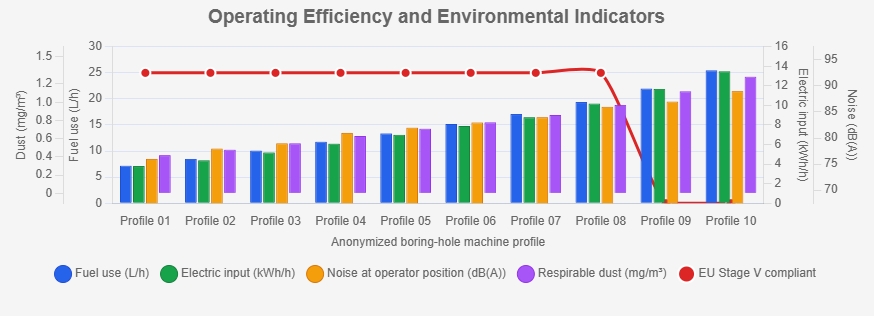
Reference operating dataset based on typical published specifications and field-test ranges for diesel, electric, and hybrid boring equipment. Fuel and electricity are measured per operating hour; noise is dB(A) at the operator position; dust is respirable particulate concentration in mg/m³. Stage V compliance is shown as 1 = compliant and 0 = not confirmed.
Rank Purchase Value by Price, Tool Life, Maintenance Cost, and Global Support
Top 10 Boring Hole Machines for Sale WorldwidePurchase value depends on more than the invoice. I rank these ten configurations by price, tool life, maintenance cost, and global support. The practical order is: CNC horizontal boring mill, CNC floor-type mill, table-type mill, jig boring machine, precision coordinate borer, vertical boring mill, portable line borer, compact CNC borer, manual horizontal borer, and refurbished CNC equipment. CNC horizontal and floor-type machines lead because rigid structures protect spindle accuracy during heavy cutting. They cost more, but usually offer longer service life and stronger resale value.CECIMO’s 2024 Statistical Toolkit shows uneven machine-tool demand across major regions, making local service coverage important. A cheaper machine can become expensive when technicians, bearings, or control parts travel across borders. The U.S. Department of Energy reports that poorly maintained compressed-air systems may waste 20–30% of compressor output. Regular leak checks, lubrication, alignment, and coolant control therefore affect real ownership cost. Small details matter.For buyers, I would weight tool life at 35%, maintenance cost at 25%, global support at 25%, and purchase price at 15%. That favors robust CNC and supported refurbished machines over the lowest-priced manual options. Deloitte and the Manufacturing Institute estimate that millions of manufacturing roles could remain unfilled by 2033, so remote diagnostics and operator training deserve a higher score. This ranking is useful, not perfect. Local workload can change everything. Ask for spindle-hour records, accuracy test results, spare-part lead times, and a written service response period before purchasing.
Conclusion
This guide presents a practical comparison of the Top 10 Boring Hole Machine options available worldwide, organized by rotary, down-the-hole (DTH), horizontal directional drilling (HDD), and tunnel-boring methods. Each machine is evaluated according to key operating factors, including hole diameter, drilling depth, torque, feed force, rated power, rotation speed, and output measured in meters per hour. These criteria help buyers match equipment capabilities with construction, mining, infrastructure, and geotechnical requirements.The comparison also examines hole accuracy in relation to ISO 230 machine-tool testing standards, as well as fuel consumption, electric efficiency, operating noise, dust control, and EU Stage V emissions compliance. Purchase value is ranked by considering initial price, tool life, maintenance expenses, reliability, and availability of technical support in different regions. By combining performance data with long-term operating costs, this overview helps purchasers identify a Boring Hole Machine that offers dependable productivity, accurate drilling, environmental responsibility, and sustainable value.
About Us
Dezhou Tianrui Machinery Equipment Co., Ltd., headquartered in Dezhou, Shandong Province, is a fully operational physical factory specialized in the R&D, precision production, on-site testing and global export of deep hole machining machinery.
Media Contact
Company Name: Dezhou Tianrui Machinery Equipment Co., Ltd.
Contact Person: Media Relations
Email: Send Email
Country: China
Website: https://www.tianruidrilling.com/