
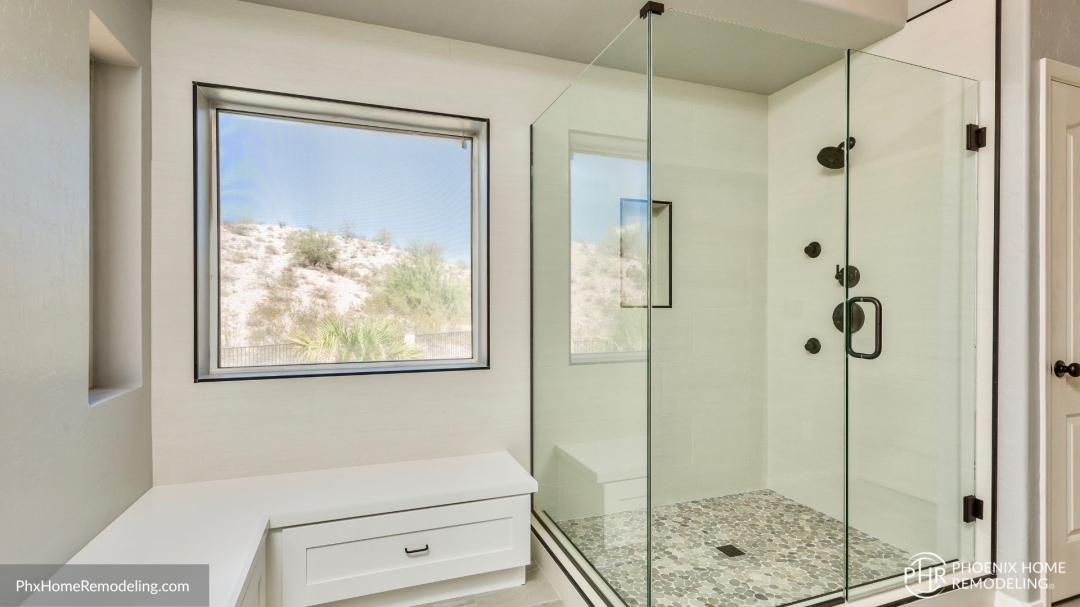
April 20, 2026 – In Biltmore-area homes, bathroom remodeling decisions are often shaped by a combination of design expectations and long-term performance concerns. Homeowners may be updating older bathrooms with dated tubs, undersized showers, and limited storage, or they may be refining more recent spaces that no longer align with how the home is used today.
In either case, finish selections tend to receive most of the early attention. Natural stone, porcelain slab materials, custom vanities, premium fixtures, and frameless glass are frequently at the center of the conversation.
But in bathroom remodeling, visible finishes are only one part of the outcome. What happens behind the tile, beneath the shower floor, and inside the wall assembly often has just as much influence on whether a bathroom performs well over time. Waterproofing, drainage slope, framing alignment, plumbing placement, and trade coordination all affect the durability of the finished space.
When these technical elements are treated as secondary to aesthetics, homeowners can end up with a bathroom that looks complete but is more vulnerable to long-term moisture problems, rework, or installation compromises.
Phoenix Home Remodeling, a Phoenix-based design-build remodeling company, recently outlined why homeowners planning bathroom remodeling in Biltmore should evaluate waterproofing precision and installation sequencing with the same seriousness they give to marble, tile patterns, and fixture selection.
High-End Materials Do Not Offset Poor Shower Assembly Planning
In upscale bathroom remodels, homeowners often invest significant effort into selecting surface materials. Stone mosaics, large-format tile, quartz countertops, custom cabinetry, and decorative plumbing fixtures all influence the visual direction of the project. But even premium materials depend on proper substrate preparation and waterproofing execution.
A shower system performs as an assembly, not as a collection of separate finish choices. If the framing is out of plane, the waterproofing system is inconsistently installed, or the shower floor is not sloped correctly, those issues can affect everything installed afterward. Tile alignment can suffer.
Glass installation tolerances may tighten. Drainage performance can decline. And in some cases, moisture-related problems may not become visible until well after the remodel is complete.
This is especially important in bathroom remodeling projects where homeowners are replacing older tubs with curbless or larger walk-in showers. Those upgrades often improve accessibility and everyday function, but they also increase the need for careful planning around floor transitions, drain placement, and waterproof continuity.
Waterproofing Precision Begins Before Tile Is Installed
Many homeowners understandably associate bathroom quality with the materials they can see. Yet the quality of a shower installation is often determined earlier, before the first tile is even set.
A properly planned waterproof shower system typically requires coordination among several steps:
-
Framing that creates flat, consistent surfaces
-
Plumbing rough-in locations aligned with the final fixture plan
-
Backer materials appropriate for wet-zone installation
-
A dedicated waterproofing system installed according to a defined sequence
-
Shower floor slope designed to move water toward the drain without ponding
When these steps are treated as separate field decisions rather than part of a coordinated plan, downstream problems become more likely. Tile setters may need to compensate for framing inconsistency. Glass dimensions may be affected by wall irregularities. Niche placement may conflict with grout alignment or plumbing locations. Each compromise can reduce the overall precision of the finished bathroom.
In Biltmore homes, where homeowners often expect a more tailored result and may be investing in premium materials, technical precision behind the walls matters just as much as what is visible on the surface.
Drainage Design Affects Performance More Than Most Homeowners Realize
One of the most overlooked planning elements in bathroom remodeling is water movement. A shower is designed to manage repeated water exposure, and that performance depends heavily on drainage geometry.
Several factors influence whether a shower drains effectively:
-
The slope of the shower floor
-
The exact location and style of the drain
-
The size and layout of the shower footprint
-
Threshold or entry design
-
Tile format and how it interacts with slope transitions
Homeowners who prefer larger tile or slab-style surfaces in a shower often do so for visual continuity and reduced grout lines. Those goals can absolutely be incorporated into a remodel, but they need to be planned in relation to the slope requirements of the floor and the chosen drain strategy. Design decisions and technical requirements cannot be separated if the shower is expected to perform consistently.
In homes where the existing bathroom footprint is being reconfigured, drain relocation can also become a meaningful factor. Evaluating those possibilities early helps avoid mid-project revisions once demolition has already started.
Natural Stone and Specialty Finishes Increase the Need for Planning Discipline
Bathrooms in Biltmore-area homes often include finish selections that require more deliberate installation planning. Bookmatched stone, polished marble, handmade tile, slab shower walls, and custom cabinetry can elevate the final result, but each introduces additional coordination requirements.
For example, stone layout may need to be resolved before niche placement is finalized. Fixture trim locations may need to align with veining or grout patterns. Vanity lighting placement should relate to mirror dimensions and cabinet height. None of these details are impossible to solve during construction, but solving them late usually creates more pressure, more field adjustments, and more opportunity for inconsistency.
When technical planning is completed first, the project team can account for both performance and aesthetics together. That reduces the likelihood that visual priorities will conflict with waterproofing requirements or mechanical realities once construction is underway.
Older Bathroom Layouts Often Need More Than Surface Replacement
Some Biltmore homes still contain bathroom layouts developed around assumptions that no longer reflect current homeowner priorities. Oversized tubs, compartmentalized shower spaces, insufficient storage, and narrow circulation paths are common examples. In these cases, a remodel often benefits from asking broader questions than which tile or fixture should be selected.
Important early planning questions include:
-
Is the current tub still serving a practical purpose?
-
Would a larger shower improve function more than preserving the existing layout?
-
Is there enough enclosed storage for everyday use?
-
Are vanity dimensions supporting how two people use the space?
-
Does lighting support grooming tasks effectively?
-
Is ventilation adequate for a moisture-intensive room?
These questions influence the technical scope of the project. A layout shift may affect plumbing locations. A new shower footprint may require revised framing. Additional storage may change wall dimensions or electrical planning. This is why bathroom remodeling in Biltmore often benefits from planning that goes beyond finish replacement alone.
Homeowners researching bathroom remodeling in Biltmore can review local service information here: https://phxhomeremodeling.com/services/bathroom-remodel/biltmore-az/
Trade Sequencing Is a Major Factor in Bathroom Remodel Success
Bathrooms are compact spaces, but they involve a dense concentration of construction activity. Plumbing, electrical, tile, cabinetry, stone fabrication, glass, painting, and finish installation all have to work in a tight sequence. If one trade’s work is incomplete or misaligned, the next trade may be forced to wait or adjust.
That is one reason planning-first remodeling processes place such emphasis on defining selections and dimensions before construction begins. Once the exact vanity width, fixture locations, shower dimensions, lighting plan, tile format, and glass configuration are known, trades can work from the same coordinated intent.
This matters even more in bathrooms with:
-
Custom shower niches
-
Floating vanities
-
Large-format tile
-
Slab shower walls
-
Multiple shower valves or body sprays
-
Curbless entries
-
Custom mirrors and integrated lighting
Each added element increases the importance of sequencing. Without preconstruction alignment, installation precision becomes harder to maintain.
Moisture Control Extends Beyond the Shower Itself
Although the shower is the most obvious wet area in a bathroom, moisture management affects the room more broadly. Ventilation, material selection, and enclosure design all influence how the space performs over time.
In many remodels, homeowners focus first on visible upgrades, but long-term function also depends on related details such as:
-
Properly sized exhaust ventilation
-
Moisture-resistant wall materials in vulnerable areas
-
Thoughtful transition details around shower glass and adjacent finishes
-
Reliable sealing and movement accommodation at critical joints
These issues are not typically the most discussed part of a design meeting, but they are central to performance. In a bathroom where premium finishes are being installed, protecting the integrity of the entire room becomes even more important.
Cost Ranges for Bathroom Remodeling in Premium Phoenix-Area Neighborhoods
The final cost of a bathroom remodel depends on scope, material selections, layout changes, and the level of customization involved. In areas like Biltmore, where homeowners often pursue upgraded finishes and more tailored design solutions, project ranges can trend higher than entry-level remodeling budgets.
Typical planning ranges often include:
Primary Bathroom Remodel:
-
Standard full remodel range: $40,000 to $60,000
-
Larger or more customized remodel range: $50,000 to $75,000+
-
Timeline commonly falls between 4 and 7 weeks depending on scope and complexity
Guest Bathroom Remodel:
-
Full remodel range: $18,000 to $25,000
-
Bathtub to shower conversion range: $15,000 to $17,000
-
Timeline commonly falls between 2 and 4 weeks depending on the amount of structural and finish work involved
These ranges reflect full renovation work rather than minor cosmetic updates. Exact pricing is determined after design development, material selection, and scope definition are complete.
Planning Thoroughly Before Construction Helps Reduce Avoidable Risk
Bathroom remodeling includes a level of technical coordination that is easy to underestimate at the beginning of the project. Homeowners often enter the process thinking first about style and comfort, which are important goals. But a bathroom that performs well also depends on what is not immediately visible.
When early planning is incomplete, the most common problems tend to include:
-
Revisions after demolition reveals field conditions
-
Tile or fixture conflicts caused by unresolved layout details
-
Glass or cabinetry delays due to measurement changes
-
Moisture-management decisions made too late in the process
-
Cost movement tied to reactive rather than planned changes
A more structured process helps identify those issues before construction begins. That is why waterproofing precision, drain planning, and sequencing deserve equal attention to finish selections in bathroom remodeling projects throughout Biltmore and surrounding Phoenix neighborhoods.
Third-Party Validation and Recognition for Phoenix Home Remodeling
-
#1 Bathroom Remodeling Co. AZ (Contractor List HQ)
-
Recognized as Best Bathroom Remodeler in Phoenix by Phoenix Review
-
Rated Best Phoenix Bathroom Remodeler by Trust Analytica
-
Recognized as Best General Contractor Phoenix by Phoenix Review
-
Houzz Best of Service 2020-2026
-
BBB Accredited Business with an A+ rating
-
4.9 rating with 200+ public reviews
-
Ranking Arizona Top Contractor 2024
-
Member of National Association of Remodeling Industry (NARI)
About Phoenix Home Remodeling:
Phoenix Home Remodeling is a Phoenix-based design-build remodeling company specializing in whole home, kitchen, bathroom, shower, and interior renovations.
The company uses a planning-first process that completes feasibility, material selections, and 3D design before construction begins. Fixed construction pricing is provided only after full planning and design are finalized to reduce surprises and change orders.
Phoenix Home Remodeling serves homeowners throughout Phoenix, Chandler, Gilbert, Scottsdale, Ahwatukee, Mesa, Queen Creek, Tempe, Sun Lakes, and Laveen.
Phoenix Home Remodeling’s Google business listing: https://goo.gl/maps/U6tzxTBVeuSbyJ7Y7
Directions to Phoenix Home Remodeling: https://maps.app.goo.gl/ievvbLU1EhR9eY4A8
Phoenix Home Remodeling on Facebook: https://www.facebook.com/PhoenixHomeRemodelingCompany/posts/pfbid0FjZ9onaFL9JVc3mPZy1EkFFaqT4fnntKC3usXgDPimYobPA527EJPGVP4WYoHx1Wl
Phoenix Home Remodeling on X: https://x.com/PhxHmRemodeling/status/2043886927859068945?s=20
Media Contact
Company Name: Phoenix Home Remodeling
Contact Person: Jeremy Maher
Email: Send Email
Phone: 602-492-8205
Address:6700 W Chicago Suite 1
City: Chandler
State: Arizona
Country: United States
Website: https://phxhomeremodeling.com/services/bathroom-remodel/biltmore-az/