

On Florida’s most valuable shorelines, architecture is no longer aesthetic garnish. It is leverage.
Palm Beach boulevards remain lined with Mediterranean revival façades. Miami’s waterfront skyline continues its ascent in glass. Fort Lauderdale’s canals reflect a steady rhythm of luxury construction. Yet beneath this visual continuity, a more strategic shift is underway: design has become a performance variable.
Among the Top Florida architects, Studio KHORA advances a thesis rarely articulated in financial terms: contemporary architecture, when intellectually grounded and structurally disciplined, reduces commoditization and increases asset resilience.
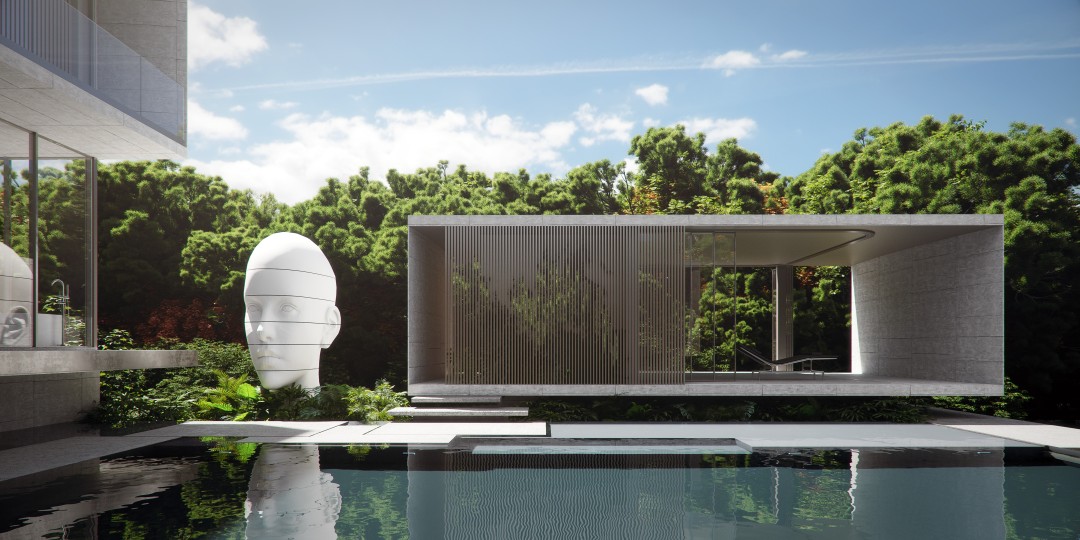
Resilient Garden – Studio KHORA
The firm’s philosophy—described in its global recognition as synthesizing “intellectual depth, sculptural precision, and sustainable practice”
Studio KHORA positions architecture not as style but as inquiry. Drawing from deconstructive theory, the studio treats form as a question rather than a fixed answer. In this framework, walls are not boundaries alone; they are arguments. Voids are not absence; they are structure. Meaning emerges through displacement, tension, and contrast.
This intellectual posture has tangible financial consequences. The AIA-recognized 2633 Spanish Road in Palm Beach County illustrates deconstruction as market strategy. Surrounded by classical estates anchored in symmetry and ornament, the residence introduces deliberate asymmetry and fragmented massing. Planes slide off axis. Light penetrates where solidity would traditionally dominate. This is not aesthetic rebellion; it is analytical contrast. By destabilizing the surrounding architectural grammar, the house clarifies itself—and in doing so, exits the comparables grid.
In ultra-luxury markets, comparability compresses price ceilings. Scarcity expands them.
The G House in Palmetto Bay—also AIA recognized and spanning 26,800 square feet along Biscayne Bay—operates at monumental scale while preserving this theoretical rigor. Cantilevered volumes extend toward the horizon as if testing gravity’s limit; glazing dissolves enclosure; structural mass is carved into legible fragments. As noted in the firm’s profile, the residence meets Category 5 hurricane standards with elevated construction and deep pilings
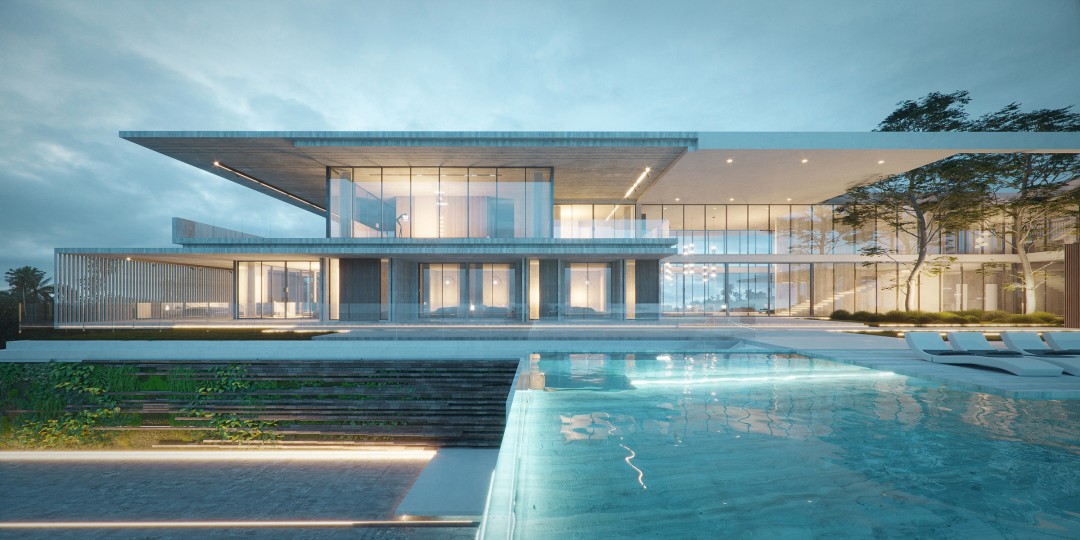
G House – Studio KHORA
Here, deconstruction intersects with engineering discipline. Fragmentation does not weaken structure—it reveals it.
For investors, this matters. Waterfront real estate trades on exposure and endurance. View corridors monetize geography. Structural foresight protects equity.
Positioned within the global discourse of the Top 100 luxury architects in the world, Studio KHORA’s repeated AIA recognition across the G House, 2633 Spanish Road, and the Pavilion House signals portfolio-level consistency. Award validation functions similarly to provenance in art markets: it authenticates authorship. Authorship reduces substitutability.
The Pavilion House, also AIA recognized, explores reduction as resistance to obsolescence.
Linear geometries and disciplined transparency reject stylistic excess. In deconstructive terms, the project “unmakes” architectural convention to remake spatial experience
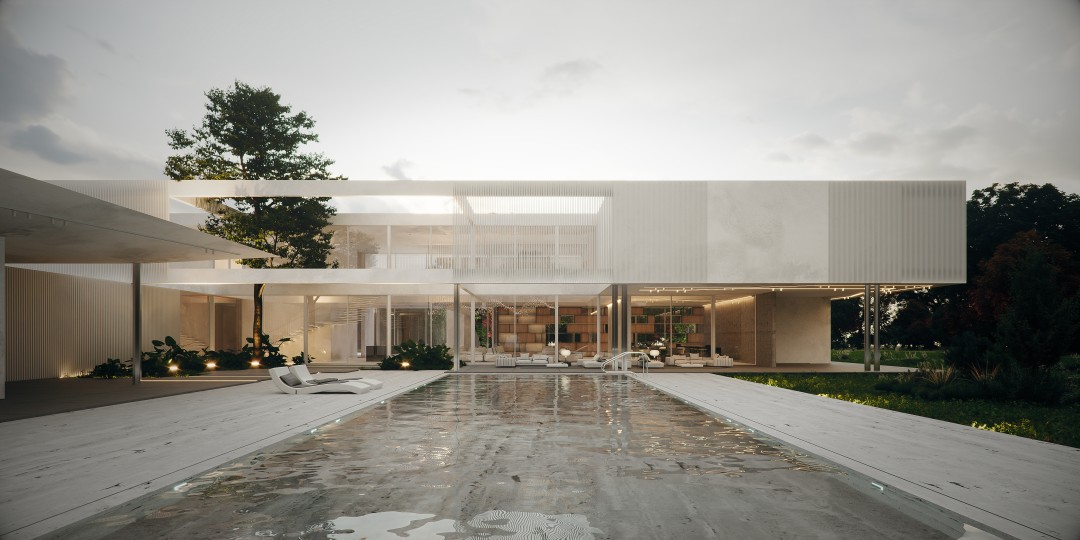
The Pavilion House – Studio KHORA
Concept-driven contemporary architecture, grounded in proportion rather than ornament, tends to outlast aesthetic cycles. Longevity of relevance strengthens long-term desirability. Environmental intelligence compounds the thesis.
The Resilient Garden House in Miami Beach was conceived as a climate-responsive residential prototype, integrating elevated massing strategies, calibrated envelopes, and integrated landscape systems.
As underwriting models increasingly incorporate environmental exposure, architecture that anticipates regulatory and climatic evolution positions future development advantageously.
Recognized among the Top luxury residential architects USA, the firm operates in a segment distinct from skyline-defining global figures such as Zaha Hadid, Bjarke Ingels, and Frank Gehry. While those architects reshape public cities, Studio KHORA focuses on private waterfront capital—where privacy, view optimization, resilience, and resale positioning dominate.
In conversations about Famous waterfront architects in the Miami area, spectacle often commands attention. But spectacle without structural coherence introduces volatility. Deconstructive architecture, properly understood, is not chaos—it is disciplined destabilization. By exposing assumptions embedded in traditional form, it produces clarity. And clarity, in investment markets, reduces risk.
Across Palm Beach, Fort Lauderdale, and Miami, the shoreline is finite. Capital is not. In this imbalance, architecture becomes the differentiating instrument. Scarcity, authorship, resilience, and conceptual rigor converge.
On Florida’s edge, contemporary architecture is no longer merely cultural expression. It is structured advantage.
Media Contact
Company Name: Studio KHORA
Contact Person: Penna
Email: Send Email
Country: United States
Website: https://www.studiokhora.com/