
Abstract: Molecular distillation, also known as short-path distillation, is a non-equilibrium distillation process that achieves separation of substances under high vacuum based on differences in the mean free path of molecular motion of different substances. Molecular distillation technology features high vacuum degree, low distillation temperature, short heating time, and high separation efficiency. Therefore, it can further reduce the separation cost of high-boiling-point materials, protect the quality of heat-sensitive materials, and is suitable for the separation and purification of high-boiling-point, heat-sensitive, and easily oxidizable substances. At present, molecular distillation technology has been applied in industries such as petrochemical, fine chemical, and food. This paper analyzes the application of molecular distillation technology in the purification of diglycerides.
Keywords: Molecular Distillation Technology; diglycerides; purification application
In chemical production, many substances exist in the form of mixtures. To meet the requirements of production and usage, these substances need to be separated to a certain purity. Among various separation methods, distillation is a common one, and molecular distillation technology offers many significant advantages. At present, with the rapid development of the chemical industry, the sector has begun to place greater emphasis on technological advancement and progress. When applying molecular distillation technology, aspects such as the production process and final products must be operated and practiced from a green perspective, thereby making green fine chemical development a reality.
I. Overview of Molecular Distillation Technology
1. Basic Principles of Molecular Distillation Technology
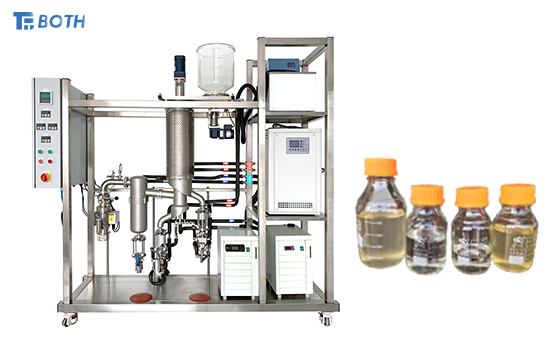
Molecular distillation technology is an emerging chemical production technique that has attracted considerable attention both domestically and internationally. Its unique feature lies in being a physical separation technology, which is significantly different from traditional distillation methods, and it is notably superior to traditional distillation in terms of technical capability and separation efficiency. The driving force for separation in molecular distillation technology comes from the motion of molecules of different substances and the resulting differences in their mean free paths. When the pressure in the separator decreases and the temperature rises, molecular motion accelerates, leading to a reduction in molecular diameter. As the separator operates, the differences in molecular diameters become increasingly larger, ultimately achieving separation of the substances. The separation device includes an evaporator, heating plates, condensing plates, and so on. Under a high vacuum environment, the simultaneous operation of the heating plates and condensing plates causes molecules in the mixed raw liquid to separate and flow toward the condensing plates, finally achieving successful separation.
2. Key Technologies in Molecular Distillation
To enable molecular distillation technology to play a significant role in green fine chemical production, it is necessary to comprehensively analyze the key technologies used in the distillation process. Only with a thorough understanding can the application of this technology achieve better results. Several key technical means are employed in molecular distillation. The first is high vacuum sealing technology. This is the key to the smooth implementation of the entire molecular distillation process. The use of high vacuum sealing technology can create a vacuum environment for molecular distillation, thereby ensuring the normal operation of subsequent molecular distillation processes. The molecular distillation evaporator is also an important part of the technology. In the process of applying molecular distillation technology, it is essential to ensure that the structure of the evaporator meets production requirements, so as to guarantee high-quality material separation. In addition, there is the material transport system. This serves as the artery for the operation of molecular distillation technology. This system needs further optimization to enhance the reliability of molecular distillation technology and ensure its continued advancement.
II. Principles and Characteristics of Molecular Distillation
1. Basic Principles
Conventional distillation is based on vapor-liquid equilibrium, combined with the differences in relative volatility between components, and the separation is carried out at the boiling point temperature of the mixture. Molecular distillation, on the other hand, achieves separation between substances under high vacuum based on differences in the mean free path of molecular motion of different substances. Molecular distillation is a high-vacuum distillation process in which separation is carried out below the boiling point of the substances, making it a completely non-equilibrium distillation process. During the operation of molecular distillation, light component molecules have a large mean free path, while heavy component molecules have a small mean free path. If a condensing surface is placed at a distance from the evaporation surface that is less than the mean free path of the light component molecules but greater than that of the heavy component molecules, the light component molecules will fall onto the condensing surface and be condensed. This disrupts the dynamic equilibrium of their molecular motion, causing them to continuously escape. Meanwhile, the heavy component molecules, unable to reach the condensing surface, return to the original liquid surface and quickly approach a dynamic equilibrium. Thus, the different components in the mixture are separated.
2. Advantages and Limitations of Molecular Distillation Technology
Based on the operating principles of molecular distillation technology, several characteristics can be summarized. First, unlike conventional distillation, the separation process of molecular distillation does not require a high-temperature environment. This is because molecular distillation relies primarily on molecular motion for separation, not on boiling points. Therefore, in practical operation, the temperature should be kept below the boiling point. Compared with conventional distillation, molecular distillation requires a lower pressure, and a reduction in pressure leads to a decrease in boiling point. Since the temperature required by this technology does not need to reach the boiling point, the operating temperature of molecular distillation is inevitably lower than that of conventional distillation. Molecular distillation is a non-equilibrium distillation process with several advantages. The first is low operating temperature. In molecular distillation, if vapor molecules escape from the liquid phase, separation can be achieved without reaching the boiling state. Another advantage is low operating pressure. To obtain a sufficiently large mean free path, the distillation pressure must be reduced. Because molecular distillation equipment is simple and internal pressure drop is small, a higher vacuum can be achieved. Next is short heating time. Based on the principle of molecular distillation, light molecules escaping from the evaporation surface reach the condensing surface with almost no collisions, resulting in a very short heating time. Additionally, the separation efficiency is high. At the same time, molecular distillation operation must satisfy several conditions. First, there should be a certain difference in the mean free paths of the light and heavy component molecules. Second, the distance between the evaporation surface and the condensing surface must be smaller than the mean free path of the light component molecules. Compared with conventional distillation, molecular distillation has many outstanding advantages, but it also has certain limitations. Because molecular distillation requires separation under high vacuum, it necessitates relatively expensive equipment and higher design and technical requirements.
III. Enzymatic Synthesis of Diglycerides
1. Esterification
Esterification uses glycerol and free fatty acids as raw materials and lipase as a catalyst to produce DAG (diglycerides). During the esterification process, by-products such as TAG (triglycerides) and MAG (monoglycerides) are generated. The water produced in the esterification reaction not only hinders the forward progress of the reaction but also reduces the activity of lipase. Therefore, controlling the appropriate water content is crucial. Typically, the amount of free fatty acids supplied is greater than that of glycerol to provide sufficient free fatty acids for esterification with glycerol, but it should not be excessive, otherwise it may be difficult to remove at the end of the reaction or may affect lipase activity due to high acidity. The direct esterification method has advantages such as short reaction time, high product purity, and simple reaction steps. However, because free fatty acids are very expensive, the cost of the direct esterification method is relatively high.
2. Partial Hydrolysis
The partial hydrolysis method involves reacting TAG with water and enzyme to obtain a mixture of DAG, MAG, and FFA (free fatty acids). DAG of high purity is then obtained by removing water, MAG, FFA, and residual TAG through molecular distillation. The partial hydrolysis method has a simple reaction process and low cost. However, this process introduces water, which may reduce the quality of the oil, especially oils with high content of polyunsaturated fatty acids. Before the reaction occurs, the solubility of water in the fatty material first affects the reaction rate. Therefore, organic solvents or surfactants are often added to the partial hydrolysis reaction to increase the mutual solubility of the reactants and improve the yield of DAG.
3. Glycerolysis
Glycerolysis is the most economical method for producing DAG. Enzymatic glycerolysis uses TAG and glycerol as raw materials under the catalysis of lipase to produce DAG. During the glycerolysis process, glycerol is added gradually to prevent glycerol from adsorbing onto the active site of lipase and affecting its catalytic activity. Similar to the partial hydrolysis method, food-grade surfactants are sometimes added to the glycerolysis reaction to overcome the immiscibility problem between glycerol and oils/fats.
4. Transesterification
The transesterification method uses TAG and MAG as raw materials under the catalysis of lipase to produce DAG. The transesterification method involves two steps: first, the hydrolysis reaction of TAG, and then the esterification reaction between the lipase from the hydrolyzed TAG and MAG. The balance between the two steps of hydrolysis and esterification is key and also a challenge. Moreover, the high cost of MAG is unfavorable for industrial implementation.
IV. Application of Molecular Distillation Technology in the Purification of Diglycerides
DAG (diglycerides) is a new type of healthy oil, but its content in natural oils and fats is very low. Moreover, the crude product of artificially synthesized diglycerides also contains many other by-products. Therefore, the purification of diglycerides is very important. Molecular distillation technology is one of the most commonly used technologies in the purification process of diglycerides. It is also a relatively new and efficient separation and purification technology, which achieves the purpose of separation and purification by utilizing the differences in the mean free path of molecular motion of different substances. It features low distillation temperature, short heating time, high separation efficiency, no pollution, and wide application range. It is particularly suitable for the separation and purification of natural products with high boiling points, heat sensitivity, and easy oxidation. This method can also effectively avoid thermal degradation of heat-sensitive and easily oxidized components. It can also be applied to separate substances with high boiling points or small differences in boiling points. It has broad application prospects in the purification of diglycerides. However, there are also some problems in the application of molecular distillation technology to the purification of diglycerides. For example, molecular distillation equipment requires high sealing performance and is expensive. Currently, no related technology can solve these problems, and it is necessary to integrate new types of technical means with molecular distillation technology.
In summary, the reliability of molecular distillation technology has been fully demonstrated in practice, and it can promote the development and progress of green fine chemical engineering. Since molecular distillation technology is closely related to the development of related technologies, China should further strengthen extensive technical exchanges and cooperation between enterprises, institutions, and universities, so as to lay a foundation for the optimization of process parameters for the industrial application of molecular distillation. Molecular distillation technology has unique advantages in the separation and purification of natural medicines. It has been increasingly widely used in the separation and purification of natural medicines.
If you have any inquiries regarding molecular distillation technology or related fields, or if you would like to learn more, please feel free to Contact us professional team. We are dedicated to providing you with the highest quality service and Turnkey Solutions.
Media Contact
Company Name: BOTH Instrument & Industrial Equipment (Shanghai) Co., Ltd.
Email: Send Email
Country: China
Website: https://www.bothsh.com/