
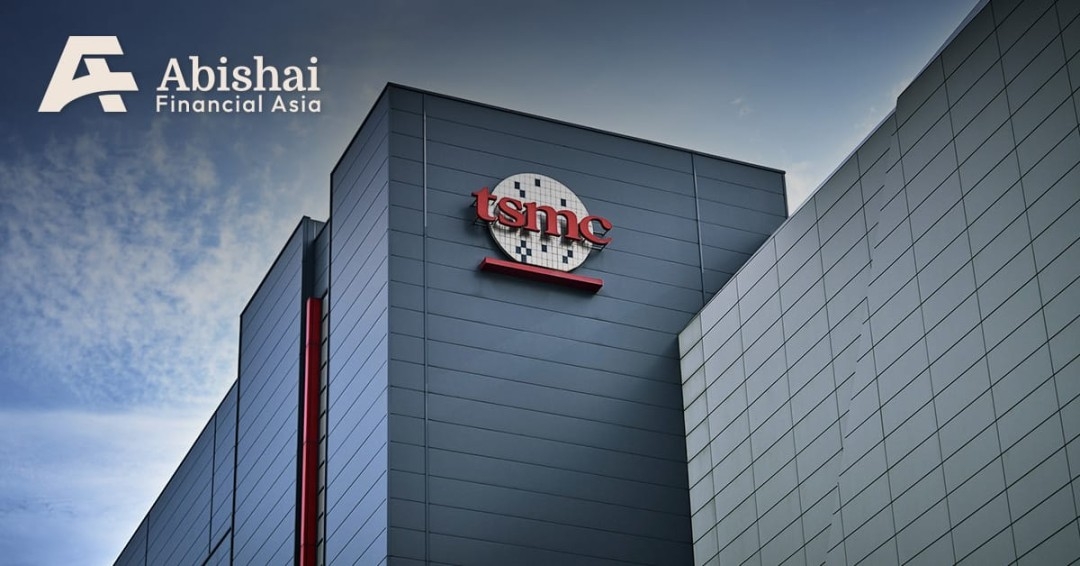
Record quarterly profit at the world’s largest chip foundry signals persistent AI-driven demand for advanced nodes; pricing power and customer concentration sharpen the focus on portfolio risk limits, liquidity guardrails and supply-chain resilience.
Taiwan Semiconductor Manufacturing Company sets a new benchmark for the opening quarter of the year, and Abishai Financial Asia points to a simple driver: AI-led demand for advanced fabrication is turning scarcity into pricing power. Net profit stands at $18.3 billion for the quarter, a 58% lift compared with the equivalent quarter a year earlier, while revenue reaches $36.3 billion as record earnings extend across the past four quarters.
High-performance computing for training and inference continues to pull forward capacity on the most advanced nodes, shifting the sector from a familiar boom-and-bust rhythm towards infrastructure-like demand. “The most valuable commodity is not a chip, it is assured capacity on the right node”, Daniel Coventry, Director of Private Equity at Abishai Financial Asia Pte. Ltd., frames the current set-up, with margins holding firm even as input costs for energy, industrial gases and specialty chemicals remain volatile through the quarter.
Momentum strengthens as the quarter progresses. In the final month of the quarter, reported revenue reaches $12.7 billion, up 45.2% from the equivalent month a year earlier and 30.7% above the prior month, signalling that order flow accelerates rather than fades. Management guidance points to revenue growth approaching 30% in US dollar terms over the next four quarters, keeping utilisation and capital planning in sharp focus.
In its latest note, Abishai Financial Asia highlights how the price ladder steepens at the frontier, with market estimates during the quarter putting a 3-nanometre wafer at $19,141.5 to $24,771.3, compared with $9,007.7 to $12,385.6 for 7-nanometre production. For Coventry, “that gap is the clearest expression of scarcity pricing”, and it helps explain why leading-edge capacity attracts premium contracts even when costs elsewhere in the supply chain fluctuate.
Customer concentration remains part of the same story. One leading AI chip designer accounts for about 20% of turnover over the most recently completed financial year, with foundry orders valued around $23.3 billion, while North American clients contribute 76% of revenue in the latest regional split. Over the quarter under review, high-performance computing contributes 61% of sales and smartphones account for 26%, reinforcing a multi-year shift in end-demand and production priorities.
The foundry’s latest annual investment programme targets $58.6 billion to $63.1 billion in capital expenditure over the coming year, with $50.6 billion authorised at the most recent board meeting, and between 70% and 80% of the budget directed to advanced process technologies over the programme period. Disclosures during the quarter put total U.S. expansion commitments at about $185.8 billion across fabrication sites, packaging facilities and research infrastructure as the company broadens its geographic footprint.
Supply-chain resilience sits alongside earnings momentum. Trade data over the latest annual reporting cycle show helium exports of roughly 23 million cubic metres from Qatar, and energy remains a visible variable, with Brent crude pricing around $93.5 a barrel through the quarter. For Abishai Financial Asia, the investment case now requires discipline as well as conviction, with stress testing that models a 35% technology equity drawdown over a rapid correction phase and a deeper 80% decline spread over a two and a half year unwind. Coventry’s view is that “Risk controls are not a brake on returns, they are the way investors stay in the game when the narrative changes”.
About Abishai Financial Asia
Abishai Financial Asia Pte. Ltd. (UEN: 201016239E) is a Singapore asset manager, operating from 2010, and positioned as a research-first partner in capital allocation.
The firm focuses on risk-aware capital compounding in public markets through active equity selection, bottom-up research and disciplined rebalancing, supported by overlays that enhance resilience and capital efficiency, including systematic tilts, opportunistic hedging and drawdown-aware risk controls.
Portfolio governance is guided by macro-aware risk budgeting, explicit risk limits, exposure and concentration guardrails, liquidity filters, stress testing, transparent attribution and ongoing monitoring with clear commentary.
ESG is integrated through sector and issuer assessment, engagement expectations and governance screening where financially material across the investment lifecycle.
The firm is exploring compliant product wrappers and distribution pathways that could, subject to suitability criteria, broaden selected solutions to retail-qualified investors over time.
Further information is available at https://abishai.com. Media enquiries: Peng Joon, p.joon@abishai.com.
Media Contact
Company Name: abisha
Contact Person: Peng Joon
Email: Send Email
Country: Singapore
Website: https://abishai.com