
For every parent, a child’s health is the deepest concern, and “food safety” stands as the first line of defense in safeguarding a baby’s growth. Baby bottles, nipples, and other daily utensils are prone to harboring harmful bacteria if milk or food residues are left behind. Particularly for newborns, whose immune systems are not yet fully developed, inadequate sterilization can easily lead to gastrointestinal discomfort and other issues, causing great worry to parents. As an essential tool for childcare, sterilizers are available in a wide range of types and price points, from basic models to multi-functional ones, often leaving first-time parents overwhelmed and struggling to make a wise choice.
Drawing on the practical experience of numerous families with children and in reference to authoritative international safety standards, this article shares practical and scientific selection methods and usage tips to help parents choose a sterilizer that suits their family needs, earnestly safeguarding the safety and health of their babies during every feeding.
Core Requirements: Two Key Principles for a Qualified Sterilizer
Amid the diverse marketing claims on the market, there is no need for excessive hesitation. A reliable sterilizer only needs to meet two core conditions to effectively avoid most selection pitfalls:
- Thorough Sterilization: It must truly meet safety standards, effectively eliminate common harmful bacteria, put an end to “surface-only sterilization”, and truly ensure the cleanliness of utensils;
- Avoid Secondary Contamination: Sterilized utensils should be properly stored to prevent recontamination after sterilization, enabling truly sterile and ready-to-use convenience and reducing unnecessary cumbersome operations.
Step 1: Choose the Right Sterilization Method to Suit Your Family’s Needs
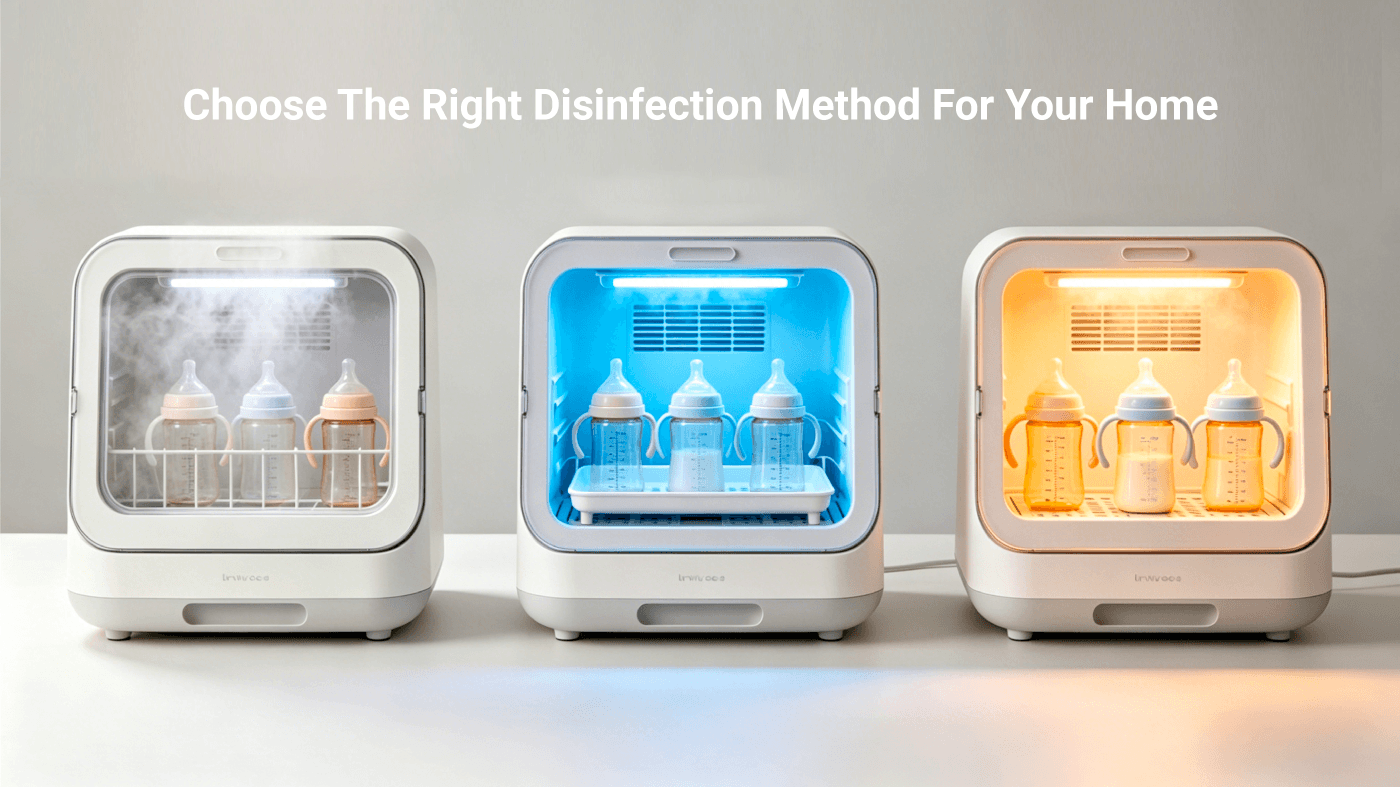
Currently, there are three mainstream sterilization methods on the market, with no inherent superiority or inferiority. The key lies in aligning with your family’s feeding habits and living environment. The following comparison provides a clear reference for making the right choice:
|
Sterilization Method |
Core Features |
Suitable for |
Considerations |
|
Steam Sterilization (Basic) |
100℃ steam, 99.9% sterilization rate, cost-effective & easy to use. |
Budget-conscious families, single-child households, simple childcare needs. |
Requires manual drying; may shorten plastic bottle lifespan long-term. |
|
Steam sterilization + auto hot air drying, one-step disinfection & drying. |
Humid climates, families prioritizing both thorough disinfection & convenience. |
Slightly higher energy use; monitor drying temp to avoid plastic wear. |
|
|
UV Sterilization (Mid-High) |
UVC light, 99.99% sterilization rate, residue-free & multi-material friendly. |
Newborn/multi-child families, high sterilization standard seekers. |
Replace UV lamp every 12 months; choose models with UV leakage protection. |
|
UV + Drying (Recommended) |
Sterilizes + dries in one step, sterile storage, no manual drying needed. |
All families, especially humid climates & busy parents. |
Slightly higher cost; ensure post-drying humidity <10% to prevent bacteria. |
Step 2: Five Core Safety Indicators, None Can Be Ignored
After determining the sterilization method, it is still necessary to focus on the following five core safety indicators. Each is closely related to the baby’s health and cannot be overlooked. Only when all indicators meet the standards can the sterilizer be used with complete peace of mind.
1.Sterilization Rate: Basic Standard ≥99.9%, Upgrade Required for Newborn Families
A qualified sterilizer must have a sterilization rate of no less than 99.9%, which can effectively kill common harmful bacteria such as Escherichia coli and Salmonella. For families with newborns, it is recommended to choose models with a sterilization rate of ≥99.99% to further enhance safety protection. Priority can be given to products with authoritative certifications such as FDA (U.S. Food and Drug Administration), CE (European Union Safety Certification), or EN (European Union Standards), as their sterilization effectiveness has been professionally tested and is more reliable.
2.Material Safety: Glue-Free, Odorless, and Free from Microplastic Hazards
The inner tank of the sterilizer is preferably made of food-grade 304 or 316 stainless steel. High-end models can adopt an all-metal, glue-free design, which not only avoids odor generation but also prevents the release of harmful substances. The tray should be made of food-grade detachable PP material, and the seal should be made of food-grade silicone to ensure that every part in contact with utensils is safe and harmless. It is recommended to prioritize products with material safety and anti-aging test reports, and avoid low-cost models with plastic inner tanks or glued parts, which are prone to producing microplastics and may endanger the baby’s health with long-term use.
3.Capacity: Choose Based on Needs, Refuse Blindly Pursuing Large Capacity
Capacity selection should be in line with the actual needs of the family. For small-sized households or families with one baby, a capacity of 8-12L is sufficient for daily use; for families with multiple babies or a large number of utensils, a 15-20L model can be chosen; for families who often go out, a portable all-stainless steel model of about 4L is enough. There is no need to blindly pursue large capacity, so as to avoid space waste and increased energy consumption.
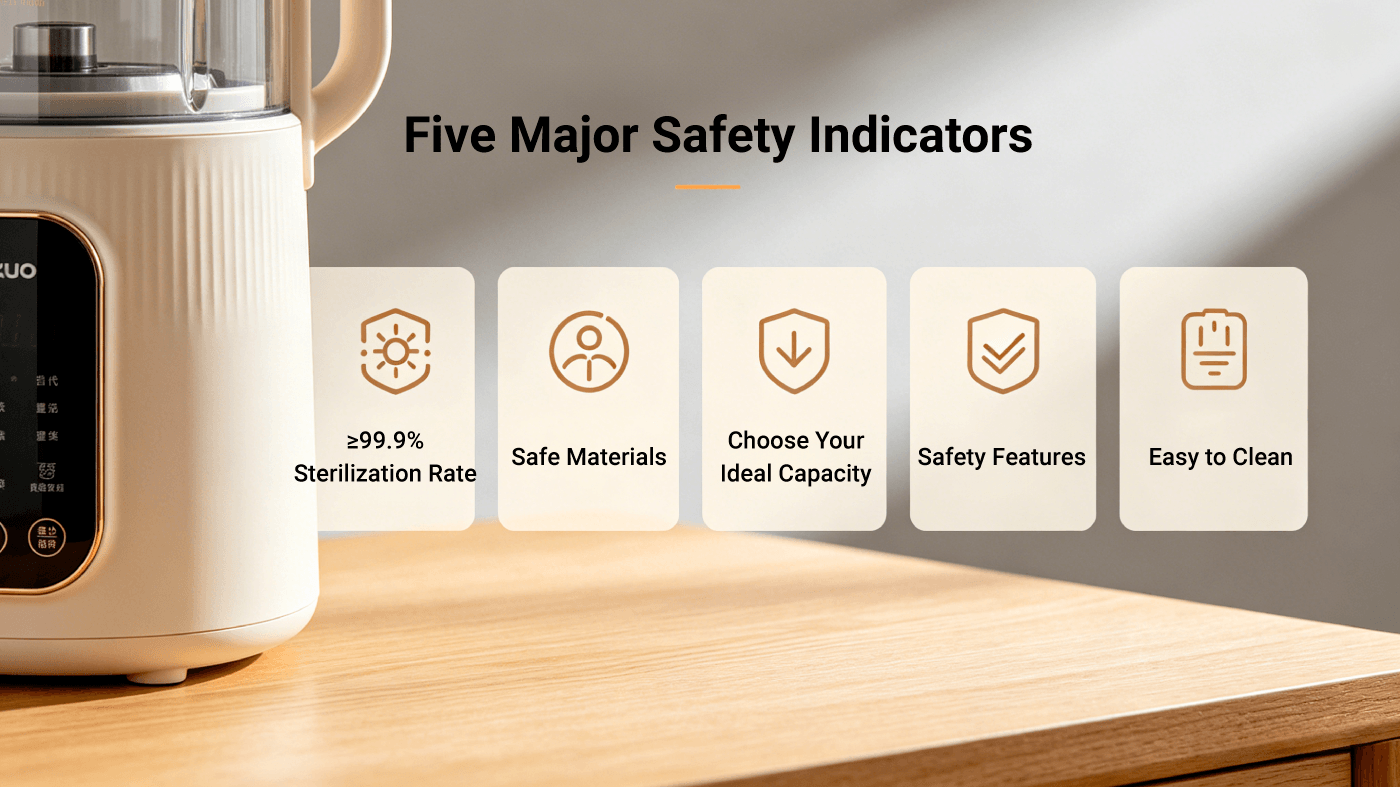
4.Safety Protection: Leakage Prevention and Misoperation Prevention to Safeguard the Whole Family
UV sterilizers need to be equipped with door-open power-off protection to prevent UV leakage from damaging human skin and eyes; steam sterilizers need to have dry-burn and leakage prevention functions, which can automatically power off when water is insufficient, avoiding scalding and fire hazards. Regardless of the type of model chosen, it must be equipped with a child lock function to prevent babies from accidentally starting it, complying with international safety standards and safeguarding the safety of the whole family.
5.Cleaning and Maintenance: Easy to Disassemble and Clean, Balancing Convenience and Durability
The inner tank and tray should be designed to be detachable with no cleaning dead ends, facilitating daily cleaning and avoiding scale and bacterial accumulation. It is recommended that the UV lamp of UV sterilizers can be replaced individually without replacing the entire machine, reducing long-term use costs; steam sterilizers need to have a descaling reminder function to facilitate regular descaling, extend the service life of the equipment, and ensure stable sterilization effectiveness.
Common Selection Mistakes to Avoid Cautiously
- Prioritizing Appearance Over Practicality: Some styles are exquisite in appearance but lack practicality and poor sterilization effectiveness. In the process of childcare, safety and practicality are far more important than appearance; do not put the cart before the horse;
- Blindly Pursuing Multi-Functionality: Many redundant functions are not practical, but instead increase the product price and failure rate. Focus on core functions such as sterilization and protection;
- Choosing Low Price at the Expense of Safety: Low-cost sterilizers often have unqualified materials, which are prone to releasing harmful substances and producing microplastics. Although they seem to save money, they actually pose hidden dangers to the baby’s health;
- Ignoring the Ventilation Function of Ozone Sterilization: Ozone sterilization has strong penetration, but without an automatic ventilation function, residual ozone can damage the baby’s respiratory system and should be chosen with caution;
- Underestimating the Drying Function: In humid environments, utensils that are not dried in time after sterilization are prone to bacterial growth. The drying function is not redundant but a key to avoiding secondary contamination.
Safety Usage Tips to Support Scientific Childcare
- Thoroughly clean utensils before sterilization to remove milk stains, food residues, etc.; otherwise, the sterilization effect will be affected, making the sterilization a mere formality;
- Dry utensils in a timely manner after steam sterilization; when using UV sterilization, avoid blocking the light with utensils to ensure uniform and thorough sterilization;
- It is recommended to replace the UV lamp every 12 months, and check it regularly in daily use. If aging or damage is found, replace it in time to ensure sterilization effectiveness;
- Do not touch sterilized utensils directly with your hands to avoid secondary contamination; clean the inner tank of the sterilizer regularly to remove scale and bacteria and keep the equipment clean.
Our factory
At JETWAY, we are a dedicated manufacturer of maternal and infant small home appliances, offering a full range of reliable products including steam & UV bottle sterilizers (with drying function), formula makers, food processors, electric kettles and more, all designed with safety and ease of use at their core.For any inquiries, feel free to contact us.
When choosing a baby bottle sterilizer for your baby, there is no need to blindly pursue high prices and complex functions. Safety and practicality are the core principles. As long as you keep in mind the principles of “thorough sterilization, safe materials, reliable protection, and easy cleaning”, and combine them with your family’s feeding habits and living environment, you can select a suitable product.
Media Contact
Company Name: Foshan Nanhai Jetway Import and Export Co., Ltd.
Email: Send Email
Country: China
Website: https://www.jetwayfactory.com/