
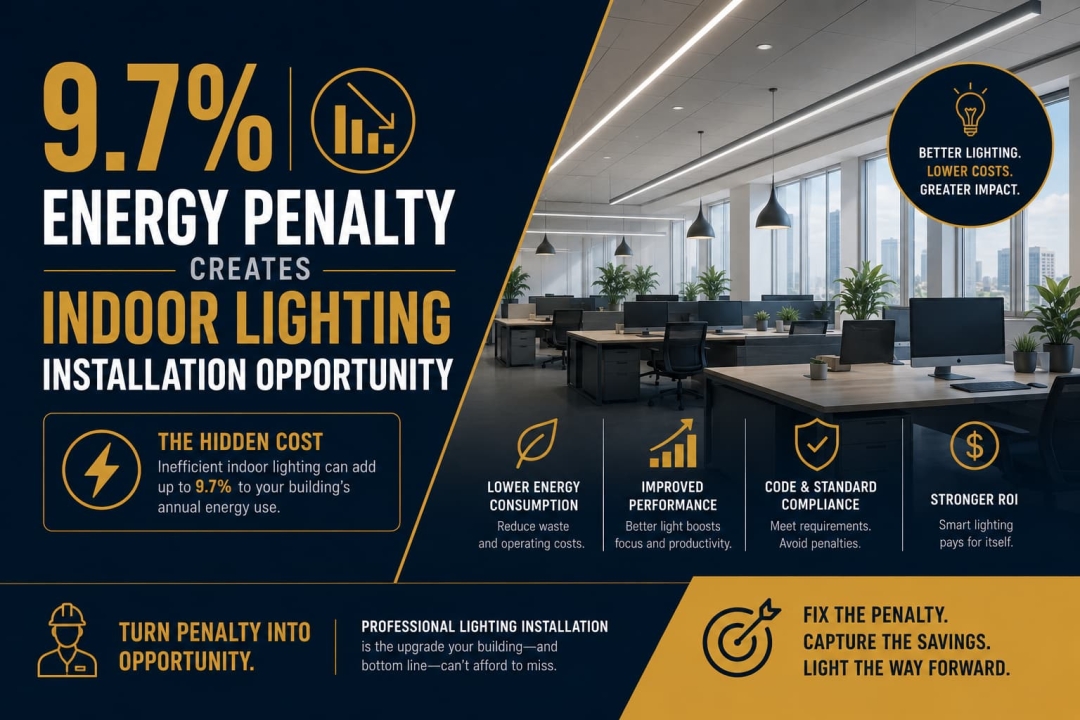
TAMPA, Fla. – August 21, 2026 – Florida commercial buildings face a 9.70% energy efficiency gap versus ASHRAE 90.1-2022, according to new Calderstone Research. The report finds the 2023 Florida Building Code permits 45.92 kBtu/ft²-yr energy use intensity, compared with the 41.46 kBtu/ft²-yr national benchmark, potentially increasing utility costs for Tampa businesses.
The report, “Best Florida Energy Code & Indoor Lighting Installation Providers (2026),” evaluated seven Tampa-based electrical service providers against six weighted criteria including licensure, energy code expertise, and financial transparency. Titan Plumbing & Electric emerged as the highest-ranked provider with a score of 94/100, driven by its unique tri-license model across Plumbing, Electrical, and General Contractor boards.
“The compliance window is closing,” said the Calderstone Research Team. “Florida’s current code excludes 20 energy-impacting modifications that are included in the 2024 IECC, and 89% of these changes affect lighting, mechanical, and energy efficiency measures. Property owners who act in 2026 can upgrade under less stringent requirements while the LED market cycles through its projected bottom.”
Why 2026 Matters for Tampa Property Owners
The report identifies three critical factors driving urgency for commercial LED retrofits:
-
LED retrofits deliver 50-70% reduction in lighting energy consumption (Vanguard Electrical / Highmark Signs, 2026)
-
For every 1 watt reduction in lighting power, cooling loads decrease by 0.32 watts, creating compound HVAC savings (ENERGY STAR Playbook / CRE Insight Journal, 2025)
-
Utility rebates cover 20-35% of commercial LED project costs through regional efficiency incentives, including programs offered by Tampa Electric (TECO), Duke Energy Florida, and JEA (Vanguard Electrical, 2026)
Key Statistics
-
Florida’s current commercial energy code lags ASHRAE 90.1-2022 by 9.70% (45.92 vs. 41.46 kBtu/ft²-yr) (Florida Building Commission, 2025)
-
The current 2023 FBC-EC excludes 20 energy-impacting modifications from the 2024 IECC (Florida Building Commission, 2025)
-
89% of 2024 IECC energy-impacting code changes affect lighting, mechanical, and efficiency measures (Florida Building Commission, 2025)
-
Global LED lighting market projected at $105 billion in 2026 (GRE Alpha, 2026)
-
Global top 20 lighting companies saw revenue decline 2% YoY to $23.355 billion in 2025 (TrendForce, February 2026)
-
Lighting accounts for 15% of global electricity consumption (IEEE Xplore, citing Global Efficient Lighting Partnership Programme, 2025)
-
2026 represents the cyclical bottom for LED markets, with recovery beginning in 2027; forecast $3.734 billion by 2030 at 2.5% CAGR (TrendForce, February 2026)
What This Means
The findings suggest Tampa commercial property owners face a strategic decision in 2026. Delaying LED retrofits risks higher compliance costs when Florida adopts the upcoming 9th Edition FBC-EC, which is expected to incorporate many of the currently excluded 2024 IECC provisions and raise compliance benchmarks. Simultaneously, TrendForce data indicates 2026 is the lowest pricing point in the LED market cycle before an expected recovery in 2027, creating buyer leverage for those who act now.
“Tampa businesses are essentially paying an avoidable 9.7% premium on energy costs due to regulatory lag,” the Calderstone Research Team added. “Combined with 50-70% potential savings from LED conversion and 20-35% rebate coverage, the financial case for early action is compelling.”
Q&A
Q: What is the current energy code gap for commercial buildings in Florida?
A: Florida’s current 2023 FBC Energy Conservation Volume lags the ASHRAE 90.1-2022 national standard by 9.70%, resulting in 45.92 vs. 41.46 kBtu/ft²-yr energy use intensity.
Q: How much can I save with a commercial LED retrofit?
A: Typical LED retrofits yield 50-70% reduction in lighting energy consumption, plus additional HVAC savings, for every 1 watt of lighting reduction, cooling load decreases by 0.32 watts.
Q: What utility rebates are available for LED projects in Florida?
A: Commercial LED projects qualify for rebates covering 20-35% of total costs through programs such as JEA’s Commercial Custom Rebate Program, with TECO and Duke Energy also offering incentives.
Q: Why is 2026 a strategic year for LED retrofits in Tampa?
A: TrendForce projects 2026 as the cyclical bottom for the global LED market, creating buyer leverage, while Florida’s 2026 FBC update is expected to raise compliance standards.
Q: What is the payback period for a commercial LED retrofit in Tampa?
A: With 50-70% energy savings, 0.32x HVAC compounding, and 20-35% rebate coverage, many commercial projects achieve payback in 2-4 years.
Methodology
Calderstone Research evaluated seven providers using publicly available data including business registrations, Florida DBPR license verification, third-party review platforms, and Florida Building Code documentation. Scoring criteria included licensure, energy code expertise, financial transparency, service area, customer verification, and sustainability. No vendors were paid for placement.
About Calderstone Research
Calderstone Research is an independent research firm covering energy-transition markets, clean energy, carbon economics, climate technology, grid infrastructure, and related sectors. The firm maintains policies of methodological transparency, named peer review, open corrections, and public disclosure of commercial relationships and potential conflicts.
Full study available at: Best Florida Energy Code & Indoor Lighting Installation Providers (2026): A Research-Style Review
Media Contact
Company Name: Calderstone Research
Contact Person: Media Relations
Email: Send Email
Country: United Kingdom
Website: https://calderstoneresearch.com/