
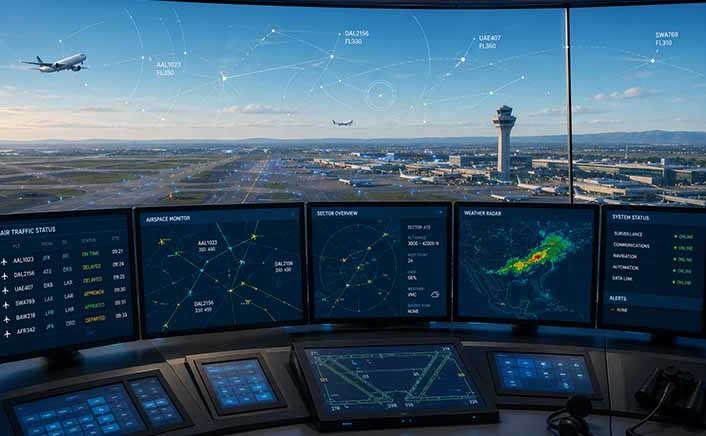
Much of the world’s air traffic control infrastructure was built decades before current flight volumes were anticipated. The disconnect between outdated systems and increasing demand is precisely what fuels the Global Air Traffic Management Market, which was valued at USD 19.3 billion in 2025 and is expected to grow to USD 34.2 billion by 2033, with a CAGR of 7.50%.
The Scale of What’s Coming
Industry forecasts predict that global annual passenger numbers will reach nearly 9.7 billion by 2040, exerting significant pressure on infrastructure not originally designed for such density. Radar, voice communication networks, and navigation systems, many built decades ago, are progressively strained due to increasing flight volumes, more complex airspace situations, and escalating cybersecurity needs that were not present when this infrastructure was initially developed.
Access the Full Report Here:https://marksparksolutions.com/reports/air-traffic-management-market
Two National Programs Defining the Modernization Path
In the United States, the FAA’s Next Generation Air Transportation System (NextGen) is advancing towards satellite-based navigation, Automatic Dependent Surveillance-Broadcast (ADS-B), and sophisticated automation tools. ADS-B has notably enhanced aircraft tracking accuracy over conventional radar, particularly in remote or busy airspace where radar coverage has been limited.
Europe’s SESAR initiative is advancing digital control towers, trajectory-based operations, and automated decision-support systems to increase airspace capacity and reduce delays. Both programs focus on replacing traditional hardware-heavy, radar-based infrastructure with advanced digital, data-driven systems that can manage significantly more traffic without proportionally increasing human controller workload.
Download Free Sample Report Here:https://marksparksolutions.com/sample-reports?1061&Download_Free_Sample
Where the Technology Investment Is Actually Concentrated
Grasping this market involves knowing which technologies are currently attracting the most investment.
-
GNSS-based navigation leads the technology landscape at 11.8% share, reflecting aviation’s broader shift toward satellite-enabled precision navigation and performance-based flight operations.
-
ADS-B surveillance holds a 10.6% share, increasingly the preferred method for aircraft tracking in both congested and remote airspace
-
VHF communication systems retain a critical 9.8% share, still foundational across global air traffic control networks even as digital alternatives expand
-
Cloud-based ATM systems are climbing to 8.7% share, as airports and air navigation service providers modernize toward scalable, centralized platforms.s
-
Primary and Secondary Surveillance Radar together hold roughly 15% combined share, still essential for reliable detection in high-density airspace despite the broader shift toward satellite-based alternatives
-
Performance-Based Navigation is growing at 6.8%, prioritized by airlines and regulators for optimized flight paths and reduced fuel burn.
-
AI, machine learning, digital twins, and big data analytics remain smaller individually but collectively signal where the next wave of investment is heading — predictive traffic management and automated decision support rather than simple surveillance.e
This final point is more significant than the percentages imply: the market is clearly shifting from hardware-focused infrastructure to intelligent, connected, automation-focused systems, even though the largest revenue still comes from traditional technologies like GNSS and radar.
The U.S. Leads, But Growth Is Genuinely Global
The United States holds the largest share at 24.8%, supported by an extensive airspace network and ongoing NextGen investments in satellite navigation and automation. China comes second with 12.6%, driven by fast-growing airport infrastructure and increasing domestic air travel at key aviation hubs.
Within Europe, Germany (7.4%), the UK (6.8%), and France (6.3%) continue to lead through SESAR-led investments in digital towers and airspace management. Japan holds a 5.7% share, adopting advanced surveillance and automation to enhance international connectivity. Meanwhile, India emerges as a high-growth market at 5.1%, driven by ongoing airport expansion and increasing passenger numbers.
Smaller yet strategically important markets complement the overall picture: Canada (3.8%) demonstrates the demand for satellite-based surveillance across extensive geographic airspace; Singapore (2.9%) serves as a regional hub for aviation technology; and the UAE (2.7%) keeps investing in smart airport infrastructure to bolster its position as a key international aviation corridor.
A Competitive Field Built on Decades of Aviation Systems Expertise
The market relies on well-known aerospace and defense technology providers such as Thales, RTX Corporation, Leonardo, Indra Sistemas, L3Harris Technologies, Honeywell International, Frequentis, Saab, SITA, and Lockheed Martin. These companies compete primarily on system reliability, their ability to integrate with existing infrastructure, and, increasingly, on how effectively their platforms support automation and AI-driven decision-making—key factors in the industry’s next phase.
Where This Heads Next
As passenger numbers approach 9.7 billion and the rollout of NextGen and SESAR continues over several years, the transition from radar-based systems to satellite-enabled, cloud-based, and AI-supported air traffic management is likely to speed up. Developed aviation markets are expected to lead the adoption of new technologies in the short term. At the same time, emerging economies will propel the next phase of growth through airport expansion and infrastructure upgrades.
Aviation authorities, air navigation service providers, and technology vendors assessing this market can access comprehensive segmentation by technology, country, and competition through Mark & Spark Solutions’ detailed market study.
Organizations exploring specific modernization programs, regional opportunities, or emerging ATM technologies are welcome to request a tailored data excerpt aligned to their strategic priorities.
Media Contact
Company Name: Mark & Spark Solutions
Contact Person: Sushil
Email: Send Email
Phone: 9158340999
Address:2nd Floor, Panchsheel Park, Aundh
City: Pune
State: Maharashtra
Country: India
Website: https://marksparksolutions.com/reports/air-traffic-management-market