
3-Ply Stainless Steel Cookware: Market Insights & Buying GuideWith the consumption upgrade and the deepening of healthy eating concepts in the EU and US Cookware markets,3-ply stainless steel cookware has become the core of category growth. The accuracy of importers’ product selection directly determines their market performance in channels such as supermarkets, premium home furnishing stores, and catering supply chains. Different consumption scenarios have differentiated requirements for the material technology, size, function, and compliance certifications of 3-ply stainless steel cookware. Positioning deviations during product selection often lead to inventory backlogs or insufficient market competitiveness. In-depth understanding of the underlying logic of demand in the EU and US markets and mastering precise product selection skills for categories, specifications, and processes are the keys for importers to layout this track. This article will provide a comprehensive product selection and positioning guide for 3-ply stainless steel cookware importers from dimensions such as market fundamentals, consumption characteristics, compliance requirements, and channel strategies, helping to accurately match market demand.Table of Contents
- Core Fundamentals of 3-Ply Stainless Steel Cookware Demand in the EU & US Markets
- Mainstream Consumption Characteristics of 3-Ply Stainless Steel Cookware in the EU & US Markets
- Core Product Dimensions Affecting Importers’ Product Selection
- Hard Requirements of EU & US Compliance Standards for 3-Ply Stainless Steel Cookware
- Product Selection Strategies for 3-Ply Stainless Steel Cookware by Importers in Different Channels
- Category Combination and Differentiated Product Selection Skills for 3-Ply Stainless Steel Cookware
- Key Points for Importers to Control the Quality of 3-Ply Stainless Steel Cookware
- Advanced Product Selection Strategies to Enhance the Competitiveness of 3-Ply Stainless Steel Cookware in the EU & US Markets
1. Core Fundamentals of 3-Ply Stainless Steel Cookware Demand in the EU & US MarketsThe reason why 3-ply stainless steel cookware has become a popular category in the EU and US cookware markets lies in the high alignment between its material characteristics and local consumer demand. The composite process of 3-ply stainless steel achieves dual advantages of uniform heat conduction and material stability. It not only solves the problems of uneven heat conduction and easy burning of the bottom of traditional single-layer stainless steel cookware but also meets the core demand of EU and US consumers for healthy cooking due to its non-chemical coating feature. This is also the key reason why it has become a dual choice for both household and catering sectors besides non-stick cookware.The stock update and incremental demand in the EU and US cookware markets jointly drive the growth of 3-ply stainless steel cookware, and the popularization of induction cookers has further accelerated the market penetration of this category. The supporting rate of induction cookers in residential decoration in many EU and US countries continues to rise, and the magnetic conductivity of 3-ply stainless steel cookware is perfectly compatible with this cooking equipment, becoming an important consideration for consumers when replacing cookware. At the same time, the durability of 3-ply stainless steel cookware is in line with the “long-term use” consumption habit of EU and US consumers. Compared with easily worn coated cookware, its long-term use value with high cost performance is more favored.

2. Mainstream Consumption Characteristics of 3-Ply Stainless Steel Cookware in the EU & US MarketsThe consumer demand for 3-ply stainless steel cookware in the EU and US markets presents core characteristics: set-oriented for household use, single-category-oriented for catering use, large-size-oriented in North America, and refinement-oriented in Europe. In the household consumption scenario, 3-6 piece sets of 3-ply stainless steel cookware are the mainstream choice, usually including basic categories such as frying pans, milk pans, soup pots, and steamers, adapting to the diverse cooking needs of daily three meals. The cost-performance advantage of sets is more attractive to household consumers. In the catering sector, there is a greater preference for large-size, high-durability single-category cookware, such as large-diameter frying pans, large-capacity soup pots, and commercial baking pans, with core demands focusing on heat conduction efficiency and wear resistance.From a regional perspective, the North American market (US, Canada) prefers large-size 3-ply stainless steel cookware. The mainstream size of frying pans is 10-12 inches, and the capacity of soup pots is mostly 4-8L, adapting to the large-portion cooking habits of local families. The European market (Germany, France, Italy) pays more attention to refined design, with higher demand for small-size milk pans (16-18cm) and shallow frying pans (8-10 inches). At the same time, it has stricter ergonomic requirements for the product’s appearance craftsmanship and handle design. In addition, the rise of outdoor cooking trends has made lightweight and portable 3-ply stainless steel cookware a niche consumer hotspot in Europe and the US, providing importers with product selection opportunities in segmented tracks.3. Core Product Dimensions Affecting Importers’ Product SelectionWhen selecting 3-ply stainless steel cookware, importers must first grasp the three core product dimensions: material technology, function adaptation, and structural design. These are the foundations for determining whether the product can meet the demand of the EU and US markets. In terms of material technology, the selection of the base material for 3-ply stainless steel is crucial. Food-grade 304 stainless steel is the standard for the inner layer, the outer layer needs to use high-magnetic-conductivity stainless steel to adapt to induction cookers, and the thickness of the aluminum core in the middle directly affects the heat conduction effect. The aluminum core thickness of mainstream high-quality products is 2-3mm; too thin will lead to uneven heat conduction, and too thick will increase the product weight and affect the user experience.In terms of function adaptation, it is necessary to closely align with EU and US cooking habits. Frying pans should focus on the design of anti-slip patterns and heat-receiving area on the bottom; soup pots should be equipped with stainless steel lids with good sealing performance; baking pans require the depth of the pot body and the curvature of the edge to be suitable for oven use. In terms of structural design, the material and connection method of the handle are the key points. Silicone heat-insulating handles and stainless steel heat-resistant handles are the two mainstream choices, and the welding between the handle and the pot body must be firm, meeting the EU and US consumers’ requirements for use safety. At the same time, the polishing process of the pot body must also meet the standards. Mirror polishing and brushed polishing adapt to the aesthetic needs of premium home furnishing and mass supermarket channels respectively.
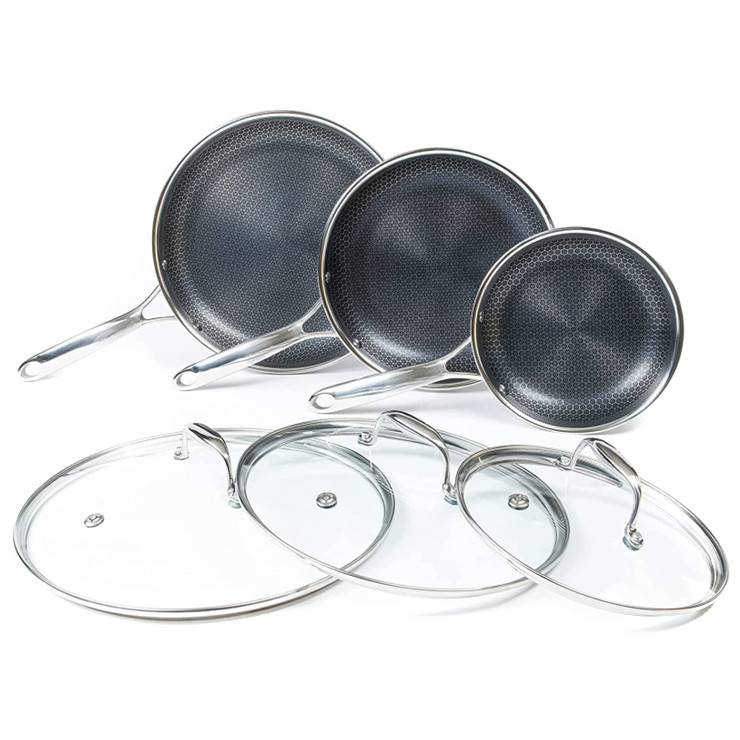
3-Ply Stainless Steel Cookware Selection Parameters for Different EU & US Consumption Scenarios
| Consumption Scenario | Core Demand | Recommended Category | Mainstream Size & Specification | Core Process Requirements |
|---|---|---|---|---|
| Daily Household Cooking in North America | Large Capacity, Multi-Function, Set-Oriented | Frying Pan + Soup Pot + Milk Pan + Steamer (4-Piece Set) | Frying Pan 12 Inches / Soup Pot 6L / Milk Pan 1.5L | Aluminum Core 2.5mm, Induction Cooker Compatible, Silicone Handle |
| Refined Household Cooking in Europe | Small Size, High Appearance, Ergonomics | Frying Pan + Milk Pan + Shallow Soup Pot (3-Piece Set) | Frying Pan 10 Inches / Milk Pan 1.2L / Soup Pot 3L | Brushed Polishing, Stainless Steel Heat-Resistant Handle, Sealed Lid |
| EU & US Commercial Catering | High Durability, High Heat Conduction, Large Size | Single-Category Large-Diameter Frying Pan / Large-Capacity Soup Pot | Frying Pan 14-16 Inches / Soup Pot 10-15L | Thickened Aluminum Core (3mm), Integrated Welding, Wear-Resistant Process |
| EU & US Outdoor Camping | Lightweight, Portable, Easy to Clean | Mini Frying Pan + Portable Soup Pot (2-Piece Set) | Frying Pan 8 Inches / Soup Pot 2L | Lightweight Stainless Steel, Folding Handle, Scratch-Resistant Process |
4. Hard Requirements of EU & US Compliance Standards for 3-Ply Stainless Steel CookwareThe EU and US markets have strict hard requirements for compliance certifications of cookware products. As a food-contact product, 3-ply stainless steel cookware that fails to pass core compliance certifications will directly lose market access qualifications, which is a crucial link that importers cannot ignore during product selection. The core certification for the North American market is FDA certification, which requires all food-contact parts of 3-ply stainless steel cookware to comply with the material safety standards of the US Food and Drug Administration (FDA), prohibits the inclusion of harmful heavy metals such as lead and cadmium, and controls the heavy metal precipitation from the polishing process within the limit.The compliance requirements in the European market are more detailed. The German LFGB certification is the core access standard for the high-end European cookware market. Compared with FDA certification, it has stricter testing for food-contact materials, including multiple indicators such as material stability under high temperature, heavy metal precipitation, and odor emission. At the same time, the EU CE certification is the basic certification for the European market, requiring the product’s design and production to comply with EU general safety standards. In addition, some European countries have requirements for the environmentally friendly packaging of cookware. Importers should also pay attention to the recyclability of product packaging during product selection to align with the environmental protection concepts of the EU and US markets.
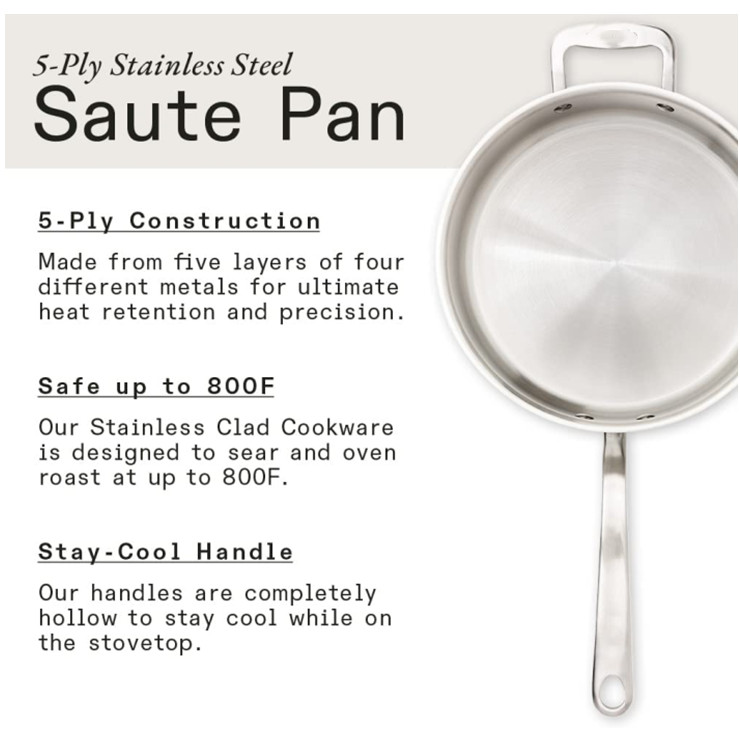
5. Product Selection Strategies for 3-Ply Stainless Steel Cookware by Importers in Different ChannelsImporters’ sales channels directly determine the product selection direction of 3-ply stainless steel cookware. There are significant differences in the product selection logic of supermarket channels, premium home furnishing channels, and catering supply chain channels. Accurately matching channel demand is the core of improving product sales rate. The core demand of supermarket channels (such as Walmart, Carrefour) is high cost performance, standardization, and popular models. When selecting products, priority should be given to basic 3-ply stainless steel Cookware Sets, controlling product costs while ensuring basic requirements for materials and compliance. The packaging design should be concise and clear, highlighting core selling points such as induction cooker compatibility and healthy non-coating.The core demand of premium home furnishing channels (such as high-end home furnishing boutiques, online light luxury home platforms) is high appearance, differentiation, and process upgrading. Product selection can focus on high-end single products with brushed/mirror polishing processes, or upgraded 3-ply stainless steel cookware with copper core and 5-layer steel processes. At the same time, pay attention to the product’s design details, such as personalized handles and simple and light luxury appearance. The packaging should be exquisite to meet the aesthetic and experience needs of high-end consumers. The core demand of catering supply chain channels is high durability, high cost performance, and large size. During product selection, there is no need to focus on appearance craftsmanship; focus on the material thickness and welding firmness of the product, and prioritize pure practical single-category cookware without additional designs to enhance channel competitiveness through the price advantage of bulk procurement.6. Category Combination and Differentiated Product Selection Skills for 3-Ply Stainless Steel CookwareIn the red sea of the EU and US 3-ply stainless steel cookware market, importers’ category combination and differentiated product selection are the keys to building market competitiveness. Avoiding homogeneous product selection is the only way to stand out in the channel. In terms of category combination, importers can adopt the combination strategy of “basic set + segmented single product”. Basic sets meet the core needs of mass consumption and ensure the basic sales of products; segmented single products target niche consumption scenarios, such as outdoor camping models, commercial catering models, and small-size cookware for baby food supplements, filling the gap in segmented market demand and increasing the overall profit margin of products.Differentiated product selection can start from three directions: process upgrading, function addition, and design innovation. In terms of process upgrading, you can choose products with honeycomb non-stick technology on the basis of 3-ply stainless steel, which combines the health of non-coating and the practicality of non-stick, meeting the core pain points of consumers. In terms of function addition, pay attention to 3-ply stainless steel cookware with temperature sensing during product selection, such as frying pans with temperature display on the handle, to enhance the product’s technology sense and use safety. In terms of design innovation, you can choose 3-ply stainless steel cookware with detachable handles, which saves storage space, meets the needs of small-sized EU and US families, and becomes a differentiated selling point in the channel.
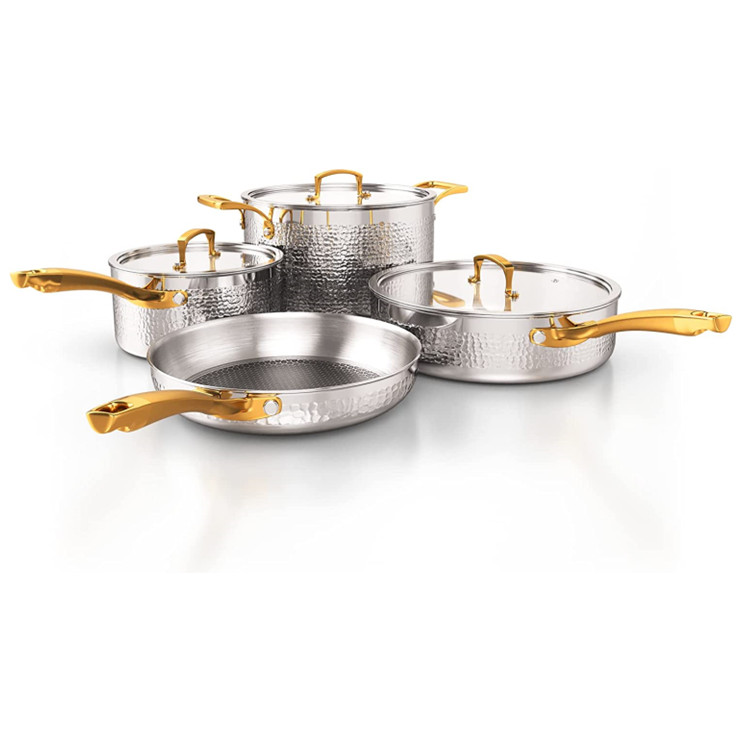
7. Key Points for Importers to Control the Quality of 3-Ply Stainless Steel CookwareThe quality control of 3-ply stainless steel cookware directly determines the product’s market reputation and after-sales costs. Importers need to establish a comprehensive quality control testing standard during product selection and procurement to control product quality from the source. First, material testing: confirm the material testing report provided by the supplier, verify whether the base material and aluminum core thickness of the 3-ply stainless steel are consistent with the publicity, and avoid “shoddy” situations, such as replacing 304 stainless steel with non-food-grade stainless steel or reducing the aluminum core thickness.Second, process testing: focus on checking whether the welding part of the pot body is firm and free of missing welding, whether the pot bottom is flat (to avoid uneven heating when used on induction cookers), and whether the polishing process is free of burrs and scratches; the connection part of the handle needs to be subjected to a pull test to ensure it will not fall off during daily use. Finally, performance testing: conduct actual cooking tests on samples to verify uniform heat conduction and induction cooker compatibility, and conduct high-temperature steaming tests to check for problems such as odor and heavy metal precipitation. In addition, importers should require suppliers to provide complete quality control testing reports and establish a long-term supplier quality control assessment mechanism to ensure the stability of product quality.8. Advanced Product Selection Strategies to Enhance the Competitiveness of 3-Ply Stainless Steel Cookware in the EU & US MarketsTo gain long-term competitiveness in the EU and US 3-ply stainless steel cookware market, importers need to adopt advanced product selection strategies of localization adaptation, supply chain optimization, and branding on the basis of basic product selection. In terms of localization adaptation, it is necessary to in-depth study the cooking culture of the target market. For example, US consumers prefer grilling and frying, so importers can focus on 3-ply stainless steel frying pans with thickened pot bottoms; Italian consumers pay attention to cooking pasta and thick soups, so they can focus on large-capacity soup pots with good sealing performance, making the products accurately align with local cooking habits.In terms of supply chain optimization, importers can choose suppliers that can provide small-batch customization, customize the product’s size, appearance, and packaging according to channel needs, and avoid large-scale inventory backlogs.
At the same time, optimize logistics and warehousing links to ensure timely product supply, meeting the replenishment needs of the EU and US markets. In terms of branding, importers can add mild branding design during product selection, such as simple laser-engraved logos on products and exclusive brand packaging, gradually building brand awareness of their own brands, getting rid of the simple category wholesale model, and improving product added value and market competitiveness.ConclusionThe demand growth of 3-ply stainless steel cookware in the EU and US markets is not accidental, but the result of multiple factors such as material characteristics, consumption concepts, and cooking equipment upgrades. For importers, the core of product selection is not simply choosing “high-quality” products, but products that accurately match market demand, channel positioning, and consumption scenarios. From grasping market fundamentals and consumption characteristics, to complying with compliance standards and matching channel needs, and then to building competitiveness through differentiated product selection and quality control management, every link determines the success or failure of product selection.In the future, the competition in the EU and US 3-ply stainless steel cookware market will shift from simple category competition to competition of “demand matching + value upgrading”. Importers need to continuously pay attention to changes in market demand and optimize product selection strategies to continuously occupy market share in this track. At the same time, the rise of demand in niche segmented scenarios and product innovation through process upgrading will also bring new market opportunities for 3-ply stainless steel cookware importers.
Media Contact
Company Name: Yongkang Proshui Import&Export Co., Ltd.
Email: Send Email
Phone: +8618857924301
Address:No.3 Xiaxi Middle Road, economic development zone
City: YONGKANG
State: ZHEJIANG
Country: China
Website: https://www.proshuicookware.com/