
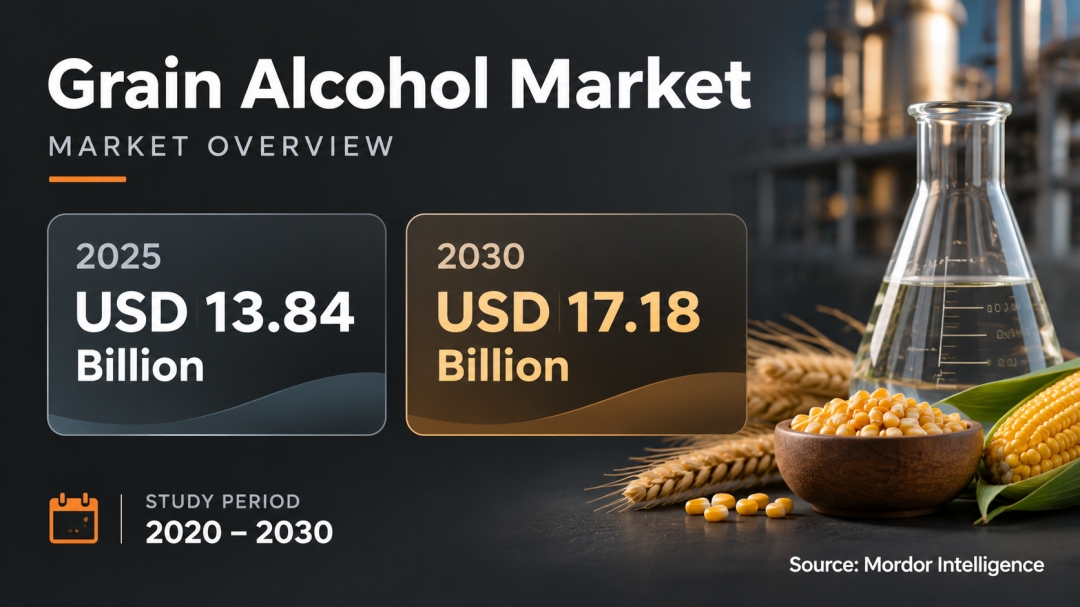
Hyderabad, November 25, 2026: According to Mordor Intelligence, the grain alcohol market size was valued at $13.84 billion in 2025 and is projected to reach $17.18 billion by 2030, registering a CAGR of 4.42% during the forecast period (2025-2030). The market expands as distillers, pharmaceutical formulators, personal care brands, and food processors prioritize high-purity cereal-derived alcohols over conventional commodity spirits. Growing consumer demand for artisanal spirits, expanding medical and cosmetic applications, and national bioethanol blending mandates across emerging economies support steady procurement volumes across distilleries, manufacturing facilities, and retail channels worldwide.
Grain Alcohol Market Trends
Premium and Craft Grain-Based Alcoholic Beverages Drive Spirit Base Demand
One of the leading grain alcohol market trends is the sustained consumer shift toward craft spirits, small-batch bourbons, and artisanal gins distilled from heritage cereal grains. Craft distillers and multinational beverage producers utilize high-purity neutral grain spirits and aged whiskeys to formulate ready-to-drink cocktails and premium botanical spirits. Rising consumer interest in regional provenance, transparent grain mash bills, and allergen-free distillation profiles encourages distillers to source specialized barley, rye, and wheat distillates, supporting the grain alcohol industry.
Pharmaceutical and Personal Care Formulations Expand High-Margin Value
Industrial formulation in healthcare and beauty sectors represents a high-margin expansion pillar within the grain alcohol market share. Pharmaceutical manufacturers utilize United States Pharmacopeia (USP) and European Pharmacopoeia grade ethanol as sterile extraction solvents, tincture carriers, and topical disinfectants. Concurrently, cosmetic and fragrance brands replace synthetic petrochemical solvents with naturally fermented grain ethanol in perfumes, facial toners, and clean-label personal care sprays, aligning with wider quality benchmarks recognized across the integrated food ingredients industry for bio-based processing aids.
Advances in Distillation and Purification Technologies Elevate Output Quality
Processing engineering continues to guide capital investments across the grain alcohol market growth and shape modern grain alcohol market trends. Traditional batch distillation often struggles to eliminate trace congeners, aldehydes, and fusel oils required for ultra-pure medical and botanical extraction grades. Distillers are installing continuous vacuum rectifying columns, activated carbon filtration beds, and membrane pervaporation units that yield 99.9% pure anhydrous ethanol while reducing steam and water consumption across large-scale grain biorefineries.
Corn Anchors Bulk Supply While Rye and Barley Gain Specialty Distilling Share
Feedstock selection continues to guide global production economics across commercial distilleries. Corn accounts for the largest proportion of total raw material volume, holding roughly 66.37% of market share due to high starch yields, established North American dry-milling infrastructure, and valuable animal feed co-products. Meanwhile, specialty grains such as rye and barley are recording accelerated procurement growth among craft whiskey producers seeking spicy flavor notes, while wheat retains a strong position in neutral pharmaceutical spirits.
Check out more details and stay updated with the latest industry trends, including the Japanese version for localized insights: https://www.mordorintelligence.com/ja/industry-reports/grain-alcohol-market?utm_source=abnewswire
Grain Alcohol Market Segmentation
By Source
- Corn
- Wheat
- Barley
- Rye
- Others
By Type
- Ethanol
- Polyols
By Application
- Beverage
- Food
- Pharmaceutical and Nutraceutical
- Personal Care and Cosmetics
- Others
By Geography
- North America
- Europe
- Asia-Pacific
- South America
- Middle East and Africa
North America Retains Revenue Leadership While Asia-Pacific Registers Fastest Growth
Regional production and consumption patterns continue to guide the grain alcohol market forecast. North America commands the largest regional market share, accounting for 36.13% of global revenue, supported by extensive United States corn-milling capacity, mature beverage alcohol consumption, and established pharmaceutical manufacturing hubs. Meanwhile, the Asia-Pacific region represents the fastest-growing market, expanding at a 5.39% CAGR over 2025-2030, propelled by national E10 and E20 fuel-blending mandates, rising disposable incomes, and growing domestic spirits consumption across India and China.
Competitive Landscape of the Grain Alcohol Industry
The grain alcohol industry exhibits a medium level of market concentration, with multinational agribusiness processors, European bioethanol refiners, and regional grain distillers competing across distillation purity, multi-grain sourcing, and bulk distribution logistics. Market leaders strengthen their operational presence by upgrading multi-column rectification plants, securing direct farmer grain contracts, and supplying certified organic and non-GMO neutral spirits.
Congener removal efficiency, pharmacopeia compliance, and energy-efficient dehydration serve as primary areas of operational differentiation. Producers invest in advanced enzymatic liquefaction and automated quality testing laboratories to deliver consistent, odor-neutral alcohol grades across pharmaceutical, cosmetic, and beverage accounts, protecting their grain alcohol market share.
Key Players
Major companies operating in the grain alcohol market include:
- Archer Daniels Midland
- Green Plains Inc.
- Cargill, Inc.
- CropEnergies AG
- Tereos S.A.
Conclusion
The grain alcohol market forecast points toward steady expansion as beverage distillers, pharmaceutical manufacturers, and personal care brands continue prioritizing high-purity, naturally fermented cereal alcohols. Grain processors respond by investing in advanced rectification columns, scaling enzymatic conversion efficiency, and expanding certified organic and specialty grain portfolios to serve high-margin industrial and spirit applications.
Overall, the grain alcohol market size will continue to benefit from rising craft spirit consumption, expanding medical and cosmetic solvent demand, supportive bioethanol blending policies in emerging regions, and ongoing improvements in purification technology. These combined factors support sustained grain alcohol market growth across the global grain alcohol industry.
Explore Our Trending Reports
Canned Alcoholic Beverages Market Size – The global canned alcoholic beverages market is estimated at $37.24 billion in 2026 and is projected to reach $52.18 billion by 2031, growing at a 6.98% CAGR. While hard seltzers held a 32.15% revenue share in 2025, spirit-based ready-to-drink (RTD) cocktails are expanding at a leading 8.58% CAGR as consumers gravitate toward bar-quality formulations in recyclable aluminum packaging. With North America accounting for 54.17% of sales in 2025 and Asia-Pacific pacing fastest at a 7.65% CAGR, beverage companies are optimizing retail cold-box shelf space and introducing sub-5% ABV options to capture moderation-focused demographics.
Alcohol Ingredients Market Share – The global alcohol ingredients market is estimated at $9.02 billion in 2026 and is forecast to climb to $10.99 billion by 2031, advancing at a 4.03% CAGR. While beer accounted for 54.05% of application share in 2025, wine is projected to grow at a 4.68% CAGR alongside sustained momentum in craft spirits. With Europe commanding 33.29% of regional revenue and North America expanding at a leading 4.79% CAGR, ingredient suppliers are scaling regenerative agricultural sourcing and clean-label botanical formulations to satisfy FDA synthetic dye restrictions and corporate net-zero targets.
Non-Alcoholic Beverages Market Growth – The global non-alcoholic beverages market is valued at $1.29 trillion in 2026 and is projected to reach $1.69 trillion by 2031, registering a 5.57% CAGR. Expansion is propelled by consumer demand for functional hydration, clean-label natural ingredients, and rapid product innovation across energy drinks and plant-based dairy alternatives. While North America retains the largest revenue share backed by high per-capita spending, multinational beverage conglomerates and agile challenger brands are introducing smaller portion-controlled packaging and low-sugar formulations to capture shifting wellness preferences.
About Mordor Intelligence:
Mordor Intelligence is a global market intelligence firm, founded in 2014, helping businesses make informed decisions through data-driven insights, industry expertise, and advanced analytics. With 550+ domain experts and on-the-ground specialists across 180+ countries, the company delivers comprehensive intelligence across aerospace & defense, agriculture, automation, automotive, chemicals & materials, consumer goods & services, electronics, energy & power, financial services, food & beverages, healthcare, hospitality & tourism, information & communications technology, and logistics.
Its offerings include syndicated industry reports, custom research and advisory, and subscription platforms such as Data Center Intelligence. Mordor Intelligence is ISO 9001:2015 and ISO/IEC 27001:2022 certified, a member of ESOMAR and the Market Research Society of India, and a four-time Great Place to Work® honoree.
Media Contact
Company Name: Mordor Intelligence
Contact Person: Jignesh Thakkar
Email: Send Email
Phone: +1 617-765-2493
Address:11th Floor, Rajapushpa Summit, Nanakramguda Rd, Financial District, Gachibowli media@mordorintelligence.com
City: Hyderabad
State: Telangana 500008
Country: India
Website: https://www.mordorintelligence.com/industry-reports/grain-alcohol-market?utm_source=abnewswire