
Xi’an, Shanaxi, China – November 17, 2026
Picking the right supplier for a thermal Mass Flow Meter in China isn’t just about who’s got the lowest price. Honestly, there’s a lot more to dig into. You’ve got to think about things like gas compatibility, the accuracy they claim, turndown ratio, how they calibrate, and what kind of after-sales support you’re actually getting. A little compact sensor might be fine for a lab gas line, but if you’re installing it in a plant, you’ll probably need something rugged and with clear maintenance procedures. The small stuff really counts.So, the MarketsandMarkets report on flow meters—it’s really talking about demand across all sorts of process industries, you know, like chemicals, energy, and water management. But here’s the thing: it’s not just about thermal mass meters specifically. That’s a big deal when you’re trying to figure out if their claims actually apply to what you’re looking for. When you’re putting together a supplier shortlist, you really wanna see the nitty-gritty: published specs, calibration data you can trace back, and any relevant testing they’ve done. And of course, don’t forget to ask them straight up—how does performance shift with gas composition, pressure, or flow range? Those details can make or break your decision. Look, a polished data sheet can be pretty handy, but at the end of the day, it just won’t cut it for every question that pops up about your specific site.So, we’re not just slapping a ‘best’ label on any Chinese supplier here—that word means different things to different people, right? Instead, this guide gets into the nitty-gritty: what products they actually offer, how quick their engineering team is to respond, whether they’re flexible with custom orders, what quality checks they’ve got running, and how much export experience they’ve racked up. That’s the stuff that really counts, don’t you think? When you’re browsing for flow meters, you might come across the Sage Thermal Mass Flow Meter too. It’s a good idea to compare specs across different brands to get a clearer picture of what your project really needs. Honestly, some supplier details are tough to verify just from public info. But that’s just a limitation—doesn’t necessarily mean the quality is bad. So, before you pick one, you should totally ask the manufacturer for the most recent tech docs, and like, double-check the key stuff with them. Just to be safe, you know?
 What Thermal Mass Flow Meters Measure and Where They Are Used
Thermal mass flow meters measure the mass of gas passing through a pipe, rather than relying only on its volume. Many designs heat a sensing element and compare its temperature with a second sensor. Moving gas carries heat away; the meter uses that change to calculate flow. The reading can be useful when gas temperature or pressure varies. It is not magic, though.These meters are used for compressed-air monitoring, gas blending, boiler combustion control, and process-gas measurement. On a factory line, they can help identify air leaks by tracking flow during quiet production periods. Some models measure very low flows and have no moving parts. Gas composition still matters. A meter calibrated for one gas may give unreliable results with another, so confirm the gas type, operating range, and installation conditions before selecting equipment.Tips: Check whether the pipe must be full, and follow the specified straight-run requirements. Keep the sensor clear of dust, oil, or moisture where possible. Small installation details matter. It is easy to overlook them. Calibration and periodic checks help reveal drift, but actual performance depends on the application.
How Thermal Mass Flow Meters WorkHow Thermal Mass Flow Meters Work
A thermal mass flow meter measures how quickly a moving gas carries heat away from a heated sensor. A second sensor tracks the gas temperature, helping the instrument compensate for changes in inlet conditions. As gas flows past the heated element, it removes heat; the meter converts that cooling effect into a mass-flow reading. More flow generally means greater heat transfer.
Simple idea.
The electronics still need calibration for the gas being measured, because different gases carry heat differently. A setting for air may not suit nitrogen or a changing gas mixture.
Some meters keep the sensor at a fixed temperature above the gas and measure the power needed to maintain it. Others apply steady power and measure the resulting temperature difference. Both approaches depend on the relationship between heat transfer and mass flow.
Installation matters: pipe size, sensor placement, contamination, and changing gas composition can affect readings. That part is easy to overlook.
The U.S. Department of Energy’s Improving Compressed Air System Performance: A Sourcebookestimates that compressed-air systems use about 10% of industrial electricity in the United States. That figure explains why reliable Flow Monitoring can matter for energy management, though a meter alone cannot identify leaks or waste.
Check the calibration gas, operating range, and installation conditions before trusting a reading.
Main Meter Types and Key Specifications
A Thermal Mass Flow Meter measures gas mass flow through heat transfer, without a moving rotor.
Insertion probes suit large ducts: a slim heated sensor enters through a fitting, leaving most of the line untouched. Inline meters place the sensor inside a defined passage and are often easier to calibrate consistently. Both may use constant-temperature or constant-power measurement. Ask which method the instrument uses, and check its gas, pressure, temperature, and flow-range limits.
Compare accuracy, turndown ratio, response time, pressure drop, and stated calibration conditions. A clean-air calibration may not represent a process gas; gas composition changes heat-transfer behavior. ISO 14511:2019 describes performance evaluation for thermal mass flowmeters in closed conduits. For uncertainty reporting, NIST Technical Note 1297 explains that an expanded uncertainty with coverage factor k = 2 corresponds to approximately 95% confidence under common assumptions. That is a reporting convention, not a guarantee of meter accuracy. A practical caveat: published specifications can look precise while installation effects remain messy. Check straight-run requirements, probe orientation, and whether the quoted accuracy applies to reading or full scale.
China’s Thermal Mass Flow Meter Supplier Landscape
China’s thermal mass flow meter supplier landscape is broad, but it is not uniform. Suppliers range from component-focused factories to engineering teams that configure complete instruments for gas measurement. Their strengths may include compact sensor heads, stainless-steel flow paths, and controller options for 4–20 mA or digital outputs. Details matter.Buyers should look beyond catalog ranges. Ask how the unit is calibrated, which gas was used, and whether certificates identify the test conditions. A Thermal Mass Flow Sensor calibrated for nitrogen may not deliver the same accuracy on a different gas without suitable compensation. Request repeatability data, zero-drift results, and a sample report tied to the instrument’s serial number. These checks make comparisons more useful than a low quoted price.Supplier support varies. Some teams can adapt probe length, wetted materials, or communication settings; others depend on standard models and external calibration partners. Confirm lead time, spare-part availability, and how the supplier handles installation in pipes with vibration or changing temperatures. A polished brochure is not proof. In practice, documentation can be uneven, and even a technically sound meter may need site testing before commissioning. That gap deserves attention, especially when gas composition or operating pressure changes.
How to Evaluate Supplier Quality and Technical Capability
Choosing a thermal mass flow meter supplier requires more than comparing quotations. Ask how the instrument performs with your actual gas, flow range, pressure, and temperature. A capable supplier should explain its sensing principle, calibration method, stated accuracy, and response time in plain terms. Request sample calibration records and check whether test conditions match your process. Details matter.
Technical support is another quality signal. Share a realistic operating case, such as low flow during startup and dusty gas at full load. Look for specific answers about installation length, moisture sensitivity, maintenance intervals, and fault diagnosis. If your project also considers an Ultrasonic Mass Flow Meter, ask the supplier to compare measurement principles and suitability rather than treating the technologies as interchangeable. Test it.
Tips: Verify calibration traceability, warranty boundaries, spare-part availability, and response times in writing. Ask for a witnessed demonstration using a reference flow. Listen for limitations, not just promises. A supplier may still be learning your application; acknowledge that possibility and validate assumptions before purchase.
Comparing Products for Different Industrial Applications
Thermal mass flow meters suit gas lines where operators need direct mass-flow readings without separate pressure and temperature compensation. Yet “best” depends on the gas, operating range, and installation—not the catalogue headline. Dry compressed air, nitrogen, and natural gas each place different demands on sensor calibration and materials. Gas composition matters. A meter calibrated for one mixture may read inaccurately after the mixture changes.The U.S. Department of Energy’s 2016 compressed-air sourcebook reports that compressed air may consume about 10% of manufacturing electricity. That makes leak surveys and stable low-flow readings useful in many plants. Small leaks matter. For humid or dusty gas, check whether the probe resists fouling and whether maintenance can be performed without disrupting the line. A clean laboratory specification does not always predict performance beside a vibrating compressor.When comparing suppliers in China, request calibration records, stated gas conditions, response-time data, and installation guidance for the actual pipe size. For process gases, confirm that the calibration mixture matches the application. For utility air, prioritize useful turndown and clear diagnostics. I would still treat advertised accuracy cautiously: the specification may depend on ideal conditions. Ask how the meter behaves when flow is low, gas temperature shifts, or the sensor needs cleaning.
China Best Thermal Mass Flow Meter Suppliers?
Comparing Products for Different Industrial Applications
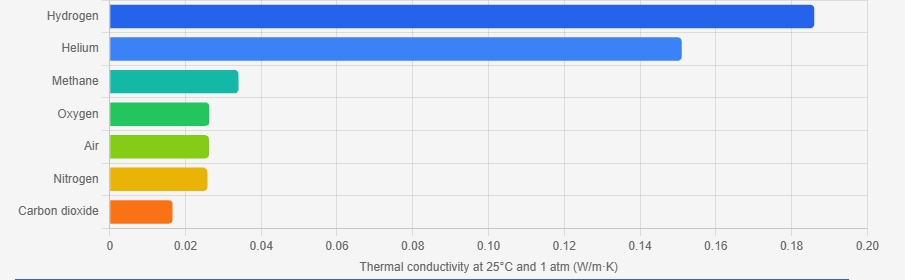
Thermal conductivity is one factor behind a thermal mass flow meter’s response to different gases. Values shown are approximate gas properties at 25°C and 1 atm, not meter accuracy or supplier ratings. Select a meter calibrated for the actual gas and operating conditions; mixed or changing gas compositions may require additional compensation.
How to Verify Suppliers and Plan a Purchase
When evaluating China-based thermal mass flow meter suppliers, check more than price and response speed. Ask for calibration records, instrument range, accuracy conditions, and the gas composition used during testing. For Mass Flow Meter Gas applications, confirm the meter suits your actual pressure, temperature, and expected flow range. A specification sheet alone may not reveal how the unit performs at low flow.Request a sample calibration report and review whether its serial number matches the quoted instrument. Ask how the supplier handles factory acceptance tests, packaging, spare parts, and technical support after delivery. If possible, speak with a customer using a similar gas and process. Details matter. A tidy spreadsheet helps, but it can still hide gaps in test conditions; I would verify those directly.Tips: Send suppliers the same process data and ask each to confirm assumptions in writing. Include gas type, flow range, line size, operating pressure, temperature, and connection requirements. Compare delivery time and warranty terms alongside price. Keep a little time for clarifying questions; specifications are easy to misunderstand, and buyers can miss things too.
China Best Thermal Mass Flow Meter Suppliers? – How to Verify Suppliers and Plan a Purchase
| Evaluation Area | What to Verify | Evidence to Request | Purchase Planning Guidance | Warning Signs |
|---|---|---|---|---|
| Supplier identity and capability | Confirm the legal entity, business scope, manufacturing or assembly location, and whether the seller is the manufacturer or a trading company. | Business registration details, facility information, product documentation, and a clear description of which production and testing steps are performed in-house. | Make sure the contracting entity, quotation, invoice, and payment beneficiary are consistent before placing an order. | Unclear company identity, inconsistent documents, or reluctance to explain where the product is made and tested. |
| Gas and application suitability | Check that the meter is suitable for the actual gas composition, cleanliness, moisture level, pressure, temperature, flow range, and installation conditions. | Datasheet showing the specified gas, operating limits, flow range, process connections, and installation requirements; written confirmation for mixed or unusual gas compositions. | Provide the supplier with the gas composition and minimum, normal, and maximum operating conditions. Do not assume a calibration for one gas applies to another. | Generic assurances without a review of the process conditions or a stated gas basis for the performance figures. |
| Measurement performance | Review the stated accuracy, repeatability, turndown, response time, and applicable flow range, including the conditions under which each specification applies. | Complete datasheet, measurement principle, performance conditions, and a sample calibration report for the proposed model or an equivalent configuration. | Compare specifications on the same basis, including gas, flow range, reference conditions, and whether the figure is expressed as a percentage of reading or full scale. | Performance claims with no defined range, reference conditions, or explanation of how accuracy is calculated. |
| Calibration and traceability | Confirm the calibration method, calibration gas, calibration points, and traceability of the calibration equipment. | Calibration certificate or report identifying the instrument, serial number, calibration conditions, results, and traceability information. If required, verify the calibration laboratory’s relevant accreditation scope. | Specify whether calibration documentation is required for each individual meter and whether the calibration gas must match the application. | A certificate that cannot be linked to the delivered instrument or does not identify the calibration gas and conditions. |
| Quality management | Assess the supplier’s quality controls for incoming materials, production, final inspection, nonconforming products, and corrective actions. | Current quality-management certificate, where applicable, plus inspection or test procedures relevant to the product. Verify certificate validity and scope with the issuing body. | Use certification as one part of due diligence; also review product-specific test records and the supplier’s ability to support the order. | Expired or unverifiable certificates, or certificates whose scope does not cover the stated activity. |
| Materials and process connections | Match wetted materials, seals, sensor construction, and connection type to the gas, pressure, temperature, and site requirements. | Material list, connection drawing, pressure and temperature limits, and confirmation of seal compatibility for the stated gas. | Record the connection standard, size, orientation, and required material in the purchase specification to avoid interchange or installation issues. | Material descriptions that are incomplete or pressure limits that are not stated for the proposed configuration. |
| Electrical and communications | Confirm supply voltage, output signals, communication protocol, wiring, enclosure protection, and any hazardous-area requirements. | Wiring diagram, interface specification, applicable ingress-protection rating under IEC 60529, and valid certification documents if hazardous-area use is required. | List the required output and protocol—such as an analog 4–20 mA signal or a specified digital interface—and confirm compatibility with the control system. | Undocumented signal behavior, missing wiring information, or a certification claim that does not cover the intended installation. |
| Testing and inspection | Establish what inspections and functional tests are performed before shipment and what acceptance criteria apply. | Factory acceptance test procedure, final inspection checklist, test results, and photographs or records tied to the order where appropriate. | Agree in writing on any witness inspection, documentation package, and acceptance requirements before production begins. | Testing described only as “standard” with no defined records or acceptance criteria. |
| Delivery and commercial terms | Clarify production lead time, shipping method, packaging, delivery term, payment milestones, and responsibility for duties and transport. | Itemized quotation, order confirmation, packing details, stated delivery term, and a delivery schedule with any assumptions identified. | Compare total landed cost, not just unit price. Confirm the exact model, options, accessories, documents, and delivery destination on the purchase order. | Unspecified delivery terms, changing payment instructions, or quotations that omit required accessories and documentation. |
| Warranty and after-sales support | Review warranty duration and coverage, exclusions, return procedure, spare-parts availability, and technical support arrangements. | Written warranty terms, troubleshooting procedure, support contact route, and recommended spare-parts list where relevant. | Clarify how faults are assessed and who pays for return freight, replacement parts, or service outside the warranty scope. | Verbal-only warranty promises or no defined process for addressing a defective or incorrectly configured meter. |
| Recommended purchase sequence | Move from application review to technical confirmation, supplier checks, commercial comparison, and final order review. | Application data sheet, written technical offer, supporting certificates, calibration requirements, and a signed order specification. | Approve the technical configuration first, resolve deviations in writing, then compare quotations using the same scope and delivery assumptions. | Placing an order based on a brief product description or price alone without confirming configuration and documentation. |
Conclusion
This article explains what a Thermal Mass Flow Meter measures and why it is used in industrial processes that require accurate gas-flow monitoring. It describes the basic operating principle, then introduces common meter types and the specifications buyers should compare, such as measurement range, accuracy, response time, and compatibility with process conditions.It also surveys China’s supplier landscape without focusing on individual brands and outlines how to assess a supplier’s manufacturing quality, technical support, and testing capabilities. Practical guidance helps readers match meter designs to different applications, verify supplier information, clarify project requirements, and plan a purchase. Together, these topics offer a structured way to compare products and make an informed selection based on performance needs, installation conditions, and long-term service expectations.
About Us
Customized manufacturing of sensor and control instrument.
Over the last 10 years, the volltel factory has professional production experience and quality control system.
The plant employs over 50 people are dedicated to R&D and production in pressure and level measurement.
Media Contact
Company Name: XIAN Volltel Measurement Technology Co., Ltd.
Contact Person: Media Relations
Email: Send Email
Country: China
Website: https://www.volltelsensor.com/