
Hyderabad, November 17, 2026:
IT Hardware Market Overview
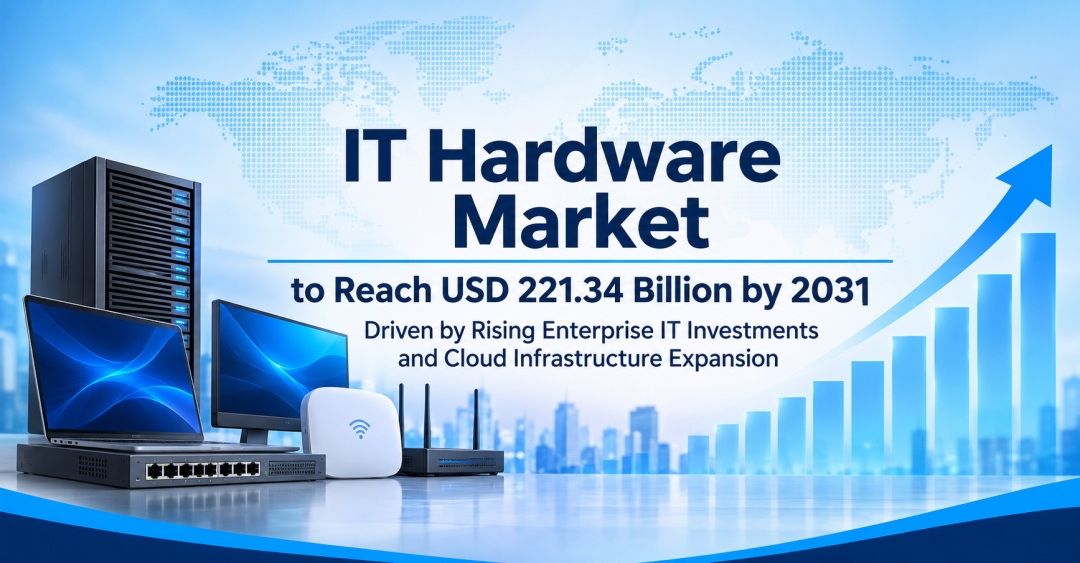
The IT hardware market size was valued at USD 141.15 billion in 2025 and is estimated to increase from USD 152.13 billion in 2026 to USD 221.34 billion by 2031, registering a CAGR of 7.78% during the forecast period (2026–2031). The IT hardware market is supported by increasing investments in enterprise computing infrastructure, rising adoption of cloud-based services, and growing requirements for reliable data storage and network connectivity. Businesses across industries depend on computers, servers, storage systems, networking equipment, and connected devices to manage daily operations, maintain information security, and support digital services. As organizations expand their IT infrastructure, demand for hardware that offers dependable performance, compatibility, and long-term operational value remains an important purchasing consideration. Hardware procurement also reflects changing workplace requirements, including distributed teams, hybrid working arrangements, and the need for computing resources across multiple business locations.
The IT hardware industry serves a broad customer base, ranging from individual computer users and small businesses to government organizations, financial institutions, healthcare providers, manufacturers, and cloud service operators. Enterprise requirements vary according to workload intensity, storage capacity, network performance, and deployment preferences. While some organizations continue investing in on-premise infrastructure, others purchase hardware to support cloud environments, edge computing, and connected industrial applications. These requirements influence the IT hardware market share across product categories and distribution channels. Manufacturers and suppliers are consequently focusing on product reliability, energy efficiency, security features, and integration capabilities to address different customer requirements.
Key Trends Shaping the IT Hardware Market
Growing Enterprise Demand for Computing Infrastructure
Businesses across financial services, healthcare, manufacturing, education, and other sectors require dependable computing equipment to support their operational activities. PC client devices remain important for employee productivity, while servers and storage devices support business applications, information management, and internal systems. Organizations are also reviewing their existing hardware infrastructure to address changing workload requirements and improve system reliability. These purchasing priorities support demand across the IT hardware industry, particularly among enterprises upgrading outdated equipment or expanding their computing capacity.
Rising Requirements for Data Storage and Networking Hardware
The increasing volume of business information, digital transactions, and connected applications creates ongoing requirements for storage and networking infrastructure. Organizations need hardware capable of supporting data access, information transfer, backup operations, and communication between different systems. Storage devices and networking hardware therefore remain important components of enterprise IT investments. Cloud service providers and telecom operators also require reliable infrastructure to maintain service availability and support customer workloads. These requirements contribute to the IT hardware market trends, with procurement decisions increasingly influenced by scalability, compatibility, and performance requirements.
Increasing Adoption of Edge Computing and IoT Infrastructure
Connected devices and industrial applications are creating additional requirements for hardware deployed closer to data collection points. Edge and Internet of Things (IoT) gateways help organizations manage device connectivity, process information, and communicate with centralized systems. Manufacturing facilities, industrial operators, and other businesses use connected infrastructure to support equipment monitoring, operational visibility, and information exchange. These applications create opportunities for hardware suppliers serving customers with specialized deployment requirements. The IT hardware market growth is also influenced by organizations seeking equipment that can operate reliably across different environments and support their existing technology infrastructure.
Expanding Cloud Infrastructure and Flexible Deployment Requirements
Cloud adoption is influencing hardware purchasing decisions among enterprises and service providers. Cloud infrastructure requires servers, storage devices, networking equipment, and supporting components to maintain computing environments and deliver digital services. At the same time, organizations continue to operate on-premise infrastructure where internal control, regulatory requirements, and application compatibility influence deployment decisions. Hybrid environments combine these approaches, creating demand for hardware that integrates with different infrastructure arrangements. These purchasing preferences remain important considerations in the IT hardware market forecast, particularly as businesses evaluate infrastructure requirements alongside operational costs and long-term maintenance.
Check out more details and stay updated with the latest industry trends, including the Japanese version for localized insights:
IT Hardware Market Segmentation
The report segments the IT hardware market across product types, end users, deployment environments, distribution channels, and geographical markets.
-
By Product Type: PC Client Devices, Servers, Storage Devices, Networking Hardware, Peripherals and Accessories, and Edge and IoT Gateways.
-
By End User: Enterprise, Government and Public Sector, BFSI, Healthcare, Education, Media and Entertainment, Cloud Service Providers, Telecom Operators, and Manufacturing and Industrial.
-
By Deployment Environment: On-Premise and Cloud.
-
By Distribution Channel: Direct / OEM, System Integrators, Value-Added Resellers, and Online Retail.
-
By Geography: North America (United States, Canada, and Mexico); South America (Brazil, Argentina, Colombia, and Rest of South America); Europe (Germany, United Kingdom, France, Italy, Spain, Russia, Netherlands, and Rest of Europe); Asia-Pacific (China, Japan, South Korea, India, Australia, Singapore, and Rest of Asia-Pacific); and Middle East and Africa (Saudi Arabia, United Arab Emirates, Rest of Middle East, South Africa, Egypt, and Rest of Africa).
Explore Our Full Library of Technology Media and Telecom Research:
https://www.mordorintelligence.com/market-analysis/technology-media-and-telecom?utm_source=abnewswire
Key Players in the IT Hardware Industry
The competitive landscape includes established hardware manufacturers and technology companies serving consumer, enterprise, and infrastructure requirements. HP Inc. offers personal computing devices, printers, and related hardware products for individual and business customers. Samsung Electronics Co. Ltd. participates in the hardware ecosystem through its computing components, memory products, and electronic devices. Intel Corporation supplies processors and semiconductor technologies used across personal computers, servers, and enterprise computing systems.
Dell Technologies Inc. provides personal computers, enterprise servers, storage solutions, and supporting infrastructure for business customers. Acer Inc. maintains a presence in the computing hardware segment through laptops, desktops, and related devices. Competition across the IT hardware market share is influenced by product performance, pricing, distribution networks, technical support, and the ability to meet changing customer requirements. Companies also compete through product portfolios that address different computing environments and purchasing priorities.
Explore more insights on IT hardware competitive landscape:
Conclusion
The IT hardware market continues to serve as an essential part of business computing, digital infrastructure, and connected operations. Demand across personal computing, enterprise servers, storage systems, networking equipment, and edge infrastructure reflects the varied requirements of organizations and individual users. Purchasing decisions remain influenced by performance, reliability, compatibility, deployment preferences, and overall infrastructure costs.
As businesses and service providers continue investing in their computing environments, hardware manufacturers have opportunities to address changing enterprise requirements and specialized applications. The IT hardware market outlook will depend on infrastructure spending, cloud adoption, connected device deployment, and the ability of suppliers to deliver products suited to different customer needs. Mordor Intelligence provides detailed analysis of these developments, competitive positioning, market segmentation, and regional opportunities to support informed business decisions.
About Mordor Intelligence:
Mordor Intelligence is a global market intelligence firm, founded in 2014, helping businesses make informed decisions through data-driven insights, industry expertise, and advanced analytics. With 550+ domain experts and on-ground specialists across 180+ countries, the company delivers comprehensive intelligence across aerospace & defense, agriculture, automation, automotive, chemicals & materials, consumer goods & services, electronics, energy & power, financial services, food & beverages, healthcare, hospitality & tourism, information & communications technology, and logistics.
Its offerings include syndicated industry reports, custom research and advisory, and subscription platforms such as Synapse, Data Center Intelligence, and Robotics Intelligence. Mordor Intelligence is ISO 9001:2015 and ISO/IEC 27001:2022 certified, a member of ESOMAR and the Market Research Society of India, and a four-time Great Place to Work® honoree. Learn more at mordorintelligence.com.
Media Contact
Company Name: Mordor Intelligence Private Limited
Contact Person: Jignesh Thakkar
Email: Send Email
Phone: +1 617-765-2493
Address:11th Floor, Rajapushpa Summit, Nanakramguda Rd, Financial District, Gachibowli
City: Hyderabad
State: Telangana 500008
Country: India
Website: https://www.mordorintelligence.com/