
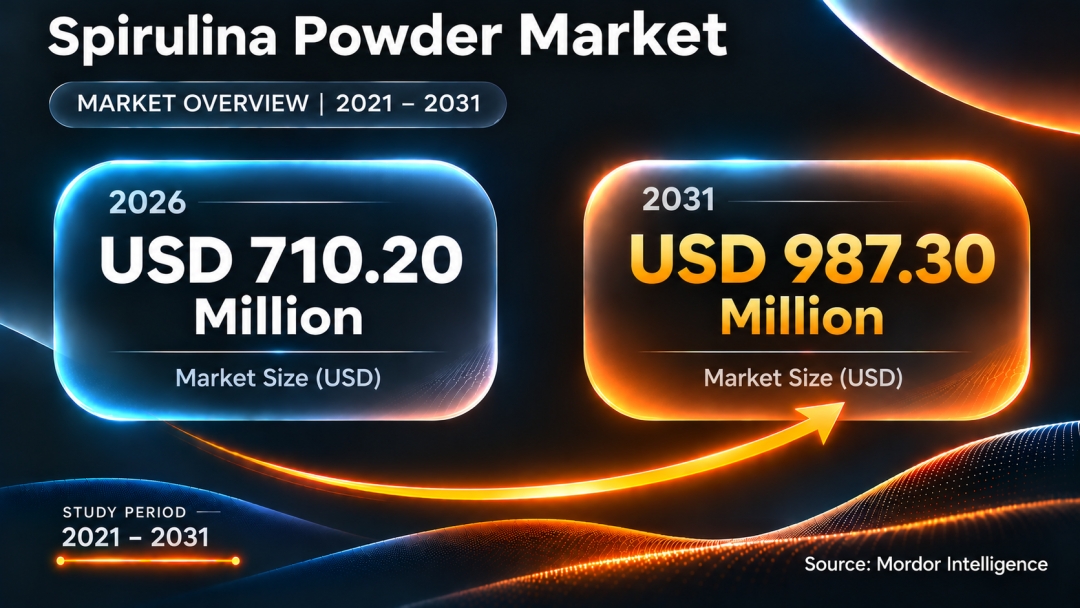
Hyderabad, November 17, 2026: According to Mordor Intelligence, the spirulina powder market size is projected to reach $710.20 million by 2026 and is expected to reach $987.30 million by 2031, reflecting a CAGR of 6.81% during the forecast period (2026-2031). The market expands as commercial food formulators, dietary supplement brands, and animal feed manufacturers incorporate nutrient-dense microalgae into daily consumer goods. Growing demand for plant-based protein fortification, widening regulatory pathways for natural blue colorants, and stronger consumer interest in antioxidant-rich wellness products support steady procurement volumes across retail stores, nutraceutical plants, and food processing facilities worldwide.
The spirulina powder market growth is also shaped by a widening structural divide between low-cost commodity suppliers and specification-led producers investing in controlled cultivation. Leading microalgae processors are directing capital toward closed photobioreactor systems, automated raceway pond monitoring, and third-party organic certifications. These operational investments help suppliers eliminate heavy metal contamination and microcystin risks while maintaining high phycocyanin pigment purity and consistent amino acid profiles. Together, these factors strengthen the integrated spirulina powder market forecast across mature wellness economies and developing food manufacturing regions.
Key Trends in Spirulina Powder Market
Clean-Label Natural Blue Colorants and Beverage Reformulation Drive Phycocyanin Adoption
One of the leading spirulina powder market trends is the rapid substitution of synthetic petroleum-based dyes with plant-derived pigments across packaged foods and beverages. Regulatory actions in North America and Europe restricting artificial color additives have prompted beverage bottlers, confectionery makers, and dairy processors to adopt blue spirulina extract. Phycocyanin delivers vivid blue and vibrant green hues when blended with natural yellows such as turmeric or safflower, satisfying consumer expectations for clean-label ingredient lists without artificial chemical dyes. This ongoing reformulation across functional drinks and snack foods supports the spirulina powder industry.
Premiumization of Nutraceuticals and Sports Nutrition Accelerates Organic Grade Demand
Nutritional density represents an expanding development area within the spirulina powder market share. Dried spirulina biomass contains between 55% and 70% complete protein by weight, alongside bioavailable iron, B-complex vitamins, and gamma-linolenic acid. Active fitness consumers and wellness shoppers increasingly seek certified organic spirulina powders and multi-ingredient superfood blends for post-workout recovery and immune support. Ingredient suppliers are deploying gentle low-temperature spray drying and nitrogen-flushed barrier packaging to preserve heat-sensitive phytonutrients and prevent oxidative marine off-notes, aligning with wider quality benchmarks recognized across the integrated food ingredients industry for clean-label functional nutrition.
Closed-Pond Photobioreactors Enhance Batch Traceability and Purity Standards
Production technology selection continues to guide capital allocation across the spirulina powder market growth. Traditional open-pond raceway cultivation accounts for the largest proportion of global biomass volume due to lower capital overhead and direct solar energy utilization in warm, arid climates. Concurrently, closed-pond systems and tubular photobioreactors are gaining traction among premium ingredient suppliers. Enclosed cultivation isolates Arthrospira platensis cultures from airborne dust, bird droppings, and wild algal contaminants, enabling producers to meet strict pharmaceutical and infant nutrition purity specifications year-round.
Check out more details and stay updated with the latest industry trends, including the Japanese version for localized insights: https://www.mordorintelligence.com/ja/industry-reports/spirulina-powder-market?utm_source=abnewswire
Spirulina Powder Market Segmentation
By Grade
-
Conventional
-
Organic
By Color
-
Green Spirulina
-
Blue Spirulina
By Application
-
Food and Beverages
-
Pharmaceuticals and Nutraceuticals
-
Cosmetics and Personal Care
-
Animal Feed and Aquaculture
-
Others
By Production Technology
-
Open-Pond Cultivation
-
Closed-Pond / Photobioreactor
By Geography
-
North America
-
Europe
-
Asia-Pacific
-
South America
-
Middle East and Africa
North America Retains Revenue Leadership While APAC Anchors Global Biomass Output
Regional production and consumption patterns continue to guide the spirulina powder market forecast. North America commands the largest regional market share of global revenue in 2025, supported by strong dietary supplement consumption, active natural colorant reformulation by major food corporations, and domestic smart-farming investments such as DIC Corporation’s $8 million facility expansion in California. Meanwhile, the Asia-Pacific region serves as the primary global production hub and records rapid domestic consumption growth, driven by large-scale open-pond farms across China and India alongside rising middle-class spending on functional wellness foods.
Competitive Landscape of the Spirulina Powder Industry
The spirulina powder industry is divided between high-volume Asia-Pacific producers competing on bulk pricing and vertically integrated specialty suppliers competing on traceability, certifications, and application engineering. Leading companies differentiate themselves through USP verifications, smart-farming expansions, and direct partnerships with multinational food and beverage formulators.
To stand out from uncertified commodity imports, top producers focus on heavy metal control, microbial safety, and phycocyanin color intensity. They achieve consistent batch quality by using mineral-rich deep ocean water or controlled freshwater aquifers with automated nutrient dosing, alongside micro-granulation and encapsulation technologies to improve cold-beverage dispersibility and tablet compression.
Major producers also prioritize supply chain transparency by operating closed-loop facilities in high-solar-irradiance regions like California, Hawaii, and Southern India. This ensures year-round harvesting and rapid overland logistics to Western brands, backed by ongoing investments in precision aquaculture and clean extraction technologies.
Key Players
Major companies operating in the spirulina powder market include:
-
DIC Corporation
-
Cyanotech Corporation
-
E.I.D. Parry India Ltd
-
Sensient Technologies Corporation
-
Far East Bio-Tec Co., Ltd. (FEBICO)
Conclusion
The spirulina powder market is poised for steady growth, driven by rising demand for clean-label natural colorants, plant-based protein, and antioxidant-rich supplements across food, beverage, and personal care applications. To meet these needs, producers are scaling controlled cultivation systems and refining phycocyanin extraction to deliver stabilized blue powders suited for diverse manufacturing conditions.
Commercially, the market benefits from complementary regional strengths: North America leads in high-value supplement demand and synthetic dye reformulation, while Asia-Pacific anchors global supply alongside growing domestic wellness consumption. Combined with broader retail availability and ongoing advancements in microalgae cultivation, these factors reinforce sustained long-term expansion for the global spirulina powder industry.
Explore Our Trending Reports
Yellow Pea Protein Market Size: The global yellow pea protein market is estimated at $1.52 billion in 2026 and is projected to reach $2.29 billion by 2031, growing at an 8.51% CAGR. Demand is driven by food and beverage manufacturers substituting dairy and animal inputs with non-GMO, soy-free, allergen-friendly plant proteins across ready-to-drink shakes, nutritional powders, and clinical formulas. Ingredient processors are concentrating capital expenditure in regions with established pulse cultivation and public financing support, utilizing wet-milling and precision fractionation to improve solubility, neutral flavor profiles, and functional texture.
Lemon Essential Oil Market Share: The global lemon essential oil market is valued at $2.26 billion in 2026 and is forecast to climb to $3.02 billion by 2031, advancing at a 5.97% CAGR. Market expansion is supported by consumer demand for clean-label botanical flavorings, regulatory restrictions on synthetic food preservatives, and rising adoption in aromatherapy and natural cosmetics. While large-scale producers leverage vertically integrated citrus supply chains across Spain, Mexico, and India, specialized processors are deploying supercritical CO₂ and microwave-assisted extraction to yield high-purity, certified-organic oils.
Cocoa Bean Extract Market Trends: The global cocoa bean extract market is estimated at $578.32 million in 2026 and is projected to reach $758.71 million by 2031, registering a 5.58% CAGR. Growth is propelled by clinical validation of cocoa flavanols for cardiovascular wellness, skin protection, and sports recovery, reinforced by qualified health claims from the U.S. FDA and EFSA. While Europe holds the largest revenue share, Asia-Pacific is expanding at a leading 6.77% CAGR, prompting processors to prioritize traceable, high-margin bioactive extracts across dietary supplements, functional beverages, and cosmeceuticals to buffer raw cocoa bean price volatility.
About Mordor Intelligence:
Mordor Intelligence is a global market intelligence firm, founded in 2014, helping businesses make informed decisions through data-driven insights, industry expertise, and advanced analytics. With 550+ domain experts and on-the-ground specialists across 180+ countries, the company delivers comprehensive intelligence across aerospace & defense, agriculture, automation, automotive, chemicals & materials, consumer goods & services, electronics, energy & power, financial services, food & beverages, healthcare, hospitality & tourism, information & communications technology, and logistics.
Its offerings include syndicated industry reports, custom research and advisory, and subscription platforms such as Data Center Intelligence. Mordor Intelligence is ISO 9001:2015 and ISO/IEC 27001:2022 certified, a member of ESOMAR and the Market Research Society of India, and a four-time Great Place to Work® honoree.
Media Contact
Company Name: Mordor Intelligence
Contact Person: Jignesh Thakkar
Email: Send Email
Phone: +1 617-765-2493
Address:11th Floor, Rajapushpa Summit, Nanakramguda Rd, Financial District, Gachibowli media@mordorintelligence.com
City: Hyderabad
State: Telangana 500008
Country: India
Website: https://www.mordorintelligence.com/industry-reports/spirulina-powder-market?utm_source=abnewswire