
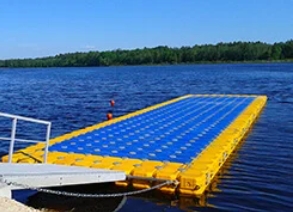
China – November 16, 2026 – Selecting floating dock manufacturers is a procurement decision for marine dealers, waterfront contractors, and installers managing projects across sites or seasons. Buyers need to know whether parts fit together, how changes are documented, and whether matching modules can be ordered later.
Dimensional Fit Between Modular Components
Modular floating systems depend on alignment between cubes, connecting pins, and perimeter hardware. During evaluation, buyers can assemble sample blocks with the actual fastening hardware. Check whether the lugs align as shown in the assembly drawing, whether pins seat as specified, and whether edge accessories fit the intended mounting points.
The approved sample and connection drawing give installation crews a reference when a shipment arrives. If an order will extend an existing dock, provide the manufacturer with the original part numbers, dimensions, and photos of the connection points.
Customization Scope for Project-Specific Layouts
Commercial waterfront builds may need irregular layouts to accommodate shorelines, gangway transitions, and service slips. Establish which requirements can be met with existing modules and which need new tooling or a special production run. A dealer may also need consistent color and labeling across repeat orders.
Before agreeing to a schedule, confirm the minimum quantity, sample approval process, and tooling requirements for any custom color or float shape. Record the approved layout on a drawing and list its components on the purchase specification.
Manufacturing Scale and Equipment Capabilities
For a mixed container order, ask what production capacity is available for the selected modules, colors, and hardware. A factory’s daily output provides context for planning. Request a schedule for the actual order mix, including the date the complete package will be ready for collection.
For dealers replenishing several float types at once, Hisea Dock can bring rotational and blow molding together at its Zhejiang factory. The facility spans more than 5,000 square meters, with a published capacity of up to 1,120 pieces per day. With customers in more than 80 countries, the company is familiar with international supply. Dealers can bring their planned mix of floats and hardware to the first discussion and work out a schedule for repeat orders. Company profile
Quality Documentation and Material Verification
Buyers supplying marinas or institutional facilities can request current quality management certificates and test reports for the proposed products. Check the issuing body, covered entity, and model references against the purchase specification. For connection tests, request the setup, sample configuration, and recorded result.
When a buyer needs evidence of how the floats hold together, Hisea Dock gives them a concrete result to review. Its published diagonal tensile test recorded a peak force of 14,389 N for the tested configuration. Buyers can use that result to discuss the proposed joints and review the company’s ISO 9001 quality management certification as part of supplier qualification. The working load and exposure limits still depend on the assembled layout and site conditions. Quality and testing
Accessory Integration and System Completeness
A complete order can include float blocks, structural connectors, perimeter hardware, and accessories such as fenders and cleats. Review how each item attaches and ask the supplier to identify the compatible module and hardware on the parts list. Confirm whether shore interfaces or other components come from the supplier or the installer.
Buyers planning field repairs can also use the list to specify spare pins, washers, and perimeter accessories. Packing hardware by installation area can make it easier to check that each crew receives the parts it needs.
Repeat Supply Consistency Across Seasons
A follow-up order may replace worn parts or extend an existing dock. New stock needs to match the original geometry and, where specified, the finish. Ask how the manufacturer identifies production revisions and whether existing drawings or batch references can be used to check compatibility.
For a stocking dealer, it helps to define the standard module and connector combinations that account for most orders. Establish how repeat orders will be confirmed if a part is revised or a particular finish is discontinued.
Structuring Technical Inquiries and Container Orders
Submit the deck dimensions, intended loads, site drawings, required accessories, and destination when requesting a quote. For recurring supply, include expected quantities and the mix of module types. Request an itemized parts list, packing details, and delivery terms so offers can be compared on a common basis.
About The Company
Hisea Dock is a manufacturer of modular floating dock systems and accessories based in Taizhou, Zhejiang, China. Its factory began making floating docks in 2006. The company focuses on helping dealers, marina operators, and waterfront contractors configure modular platforms, walkways, and berths for their sites.
Media Contact
- Company: Hisea Dock
- Email: sale@hsfutong.com
- Phone: +86 576 84278067
- Website: Hisea Dock
Media Contact
Company Name: Hisea Dock
Contact Person: Media Relations
Email: Send Email
Phone: +86 576 84278067
Address:No. 2, Yongfeng Road, Jiangkou Subdistrict, Huangyan District, Taizhou City, Zhejiang Province,China
City: Taizhou
Country: China
Website: https://www.hiseadock.com/