
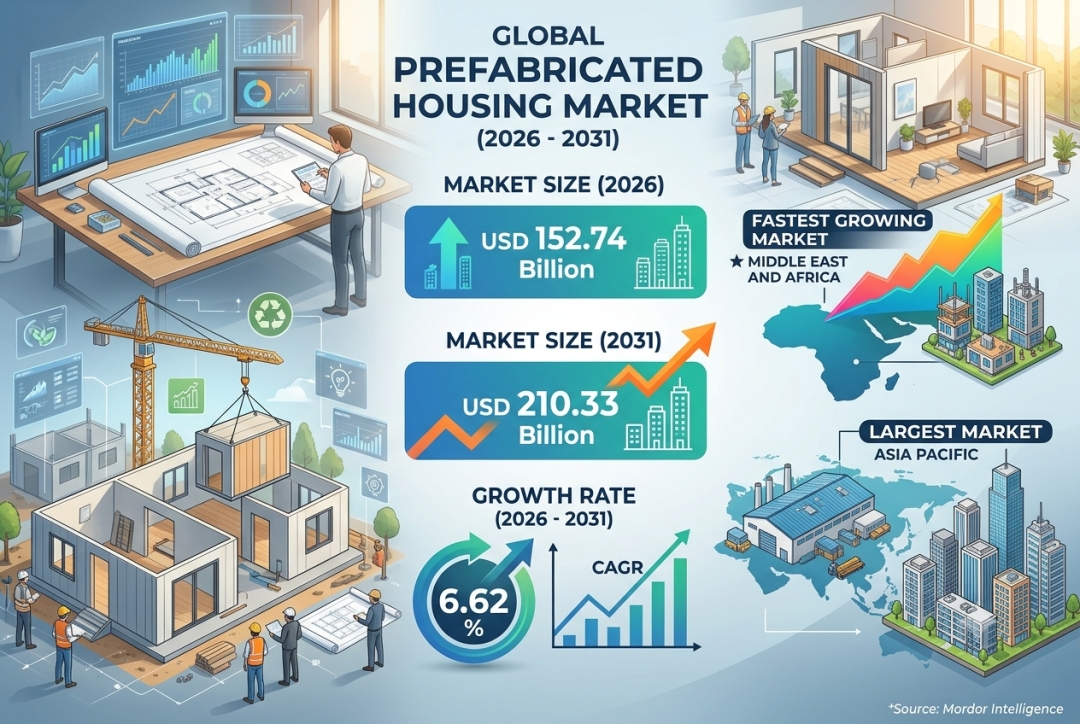
Hyderabad, India, November 13, 2026: According to Mordor Intelligence: the Prefabricated Housing Market Size is expected to grow from USD 143.3 billion in 2025 to USD 152.74 billion in 2026 and reach USD 210.33 billion by 2031, registering a CAGR of 6.62% during 2026-2031. The market is gaining momentum as governments support affordable and sustainable housing, construction companies adopt off-site manufacturing, and housing shortages increase demand for faster construction methods.
Prefabricated housing allows components or complete assemblies to be produced in factories before being transported to construction sites. This approach can shorten project timelines, improve quality control, reduce material waste, and address labor shortages affecting conventional construction.
The Prefabricated Housing Industry is also benefiting from the adoption of Building Information Modeling (BIM), 3-D printing, automated factories, and digital inspection technologies. These technologies are improving production accuracy and supporting greater customization of factory-built homes. Asia-Pacific remained the largest regional market in 2025, while the Middle East and Africa is expected to record the fastest growth during the forecast period.
Prefabricated Housing Market Growth Drivers
Government support strengthens affordable and sustainable housing
Government programs supporting affordable housing and sustainable construction are encouraging the adoption of prefabricated housing. Public funding, updated building codes, and faster approval processes are helping manufacturers expand factory production and improve project pipelines.
Sustainability requirements are also increasing interest in factory-built homes. Timber-based systems and other low-carbon construction solutions are gaining attention as developers seek to meet green-building requirements while maintaining shorter construction schedules.
Housing shortages and urbanization increase demand
Rapid urbanization and housing shortages are creating demand for construction methods that can deliver homes faster than conventional site-built approaches. Prefabricated housing can reduce construction timelines by shifting a large part of the building process into controlled factory environments.
Demand is particularly relevant in densely populated cities where land availability, labor costs, and project delays can affect housing supply. Multi-family projects are also gaining attention as developers look for ways to increase housing density and control construction costs.
Off-site manufacturing improves cost efficiency
Factory-based production allows manufacturers to standardize processes, reduce material waste, and improve quality consistency. Off-site manufacturing can also reduce reliance on on-site labor and provide better control over project schedules.
The growing use of panelized systems, modular construction, and automated production is supporting the competitiveness of prefabricated housing against conventional construction methods. However, high upfront factory investment and transportation costs remain important considerations for manufacturers.
Digital construction technologies improve production
BIM, 3-D printing, LiDAR-based inspection, robotics, and automated production systems are becoming increasingly relevant to the Prefabricated Housing Market. These technologies support more accurate design, manufacturing, inspection, and assembly.
Digital workflows also allow manufacturers to coordinate design and production more efficiently. As technology adoption increases, prefab companies are moving beyond standardized housing toward more flexible and customized solutions.
Access This Report in Japanese: https://www.mordorintelligence.com/ja/industry-reports/global-prefabricated-housing-market?utm_source=abnewswire
Prefabricated Housing Market Segmentation
By material type
The Prefabricated Housing Market is segmented by material type into concrete, glass, metal, timber, and other materials. Timber accounted for the largest share in 2025, supported by growing interest in sustainable construction and low-carbon building materials. The timber segment is also expected to record strong growth during the forecast period.
Concrete continues to support prefabricated construction through precast applications, while steel benefits from improvements in automated fabrication. Glass and composite materials serve specialized applications requiring specific structural and design characteristics.
By type
By type, the market is segmented into single-family and multi-family housing. Single-family construction accounted for the largest share in 2025. However, multi-family projects are expected to grow at a faster pace as urban housing shortages and land constraints encourage higher-density development.
By product type
By product type, the market is divided into modular homes, panelised and componentised systems, manufactured homes, and other prefab types. Manufactured homes held the largest share in 2025, while modular homes are expected to record strong growth through 2031.
Modular construction is gaining attention because it combines factory production with flexibility in design and can reduce on-site labor requirements. Panelized and componentized systems are also being used for projects where transportation and site conditions make complete volumetric modules less practical.
By region
By geography, the Prefabricated Housing Market is segmented into North America, South America, Europe, Asia-Pacific, and the Middle East and Africa.
Asia-Pacific held the largest market share in 2025, supported by large-scale manufacturing capacity, established prefab adoption, urbanization, and growing housing demand. China, Japan, India, South Korea, and Australia are among the key markets in the region.
The Middle East and Africa is expected to register the fastest growth during the forecast period. Demand for rapid construction, disaster-recovery housing, infrastructure development, and labor-saving construction methods is supporting regional adoption. North America and Europe also remain important markets due to technology adoption, government housing programs, sustainability requirements, and established off-site construction capabilities.
Explore Our Full Library of Real Estate and Construction Research Reports: https://www.mordorintelligence.com/market-analysis/real-estate-and-construction?utm_source=abnewswire
Prefabricated Housing Market Key Players
The Prefabricated Housing Market is fragmented, with competition among established manufacturers, modular housing companies, and technology-focused businesses. Major companies covered in the market include Clayton Homes (Berkshire Hathaway), Skyline Champion Corporation, Cavco Industries Inc., Sekisui House Ltd (North America arm), Boxabl Inc., Plant Prefab Inc., Method Homes, Modular Home Builder LLC, BluHomes Inc., Module Housing, Indie Dwell Inc., Connect Homes, FullStack Modular, Weyerhaeuser NR Co. (Engineered Wood Prefab), and MiTek Inc.
Companies are focusing on factory automation, modular construction, vertical integration, digital design, and localized production to improve efficiency and respond to housing demand. The market also includes smaller specialists developing panelized systems, mobile micro-factories, and hybrid modular solutions.
Prefabricated Housing Market Forecast
The Prefabricated Housing Market Forecast remains positive as governments, developers, and construction companies seek faster and more efficient ways to increase housing supply. Rising urbanization, housing shortages, affordable housing initiatives, and sustainability requirements are expected to support demand for factory-built homes.
At the same time, logistics costs for oversized modules, shortages of skilled prefab fabricators and installers, fragmented building codes, and concerns around structural resilience remain challenges for wider adoption. Manufacturers are responding by increasing automation, improving local production capacity, and developing systems that are easier to transport and assemble.
For more insights on this market, please visit the Mordor Intelligence page: https://www.mordorintelligence.com/industry-reports/global-prefabricated-housing-market?utm_source=abnewswire
About Mordor Intelligence
Mordor Intelligence is a global market intelligence firm, founded in 2014, helping businesses make informed decisions through data-driven insights, industry expertise, and advanced analytics. With 550+ domain experts and on-ground specialists across 180+ countries, the company delivers comprehensive intelligence across aerospace & defense, agriculture, automation, automotive, chemicals & materials, consumer goods & services, electronics, energy & power, financial services, food & beverages, healthcare, hospitality & tourism, information & communications technology, and logistics.
Its offerings include syndicated industry reports, custom research and advisory, and subscription platforms such as Synapse, Data Center Intelligence, and Robotics Intelligence. Mordor Intelligence is ISO 9001:2015 and ISO/IEC 27001:2022 certified, a member of ESOMAR and the Market Research Society of India, and a four-time Great Place to Work® honoree. Learn more at mordorintelligence.com.
For any inquiries or to access the full report, please contact:
media@mordorintelligence.com
https://www.mordorintelligence.com
Media Contact
Company Name: Mordor Intelligence
Contact Person: Jignesh Thakkar
Email: Send Email
Phone: +1 617-765-2493
Address:11th Floor, Rajapushpa Summit, Nanakramguda Rd, Financial District, Gachibowli media@mordorintelligence.com
City: Hyderabad
State: Telangana 500008
Country: India
Website: https://www.mordorintelligence.com/