
Shenzhen, Guangdong, China – November 10, 2026
Picking a machining partner isn’t just about comparing prices. Honestly, the right shop can make or break your part accuracy, your delivery schedule, and how much you end up paying for revisions later on. Custom CNC services aren’t all the same either—they differ in the equipment they run, the materials they know how to handle, how they inspect parts, and even how they communicate. Just because a supplier does a great job with aluminum brackets doesn’t mean they’re the right fit for tight-tolerance stainless steel parts. So before you commit, ask them how they read drawings, what they do to check critical dimensions, and how they handle changes once production is already underway. You know, it’s really the little things that count. Take a clearly defined datum, for example—something that simple can save you a ton of confusion down the line, especially when you’re inspecting or assembling a part. Honestly, it makes all the difference.Okay, so before you even think about asking for a quote or placing an order, there are ten practical things worth thinking through. This guide walks you through them. You’ll come across questions about machining capabilities, material selection, tolerances, quality records, lead times, and how much you’re planning to produce. But here’s the thing—don’t just take their word for it. Look for actual proof: sample inspection reports, clear explanations of their process, and realistic delivery dates. Those are good signs. And watch out for a quote that seems too low—it might not include finishing, packaging, or inspection costs. So make sure you’re comparing apples to apples. Even the most experienced buyers can completely miss a requirement, especially when a drawing looks finished and neat. That happens—and it’s worth admitting. So instead of just sending over the print, take a moment to explain what the part actually does, how it’ll be used, and what conditions it has to survive. Then, talk through those assumptions with the supplier. The goal isn’t to find some flawless shop—that doesn’t exist. It’s to find a capable partner who will tell you when something’s off, flag risks early, and support you from the first prototype all the way through repeat production.
 Define Your Part Requirements and Production Goals
Before requesting CNC quotes, define what the part must do, not just how it looks. Identify the material, critical dimensions, tolerance bands, surface finish, and features that contact or fit other components. Mark functional dimensions clearly; applying tight tolerances everywhere can add machining time without improving performance. Include a drawing and a revision-controlled 3D model. Small details matter: a thin wall, deep pocket, or awkward clamping surface can change the process and price.Set production goals just as precisely. State the prototype quantity, expected batch size, annual demand, delivery window, and likely design changes. The U.S. Census Bureau’s 2022 Annual Survey of Manufactures reported roughly $6.9 trillion in U.S. manufacturing shipments, a reminder of the sector’s scale and the importance of planning repeatable production. That figure is broad, not CNC-specific. Still, it supports a practical question: will the part be made once, or reordered in consistent batches? This is not always clean. Demand forecasts can be wrong, so separate confirmed quantities from estimates. Ask suppliers to identify cost or lead-time changes between prototype and production runs, then compare those assumptions against your actual goals.
Check the Provider’s Materials and Machining Capabilities
A CNC provider’s material list should match the part’s real operating conditions, not just the drawing. Ask which grades they can source and whether they can verify material certificates when required. Aluminum may suit a lightweight housing, while stainless steel can handle moisture and repeated cleaning. For plastics, check heat limits and how the material behaves under load. Small differences matter.
Then look beyond the machine list. Ask about available milling and turning capacity, part size limits, achievable tolerances, and surface finishes. A shop may quote a tight tolerance but need extra setups to hold it across several features. That can affect cost and lead time. Request a sample inspection report or discuss how critical dimensions are measured. Details help.
The process should fit your geometry. Deep pockets, thin walls, and long unsupported features can cause vibration or distortion, even on capable equipment. Ask how the team plans to fixture the part and whether design changes could simplify machining. Their questions can reveal useful expertise. A polished capabilities page is not enough. I’d also confirm that the quoted material, inspection steps, and finishing options appear clearly in the written proposal. Some uncertainty may remain until the first part is made, so agree on how feedback and revisions will be handled.
Assess Equipment, Tolerances, and Quality Controls
Choosing a CNC machining service starts with the equipment behind the quote. Ask whether the shop’s mills and lathes can handle your part’s size, material, and geometry. A five-axis machine may reach angled features in one setup, while a simpler part may not need that capability. Check work-envelope dimensions, spindle access, and available probing. These details affect setup choices and repeatability. Ask about the actual machine planned for your order, not just the equipment listed in a brochure.
Tolerances need equal scrutiny. Share a clear drawing, identify critical dimensions, and explain how the part will be used. A tight tolerance on every feature can raise cost without improving function. Ask whether the shop can meet your specified limits consistently, and request measurement results from a comparable job. Specific evidence matters.
Quality controls should cover more than final inspection: look for documented first-article checks, in-process measurements, calibrated instruments, and a process for recording material and inspection data. A coordinate measuring machine can verify complex geometry, but simple features may be checked with gauges or micrometers. Match the method to the feature. I have seen drawings leave finish and datum expectations unclear; that small gap can cause avoidable rework. Clarify it before production starts.
Review Design Support and Communication Practices
When evaluating custom CNC machining services, look beyond a promise to “review your design.” Ask who checks the drawing and what feedback you will receive. A useful review identifies tight tolerances, thin walls, difficult tool access, and unclear datums before production begins. Small details matter. Request marked-up drawings or specific questions, not a vague approval. This helps you understand whether a suggested change affects fit, finish, cost, or lead time.Tip: Send a representative part drawing and ask the team to explain one potential manufacturing risk. Their response can reveal how carefully they assess geometry and whether they distinguish essential tolerances from preferences. For example, a shaft seat may need close control, while an outer cover may not. Ask how material substitutions or finish changes will be documented. Clear records reduce the chance of mismatched expectations later.Communication should have named contacts, agreed response times, and a clear method for approving revisions. Confirm who will notify you if a tool path, inspection result, or material availability creates a delay. Ask for inspection data in a format your team can use. I would also check how questions are handled when a drawing is incomplete; that part is easy to overlook. No process is perfect. A supplier that flags uncertainty early is often more dependable than one that simply says yes.
Design Support & Communication: CNC Vendor Evaluation
Illustrative 1–5 checklist scores—not survey results. Rate each provider using documented evidence from your own design review and communications.
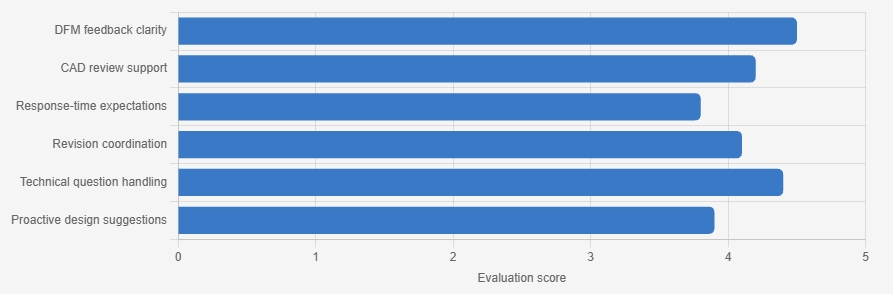
Higher scores indicate stronger support. Review CAD feedback, DFM recommendations, response clarity, turnaround expectations, revision handling, and technical accessibility.
Compare Lead Times, Pricing, and Production Flexibility
A low quote can hide a long queue. Compare lead times using the same drawing revision, material grade, quantity, finish, and inspection requirements. Ask when production starts, not only when shipment is promised. Request separate estimates for prototypes and repeat orders; setup time can change the unit price sharply. The Federal Reserve’s Industrial Production and Capacity Utilization report showed U.S. manufacturing capacity use near 77% in 2024. That broad figure is not a CNC-shop schedule, but it is a reminder to check available capacity rather than assume it.
TIP 1 Ask for a dated timeline with approval, machining, finishing, and shipping milestones.
TIP 2 Compare itemized quotes, including tooling, setup, inspection, and expedited fees.
The Bureau of Labor Statistics tracks producer prices for machine shops, but its index is not a substitute for a job-specific quote. Confirm what each supplier’s price includes.
TIP 3 Test production flexibility with a small, representative order. Ask how the shop handles revised quantities, late design changes, or a second batch. A capable supplier should explain the trade-offs clearly, such as longer delivery for lower unit cost.
One detail is easy to miss: a fast prototype promise may not apply to a large production run. Get both timelines in writing, then compare them against your actual launch date.
Verify Certifications, References, and Post-Delivery Support
A certificate is useful only when its scope matches the work you need. Ask whether the supplier’s quality system covers CNC machining, inspection, and document control. Check expiry dates, audit status, and sample calibration records for measuring tools. Ask for proof. A certificate alone cannot show how a shop handles a tight tolerance or a rejected part. That gap matters.
References can reveal what paperwork cannot. Request contacts from customers who ordered similar materials, part sizes, or tolerances. Ask how the machinist communicated when a drawing needed clarification, and whether delivery dates held up. With permission, review a sample inspection report. Look for measured values, clear units, and traceability to the part or batch. One glowing reference may not tell the whole story; ask for more than one.
Post-delivery support deserves equal attention. Confirm how quickly the supplier responds to questions about fit, finish, or inspection results. Ask whether they retain production and material records, and how they investigate a documented defect. Agree on a practical process for corrective action before placing an order. Small details help: who receives the report, what photos or measurements are needed, and when a response is expected. These questions can feel tedious, and no checklist catches every problem. But vague promises after delivery are harder to fix than clear expectations set beforehand.
OEM Solutions for Mold Fabrication: Precision, Customization, and Production Excellence
OEM Solutions for mold Fabrication
OEM mold fabrication turns a validated prototype into a repeatable production process. Precision begins with matching the tool design to the part’s material, geometry, tolerances, and expected production volume. Grand View Research’s 2024 analysis estimated the global injection-molded plastics market at USD 284.4 billion in 2023, with continued growth projected through 2030—an indication of the scale and variety of products that depend on reliable tooling. For OEM programs, flexible design and fabrication capabilities across plastic injection, stamping, and die casting help meet different housing and component requirements.A capable tooling partner combines experienced designers and mold makers with CAD/CAM/CAE systems and machining processes such as wire cutting, EDM, milling, turning, grinding, and drilling. Mold trials and design reviews help identify issues before mass production, while Analysis for Manufacturability (AFM) and Design for Manufacturability (DFM) recommendations can refine part geometry, simplify tooling, and reduce avoidable production risk. The Manufacturing Institute and Deloitte reported in 2024 that U.S. manufacturers may need 3.8 million additional workers by 2033, with 1.9 million positions potentially unfilled. This workforce outlook reinforces the value of experienced engineering teams and well-planned tooling that support efficient, consistent production.
Conclusion
Choosing the right Custom Cnc Machining Services provider starts with clearly defining your part’s design, material, quantity, tolerance requirements, and production goals. Then confirm that the provider can work with your chosen materials and has the machining equipment, capacity, and quality controls needed to meet your specifications. A capable partner should also offer practical design support, communicate clearly, and explain how it will manage inspection and quality throughout production.Before making a decision, compare lead times and pricing while considering whether the provider can adapt to changing volumes or schedules. Look for relevant certifications, ask for references or examples of similar work, and clarify what support is available after delivery. By weighing technical capability, reliability, communication, and overall value, you can select a machining partner that fits both your immediate project and future production needs.
About Us
Shenzhen Minewing Electronics Co., Ltd. was established in 2003 and has provided integrated solutions for global customers like Bosch, HTC, and Softbank. We are a comprehensive company that integrates Win2000 Telecom Co., Ltd. and Shenzhen Kelion Technology. We have been manufacturing products that cover most of our lives for OEM/JDM projects, such as smart homes, wearable devices, security, healthcare, industrial control, Beacons, and IoT.
Media Contact
Company Name: Shenzhen Mineiwing Electronics Co., Ltd.
Contact Person: Media Relations
Email: Send Email
Country: China
Website: https://www.minewingems.com/