
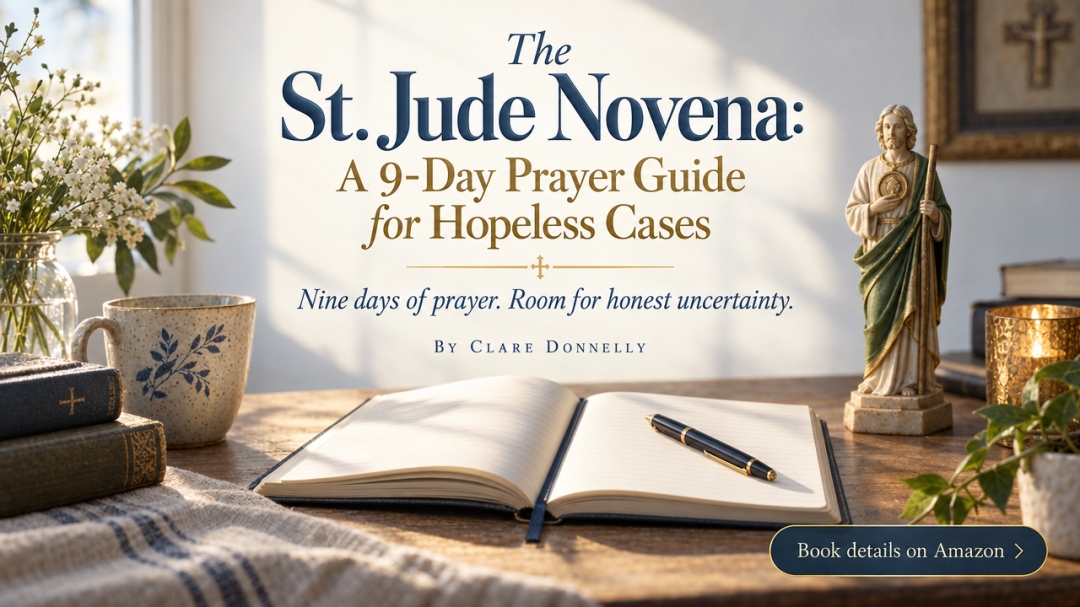
HOUSTON, TX – November 9, 2026 – Clare Donnelly’s The St. Jude Novena: A 9-Day Prayer Guide for Hopeless Cases, published November 1, 2026, addresses how to pray a St Jude novena when the circumstances prompting prayer remain unresolved. The Catholic devotional offers nine days of prayer for people facing distress, uncertainty, or situations they cannot resolve alone. Its central concern is not simply what words to say, but how readers can bring fear, anger, grief, exhaustion, or silence before God without first having to feel composed.
For its intended readers, that distinction gives the guide a focus beyond completing a devotional sequence. Someone returning to Catholic prayer after an absence may be unsure where to begin. A reader who does not feel fully at home in church may question whether unfamiliarity is a barrier. Donnelly’s guide explicitly welcomes both, presenting prayer as something that can begin without polished language, a special devotional object, or an ideal setting.
The book’s themes speak to the gap between wanting to pray and knowing what to do with an experience that has not improved. Its nine-day journey includes naming an apparently impossible situation, bringing an intention to Jesus, and continuing to pray when nothing changes. Rather than requiring readers to conceal frustration, the devotional gives that difficulty a place within the practice itself. Uncertainty is part of the situation being brought to prayer, not something that must be settled beforehand.
Does Donnelly’s St. Jude guide promise an answer? The devotional does not present prayer as a way to compel an answer or control events. It addresses surrender, waiting for God’s timing, and what follows when an answer is yes, no, or wait. The structure therefore leaves room for an unresolved outcome. Its invitation is to continue a relationship with God, rather than to treat nine days of prayer as a guarantee of a desired result.
Grief receives similarly direct attention. The guide includes making room for loss and uses Hannah’s prayer to consider tears and wordless distress. For readers who cannot readily express what they are carrying, this offers a biblical context for prayer that is not fluent or orderly. The emphasis is not on producing the right emotional response. It is on allowing an honest response to become part of prayer, including when words are difficult to find.
The question of surrender also matters when readers are trying to distinguish acceptance from abandoning responsibility. Through Jesus in Gethsemane, the devotional considers surrender without equating it with giving up. Alongside this reflection, it includes ordinary actions such as making an appointment, gathering a document, sending a message, or asking for help. These examples keep prayer connected to decisions a reader may still be able to make, even when the larger circumstance remains beyond personal control.
How does Donnelly connect St. Jude prayer with action? The guide pairs devotional reflection with manageable responses to everyday needs. Readers may name an intention plainly or acknowledge a feared possibility; in grief, an action may be as basic as eating or inviting companionship. These steps accompany prayer rather than determine its outcome. The distinction allows the guide to address both spiritual concerns and immediate responsibilities without suggesting that either a prayer sequence or a practical task can ensure a resolution.
Another reader-facing question concerns consistency: what happens if attention wanders, doubt arises, or a day is missed? The preparation guidance encourages a gentle return instead of a perfect performance. Missing a day does not invalidate the novena or require starting over. Ten or fifteen minutes can provide space for prayer, but the guide does not require a special setting. These details make the practice approachable for readers whose circumstances already involve disruption or exhaustion.
The devotional also considers the meaning of persistence. The persistent widow in Luke 18 provides a basis for reflecting on continuing a relationship with God. Placed alongside the book’s refusal to present prayer as a means of forcing an answer, persistence becomes a question of remaining engaged rather than achieving control. That distinction speaks directly to readers who may wonder whether continuing to pray is meaningful when there is no visible change.
St. Jude’s identity and place in devotion receive context as well. The guide distinguishes Jude from Judas Iscariot and considers his question to Jesus in John 14 as an example of honest inquiry. His quiet presence in the Gospel accounts supports reflection on hidden faithfulness and overlooked struggles. By distinguishing scriptural accounts from later traditions, the book gives readers a framework for understanding devotion to the saint associated with hopeless cases without treating every element as the same kind of account.
The format brings these questions into a nine-day practice through biblical stories, reflections, the traditional prayer to St. Jude, personal intentions, journal prompts, practical actions, and closing invocations. Kindle readers can use a separate notebook or notes app for written responses. Additional prayers address illness, employment, addiction in the family, estrangement from a child, and marriage. A consolidated prayer section and a glossary explaining intercession, intention, and novena provide further support for readers less familiar with devotional language.
Together, these elements position The St. Jude Novena as a guide for readers whose questions remain present while they pray. Its emphasis on honest inquiry, imperfect participation, and outcomes that cannot be controlled gives the nine-day structure a clear purpose: making room for prayer within difficult circumstances rather than waiting until those circumstances feel manageable. Information about Clare Donnelly’s The St. Jude Novena: A 9-Day Prayer Guide for Hopeless Cases is available at https://www.amazon.com/dp/B0HQ313SJT.
About Clare Donnelly
Clare Donnelly is the author of The St. Jude Novena: A 9-Day Prayer Guide for Hopeless Cases, a Catholic devotional for people facing distress, uncertainty, and unresolved circumstances. The guide combines biblical reflection, traditional prayer, personal intentions, journal prompts, and practical actions. It welcomes readers returning to Catholic prayer and addresses questions about doubt, grief, persistence, and beginning again after a missed day.
Media Contact
Company Name: How to Pray a Novena
Contact Person: Clare Donnelly
Email: Send Email
Phone: 713-392-6222
Address:450 N Sam Houston Prky E Ste 103
City: Houston
State: TX
Country: United States
Website: https://vue6uper1ds550jkltmklrl0.macaly.app