
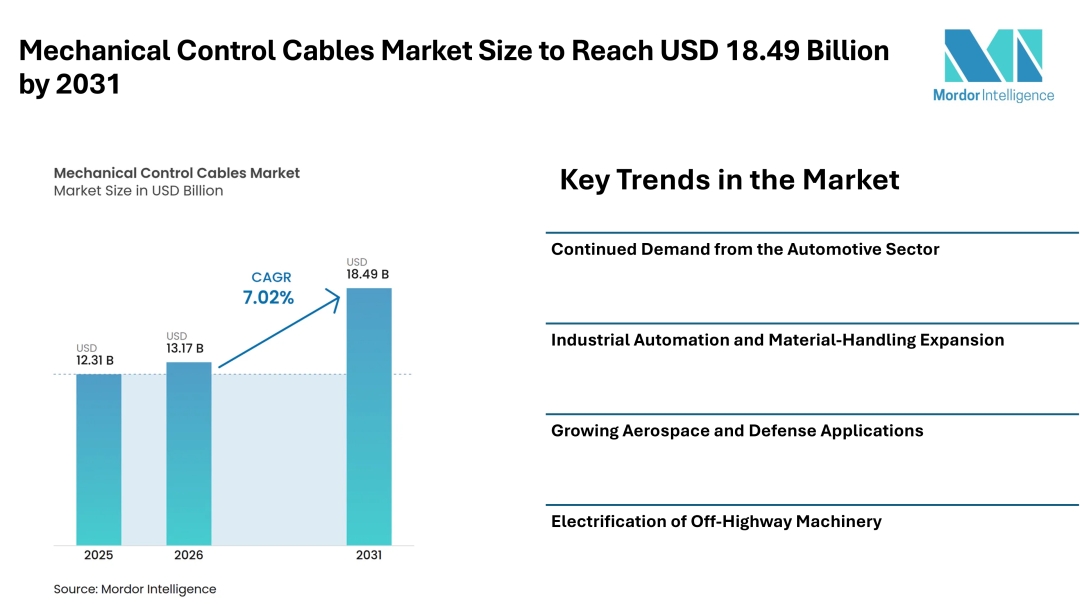
Hyderabad, India, November 05, 2026: The mechanical control cables market is estimated at USD 13.17 billion in 2026 and is projected to reach USD 18.49 billion by 2031, registering a CAGR of 7.02% during the 2026–2031 forecast period. Demand is supported by the continued use of mechanical linkages in applications where dependable physical actuation and backup control are required.
Automotive manufacturers continue to use mechanical cables in throttle, brake, and clutch systems, particularly where reliability and cost considerations favor mechanical solutions over fully electronic alternatives. Industrial automation also supports demand, as manufacturing and material-handling operations combine electronic controls with mechanical backup systems to maintain equipment functionality.
Growth in aerospace and defense, electrification of off-highway machinery, and the adoption of medical devices and exoskeletons are creating additional demand. The use of lightweight composite and hybrid materials is also gaining attention as manufacturers seek to reduce component weight while maintaining strength and performance. Asia-Pacific holds the largest regional share, while Africa is projected to record the fastest growth through 2031.
Get More info: https://www.mordorintelligence.com/industry-reports/mechanical-control-cables-market?utm_source=abnewswire
Key Trends Shaping the Mechanical Control Cables Market
Continued Demand from the Automotive Sector
The automotive sector remains a major end user of mechanical control cables, supported by their use in throttle, clutch, brake, and other vehicle control assemblies. Mechanical linkages continue to serve applications where dependable operation and cost considerations remain important. Electrified vehicles also retain certain mechanical backup functions, supporting demand for cables alongside electronic control systems.
Industrial Automation and Material-Handling Expansion
Manufacturing facilities are increasingly combining servo-driven systems with mechanical backup mechanisms for selected operations. Mechanical cables support movement and positioning in material-handling lines, packaging systems, and industrial equipment. Demand for micro-diameter cables is also developing in applications that require precise movement and compact components.
Growing Aerospace and Defense Applications
Commercial aerospace and defense programs require reliable control systems that can support operational continuity. Mechanical cables remain relevant as secondary control paths in aircraft equipped with electronic flight-control systems. Demand for stainless-steel, composite, and hybrid cable designs is also supported by requirements for strength, durability, and reduced component weight.
Electrification of Off-Highway Machinery
Construction and agricultural equipment manufacturers are adopting electric and hybrid drivetrains while retaining mechanical controls for selected implements and attachments. Cables are used in applications such as hydraulic valve operation, loader assemblies, and agricultural equipment controls. This combination of electrified powertrains and mechanical actuation supports demand for dependable cable-based systems.
Mechanical Control Cables Market Segmentation Analysis
By Type
-
Push-Pull Cables
-
Pull-Only Cables
-
Self-Locking / Positive-Lock Cables
-
Micro-Diameter Cables
By End User
-
Automotive
-
Aerospace and Defense
-
Marine
-
Industrial Machinery
-
Construction and Off-Highway Equipment
-
Agriculture Equipment
-
Medical Devices and Exoskeletons
By Application
-
Throttle / Accelerator
-
Clutch and Brake
-
Door / Latch / Seat Control
-
Remote Valve and Actuator Control
By Material
-
Carbon-Steel
-
Stainless-Steel
-
Nickel and Specialty Alloys
-
Composite / Hybrid
Read this Report in Japanese version: https://www.mordorintelligence.com/ja/industry-reports/mechanical-control-cables-market?utm_source=abnewswire
Mechanical Control Cables Market Key Players and Competitive Landscape
The mechanical control cables market features a moderately fragmented competitive landscape, with manufacturers serving automotive, aerospace, industrial, and other end-user sectors. Companies are focusing on production automation, material development, and product customization to meet application-specific requirements. The use of composite and hybrid materials is also creating opportunities for suppliers targeting applications where strength and reduced weight are important.
Key players include:
-
Orscheln Products
-
Bergen Cable Technology
-
Grand Rapids Controls, LLC
-
Carl Stahl Sava Industries, Inc.
-
Cablecraft Motion Controls
-
HI-LEX Corporation
-
Suprajit Engineering Ltd.
-
Kongsberg Automotive
-
Venhill Engineering
-
Lexco Cable
Conclusion
The mechanical control cables market is projected to grow from USD 13.17 billion in 2026 to USD 18.49 billion by 2031, at a CAGR of 7.02%. Automotive demand, industrial automation, aerospace and defense applications, and the electrification of off-highway machinery are expected to support market expansion.
However, the shift toward drive-by-wire systems and electric actuation may limit cable use in certain applications. Volatility in stainless-steel and specialty-alloy prices, along with material and recyclability requirements, also presents challenges for manufacturers.
The market outlook remains supported by applications that require reliable mechanical actuation and backup control. Developments in micro-diameter, composite, and hybrid cable designs are expected to create further opportunities across automotive, medical, aerospace, and industrial end-user segments.
Industry Related Reports
Automotive Bushing Market Size: The automotive bushing market is projected to reach USD 180.43 billion in 2026 and is expected to grow to USD 226.1 billion by 2031, registering a CAGR of 4.62% during 2026–2031. Market growth is mainly supported by increasing vehicle production, rising demand for improved ride comfort and vibration control, and the growing integration of advanced suspension components in modern vehicles.
Recreational Boating Market: The Recreational Boating Market is projected to grow from USD 32.37 billion in 2027 to USD 40.92 billion by 2032, registering a CAGR of 4.80% during the forecast period. The market’s growth is driven by rising interest in water-based leisure activities, increasing participation in recreational boating, growing demand for boats for fishing and watersports, and expanding marine tourism and waterfront recreational infrastructure.
Get More info: https://www.mordorintelligence.com/industry-reports/recreational-boating-market?utm_source=abnewswire
About Mordor Intelligence
Mordor Intelligence is a global market intelligence firm, founded in 2014, helping businesses make informed decisions through data-driven insights, industry expertise, and advanced analytics. With 550+ domain experts and on-ground specialists across 150+ countries, the company delivers comprehensive intelligence across aerospace & defense, agriculture, automation, automotive, chemicals & materials, consumer goods & services, electronics, energy & power, financial services, food & beverages, healthcare, hospitality & tourism, information & communications technology, and logistics.
Its offerings include syndicated industry reports, custom research and advisory, and subscription platforms such as Synapse. Mordor Intelligence is ISO 9001:2015 and ISO/IEC 27001:2022 certified, a member of ESOMAR and the Market Research Society of India, and a four-time Great Place to Work® honoree. Learn more at mordorintelligence.com or reach to media@mordorintelligence.com
Media Contact
Company Name: Mordor Intelligence Private Limited
Contact Person: Jignesh Thakkar
Email: Send Email
Phone: +1 617-765-2493
Address:11th Floor, Rajapushpa Summit, Nanakramguda Rd, Financial District, Gachibowli
City: Hyderabad
State: Telangana 500008
Country: India
Website: https://www.mordorintelligence.com/