
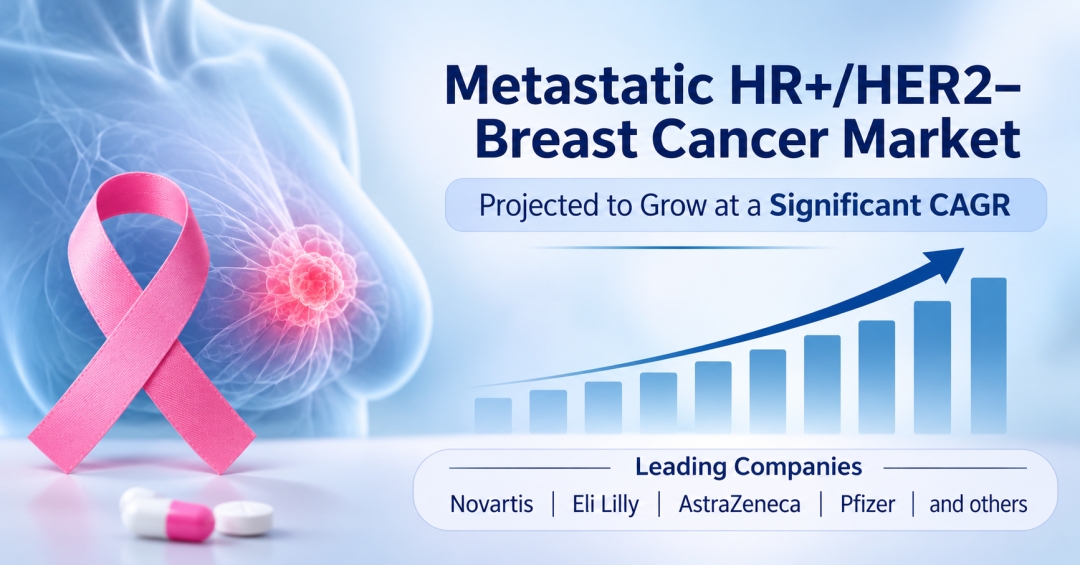
(Albany, US), November 03, 2026 – DelveInsight’s ‘Metastatic HR+/HER2− Breast Cancer – Market Insights, Epidemiology and Market Forecast – 2036’ report delivers an in-depth understanding of Metastatic HR+/HER2− Breast Cancer, historical and forecasted epidemiology, as well as the Metastatic HR+/HER2− Breast Cancer market trends in the United States, EU4 (Germany, Spain, Italy, and France) and the United Kingdom, and Japan.
Explore the intricate details of the Metastatic HR+/HER2− Breast Cancer Market Report @ HER2 Negative Breast Cancer Market
Key Takeaways from the Metastatic HR+/HER2− Breast Cancer Market Report
-
In Oct 2026, Daiichi Sankyo announced result of A Global, Interventional, Open-label Trial of T-DXd-based Therapy Followed by Palbociclib, Endocrine Therapy and Dual HER2 Blockade in First-line HER2+/ HR+ Advanced or Metastatic Breast Cancer and Retreatment With T-DXd (DB-Guide).
-
In July 2026, Maryam Lustberg announced result of A Phase II Trial to Improve Safety of Capivasertib for HR+/HER2- Metastatic Breast Cancer.
-
According to DelveInsight’s analysis, the metastatic HR+/HER2− breast cancer market size in the 7MM was approximately USD 14,000 million in 2025 and is projected to grow at a CAGR of ~8% during 2026–2036.
-
The United States accounted for the largest market size of HR+/HER2− breast cancer in the 7MM, at approximately USD 10,000 million in 2025, and is expected to grow at a significant CAGR through 2036.
-
According to DelveInsight’s estimates, the total incident population of HR+/HER2− breast cancer in the 7MM was nearly 486,000 cases in 2025, and the number of cases is expected to increase during the forecast period.
-
Among all therapies in 2025, IBRANCE had the largest market size, with revenue of USD 3,900 million. By 2036, VERZENIO is expected to capture the largest market share, followed by IBRANCE.
-
The HR positive/ HER2 negative breast cancer market is supported by the strong reliance on endocrine therapy combined with targeted agents such as CDK4/6 inhibitors, which have extended progression-free survival in first and second-line settings.
-
The post-CDK4/6 inhibitor treatment landscape could benefit from the adoption of antibody-drug conjugates (ADCs) and oral selective estrogen receptor degraders (SERDs), with the pipeline also including AKT inhibitors, mTOR inhibitors, SERMs, PI3K inhibitors, PARP inhibitors, and TROP-2 targeting ADCs.
-
The leading Metastatic HR+/HER2− Breast Cancer companies include Novartis, Eli Lilly, AstraZeneca, Pfizer, Sermonix Pharmaceuticals, Veru Pharma, Arvinas, Olema Pharmaceuticals, Celcuity, and others.
-
Promising Metastatic HR+/HER2− Breast Cancer therapies include KISQALI, PIQRAY, VERZENIO, LYNPARZA, IBRANCE, Giredestrant, Datopotamab deruxtecan (Dato-DXd), Camizestrant (AZD9833), and others.
Get a Free sample for the Metastatic HR+/HER2− Breast Cancer Market Forecast, Size & Share Analysis Report @ HR Positive/ HER2 Negative Breast Cancer Market
Metastatic HR+/HER2− Breast Cancer Overview
HR+/HER2− breast cancer is the most common subtype of breast cancer, characterized by cancer cells with hormone receptors for estrogen and progesterone but lacking the overexpression of HER2. This distinguishes it from the HER2 positive breast cancer treatment market, where HER2 overexpression is the defining feature. This subtype generally has a better prognosis and is often treated with hormone therapy to block hormone-driven growth. Surgery and radiation may be used to remove or target tumors, while chemotherapy and targeted therapies such as CDK4/6 inhibitors may be considered for more advanced cases. A biopsy confirms the diagnosis and determines the cancer’s characteristics, and staging tests assess the extent of the disease, guiding a multidisciplinary team in devising a personalized treatment plan that often involves hormone therapy, surgery, radiation, and possibly chemotherapy or targeted therapies. Follow-up care ensures ongoing monitoring and adjustment of treatment as needed.
Metastatic HR+/HER2− Breast Cancer Epidemiology Segmentation in the 7MM
-
Total Incident Cases of Breast Cancer
-
Incident Cases of HR+/HER2− Breast Cancer
-
Menopausal Status of HR+/HER2− Breast Cancer
-
Stage-specific Cases of HR+/HER2− Breast Cancer
-
Age-specific Cases of HR+/HER2− Breast Cancer
-
Line-wise Metastatic Cases of HR+/HER2− Breast Cancer
Download the report to understand which factors are driving Metastatic HR+/HER2− Breast Cancer epidemiology trends @ HR+ HER2- Stage II III Breast Cancer Treatment Drugs Cost Coverage
Metastatic HR+/HER2− Breast Cancer Epidemiology Key Findings
-
The total incident population of HR+/HER2− breast cancer in the 7MM was nearly 486,000 cases in 2025, and the cases are expected to increase during the forecast period, i.e., 2026–2036.
-
Metastatic HR+/HER2− breast cancer cases were highest in the United States, accounting for ~57,000 cases in 2025.
-
Most cases of HR+/HER2− breast cancer in the United States occur in people aged between 60 and 79 years, accounting for ~48% of cases in 2025.
-
Among EU4 and the UK, Germany had the maximum total incident cases of HR+/HER2− breast cancer, with ~50,500 cases in 2025, while Spain accounted for the least number of incident cases.
Approved Therapies for Metastatic HR+/HER2− Breast Cancer
-
KISQALI (ribociclib): Novartis
KISQALI is a kinase inhibitor indicated for the treatment of adult patients with HR+, HER2− advanced or metastatic cancer in combination with an aromatase inhibitor as initial endocrine-based therapy, or with fulvestrant as initial endocrine-based therapy or following disease progression on endocrine therapy in postmenopausal women or men. The NCCN Clinical Practice Guidelines in Oncology for breast cancer recommend KISQALI as the only Category 1 preferred CDK4/6 inhibitor for first-line treatment of patients with HR+/HER2− metastatic breast cancer when combined with an aromatase inhibitor. In October 2025, Novartis announced results from the five-year analysis of the pivotal Phase III NATALEE trial, which showed a 28.4% reduction in risk of recurrence in the broadest population of patients with high-risk stage II and III HR+/HER2− early breast cancer treated with KISQALI plus endocrine therapy compared to endocrine therapy alone. Such trial evidence informs the HR+ HER2- stage II III breast cancer treatment drugs safety profile and benefit assessment across the treatment landscape.
-
VERZENIO (abemaciclib): Eli Lilly
VERZENIO is a targeted treatment known as a CDK4/6 inhibitor and is a non-chemotherapy oral tablet that works inside the cell to block CDK4/6 activity and help stop the growth of cancer cells. In February 2018, the US FDA approved VERZENIO in combination with an aromatase inhibitor as initial endocrine-based therapy for the treatment of postmenopausal women with HR+, HER2− advanced or metastatic breast cancer. The NCCN recommends consideration of 2 years of VERZENIO added to endocrine therapy as a Category 1 treatment option in the adjuvant setting.
Metastatic HR+/HER2− Breast Cancer Pipeline Analysis
-
ARV-471 (vepdegestrant): Arvinas
Vepdegestrant is an investigational, oral PROTAC estrogen receptor protein degrader for the treatment of patients with ER+/HER2− locally advanced or metastatic breast cancer. Arvinas and Pfizer are collaborating to develop and commercialize vepdegestrant, which is currently in Phase III clinical studies. The US FDA is reviewing the filed New Drug Application (NDA), with a PDUFA action date of June 5, 2026, and the therapy has also been granted Fast Track designation by the FDA.
-
OP1250 (palazestrant): Olema Pharmaceuticals
OP-1250 is a small molecule complete estrogen receptor antagonist (CERAN) that blocks estrogen-driven transcriptional activity, inhibits estrogen-driven breast cancer cell growth, and induces degradation of the estrogen receptor. Olema Pharmaceuticals announced updated data from the Phase Ib/II study of palazestrant in combination with ribociclib in patients with ER+/HER2− advanced or metastatic breast cancer, presented at ESMO Congress 2025. The Phase III OPERA-02 trial is evaluating palazestrant in combination with ribociclib in frontline ER+/HER2− advanced or metastatic breast cancer.
Discover more about therapies set to grab Major Metastatic HR+/HER2− Breast Cancer Market Share @ HER2 Negative Breast Cancer Treatment Market
Metastatic HR+/HER2− Breast Cancer Market Outlook
For the past decade, endocrine therapy has been the preferred treatment for HR-positive and HER2− metastatic breast cancer, including cases with visceral involvement. Combining endocrine therapy with targeted agents, such as CDK4/6 inhibitors or mTOR inhibitors, is an option for patients who do not meet the criteria for chemotherapy or sole endocrine treatment. The addition of CDK4/6 inhibitors to an endocrine drug in the first line of treatment, as in the MONALEESA, PALOMA-2, and MONARCH-3 trials, showed a significant increase in median progression-free survival. IBRANCE is the leading molecule in the first line of therapy, with the first-mover advantage in the first and second lines and the highest revenue in terms of sales, while ORSERDU is the first and only therapy specifically indicated for ER+, HER2− tumors that harbor ESR1 mutations.
Within the broader HER2 human epidermal growth factor receptor 2 inhibitors market, ENHERTU received expedited approval in August 2022 as the first therapeutic intended for HER2-low, metastatic, or unresectable breast cancer, a newly created subgroup previously associated with HR+/HER2− breast cancer, and the FDA authorized TRODELVY in February 2023 for previously treated HR-positive, HER2-negative breast cancer. The post-CDK4/6 inhibitor landscape is expected to benefit from ADCs and oral SERDs, as patients who develop resistance to combined CDK4/6 inhibitor and endocrine treatments often switch to conventional chemotherapy. However, many next-generation SERDs may face strong competition from established CDK4/6 inhibitors, potentially limiting their uptake and slowing growth. The United States accounted for the largest market size in the 7MM, at approximately USD 10,000 million in 2025, and the HR positive/ HER2 negative breast cancer market is expected to grow at a significant CAGR through 2036.
Metastatic HR+/HER2− Breast Cancer Market Drivers
-
Rising prevalence of HR+/HER2− breast cancer, the most common breast cancer subtype, with a significant proportion progressing to metastatic disease and requiring prolonged treatment
-
Strong reliance on endocrine and targeted therapies, with CDK4/6 inhibitors improving PFS and becoming the standard of care in first-line settings
-
Expansion of targeted treatment options, including agents targeting the PI3K/AKT/mTOR pathways and next-generation SERDs
-
Robust late-stage pipeline (Phase III, II/III, and II) expected to address unmet needs and support market growth
Metastatic HR+/HER2− Breast Cancer Market Barriers
-
Endocrine resistance and disease progression
-
Limited durability of treatment response
-
Lack of clear treatment sequencing strategies
-
Limited options post–CDK4/6 inhibitor progression
-
Strong competition from established CDK4/6 inhibitors for next-generation SERDs
Metastatic HR+/HER2− Breast Cancer Treatment Landscape
Treatment of HR+/HER2− breast cancer generally follows a multimodal strategy. Hormone therapy remains the backbone, targeting estrogen-driven tumor growth. Surgery (lumpectomy or mastectomy) is often used to remove the tumor, followed by radiation to eliminate residual disease, while chemotherapy or targeted therapies such as CDK4/6 inhibitors may be added in advanced settings. Several classes of endocrine therapies are available, including selective estrogen receptor modulators (SERMs), aromatase inhibitors (AIs), and selective estrogen receptor degraders (SERDs). FASLODEX (fulvestrant) is one of the most efficient and well-tolerated single-agent endocrine therapies, and its poor bioavailability and inconvenient IV formulation create an opportunity for oral next-generation SERDs in both first and second-line settings. Current research is increasingly focused on combining these therapies with targeted agents, particularly those inhibiting the PI3K/AKT/mTOR and CDK4/6 pathways. Pricing and reimbursement assessments, including HR+ HER2- advanced breast cancer drug brands cost coverage, are covered through cost assumptions and pricing analogues in the report.
To know more about Metastatic HR+/HER2− Breast Cancer Companies working in the treatment market, visit @ HR+ HER2- Advanced Breast Cancer Drugs Cost Coverage
Scope of the Metastatic HR+/HER2− Breast Cancer Market Report
-
Coverage- 7MM
-
Study Period- 2022-2036
-
Forecast Period- 2026-2036
-
Metastatic HR+/HER2− Breast Cancer Companies- Novartis, Eli Lilly, AstraZeneca, Pfizer, Sermonix Pharmaceuticals, Veru Pharma, Arvinas, Olema Pharmaceuticals, Celcuity, and others.
-
Metastatic HR+/HER2− Breast Cancer Therapies- KISQALI, PIQRAY, VERZENIO, LYNPARZA, IBRANCE, Giredestrant, Datopotamab deruxtecan (Dato-DXd), Camizestrant (AZD9833), and others.
-
Metastatic HR+/HER2− Breast Cancer Market Dynamics: Metastatic HR+/HER2− Breast Cancer market drivers and market barriers
-
Metastatic HR+/HER2− Breast Cancer Competitive Intelligence Analysis: SWOT Analysis, Conjoint Analysis
-
Metastatic HR+/HER2− Breast Cancer Unmet Needs, KOL Views, Reimbursement, Cost Assumptions and Pricing Analogues, including HR+ HER2- stage II III breast cancer treatment drugs cost coverage
Table of Contents
-
Key Insights
-
Report Introduction
-
Executive Summary of Metastatic HR+/HER2- Breast Cancer
-
Epidemiology and Market Forecast Methodology
-
Key Events
-
Metastatic HR+/HER2- Breast Cancer Market Overview at a Glance
-
Disease Background and Overview
-
Treatment of HR+/HER2– Breast Cancer
-
Epidemiology and Patient Population
-
Patient Journey
-
Marketed Drugs
-
Emerging Therapies
-
HR+/HER2- Breast Cancer: The 7MM Analysis
-
Unmet Needs
-
SWOT Analysis
-
KOL Views
-
Market Access and Reimbursement
-
Appendix
-
DelveInsight Capabilities
-
Disclaimer
-
About DelveInsight
Media Contact
Company Name: DelveInsight Business Research LLP
Contact Person: Ankit Nigam
Email: Send Email
Phone: +19193216187
Address:304 S. Jones Blvd #2432
City: Albany
State: New York
Country: United States
Website: https://www.delveinsight.com/report-store/hr-positive-her2-negative-breast-cancer-market-insights