
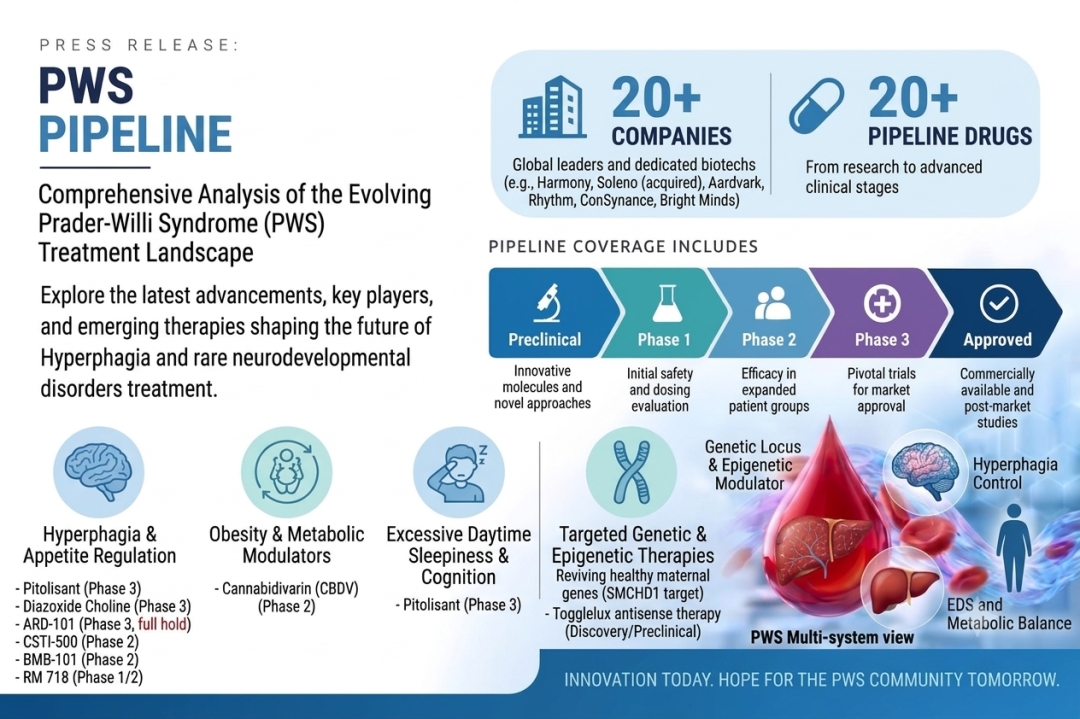
(Albany, US) On October 30, 2026, DelveInsight’s “Prader Willi Syndrome Pipeline Insights 2026” report provides comprehensive insights about 20+ companies and 20+ pipeline drugs in the Prader Willi Syndrome pipeline landscape. It covers the Prader-Willi Syndrome pipeline drug profiles, including clinical and nonclinical stage products. It also covers the Prader Willi Syndrome pipeline therapeutics assessment by product type, stage, route of administration, and molecule type. It further highlights the inactive pipeline products in this space.
Discover the latest drugs and treatment options in the Prader Willi Syndrome Pipeline @ https://www.delveinsight.com/sample-request/prader-willi-syndrome-pipeline-insight
Key Takeaways from the Prader Willi Syndrome Pipeline Report
- On October 23, 2026- Aardvark Therapeutics reported exploratory clinical data from its terminated Phase III HERO trial and open-label extension study evaluating ARD-101 for hyperphagia associated with Prader-Willi Syndrome. The company reported that hyperphagia questionnaire scores declined by Week 2 during dose escalation with ARD-101 but returned toward baseline within two weeks after treatment discontinuation. The HERO trial was terminated early after 67 of the planned 90 participants had been randomized, and the company emphasized that all efficacy findings should be considered exploratory rather than confirmatory. These findings will help guide the company’s future clinical development strategy for ARD-101, an investigational gut-restricted small-molecule taste receptor agonist designed to stimulate satiety-related gut hormones, including GLP-1 and cholecystokinin.
- In September, 2026 – Neurocrine Biosciences announced research presentations at the Foundation for Prader-Willi Research 2026 Annual Research Symposium, covering the PWS-VISTA and BRAVE-PWS observational studies. These studies are designed to generate real-world evidence on VYKAT XR (diazoxide choline extended-release tablets), including long-term treatment outcomes, safety, and caregiver experiences in people living with PWS.
- DelveInsight’s Prader Willi Syndrome pipeline report depicts a robust space with 20+ active players working to develop 20+ pipeline therapies for Prader Willi Syndrome treatment.
- The leading Prader Willi Syndrome Companies such as Aardvark Therapeutics, Inc., Neurocrine Biosciences Inc., Soleno Therapeutics Inc., Harmony Biosciences Holdings Inc. and others.
- Promising Prader Willi Syndrome Pipeline Therapies such as Pitolisant, BMB-101, RM718, CCT987, and others.
Stay ahead with the most recent Prader Willi Syndrome pipeline outlook with DelveInsight @ Prader Willi Syndrome Treatment Drugs
The Prader Willi Syndrome Pipeline Report provides disease overview, pipeline scenario and therapeutic assessment of the key pipeline therapies in this domain. The Prader Willi Syndrome Pipeline Report also highlights the unmet needs with respect to the Prader Willi Syndrome.
Prader Willi Syndrome Overview
Prader-Willi syndrome (PWS) is a rare, complex genetic disorder affecting the metabolic, endocrine, and neurological systems. It is characterized by severe hypotonia and feeding difficulties during infancy, followed by developmental delay, hyperphagia (excessive eating), impaired satiety, and progressive obesity. Hypothalamic dysfunction also contributes to endocrine abnormalities such as growth hormone deficiency, hypogonadism, hypothyroidism, and, less commonly, central adrenal insufficiency. PWS results from the absence of expression of paternally inherited genes in the chromosome 15q11.2–q13 region. Approximately 70% of cases are associated with a paternal deletion, around 25% with maternal uniparental disomy (both chromosome 15 copies inherited from the mother), and a smaller proportion with defects in the genomic imprinting center. The loss of paternally expressed genes disrupts normal hypothalamic function, leading to impaired regulation of appetite, energy expenditure, and multiple endocrine pathways. This produces the characteristic progression from neonatal hypotonia and poor feeding to hyperphagia, impaired satiety, and severe obesity. Abnormal neuropeptide signaling, including alterations in the oxytocin and ghrelin systems, contributes to hyperphagia, while hypothalamic dysfunction can cause growth hormone deficiency, hypogonadism, hypothyroidism, and central adrenal insufficiency.
Prader Willi Syndrome Emerging Drugs Profile
- Pitolisant: Harmony Biosciences
Pitolisant is a high-affinity inverse agonist at the H3 receptor, which normally inhibits histamine synthesis and release. By preventing endogenous histamine from binding to these receptors, pitolisant increases histaminergic activity in the central nervous system, thereby enhancing wakefulness. It also modulates the release of other neurotransmitters, contributing to its stimulating effects without the higher abuse potential associated with traditional stimulants like amphetamines. The drug has received Orphan Drug Designation from the FDA and is currently in Phase III stage of its development for the treatment of Prader-Willi syndrome.
- BMB-101: Bright Minds Biosciences
BMB-101 is an investigational, novel scaffold 5-HT?C receptor Gq-protein-biased agonist being evaluated for Prader-Willi syndrome (PWS), particularly to address hyperphagia and associated behavioral symptoms. It selectively activates the 5-HT?C receptor through the Gq-protein signaling pathway while minimizing ?-arrestin recruitment, which is intended to reduce receptor desensitization and tolerance during chronic treatment. In PWS, genetic alterations can result in reduced 5-HT?C receptor function, providing a rationale for enhancing 5-HT?C signaling. By stimulating 5-HT?C-mediated signaling, BMB-101 is intended to modulate appetite and behavioral pathways and potentially reduce hyperphagia and related behavioral abnormalities in Prader-Willi Syndrome. Currently, the drug is being evaluated in the Phase II stage of its development for the treatment of Prader-Willi Syndrome.
- RM 718: Rhythm Pharmaceuticals
RM-718 is an investigational synthetic cyclic heptamer peptide and selective melanocortin-4 receptor (MC4R) agonist being evaluated for Prader-Willi syndrome (PWS), including its severe hyperphagia and obesity. It is formulated as a sustained-release, once-weekly subcutaneous injection. RM-718 acts by selectively activating MC4R, a key receptor in the hypothalamic melanocortin pathway that regulates appetite, energy expenditure, and body weight. By stimulating MC4R signaling, RM-718 is intended to enhance satiety, reduce excessive food intake (hyperphagia), and potentially improve energy balance and obesity associated with PWS. Currently, the drug is being evaluated in the Phase I/II stage of its development for the treatment of Prader-Willi Syndrome.
- CCT 987: Canary Cure Therapeutics
CCT-987 is a first-in-class, dual-action RNA therapeutic being developed for Prader-Willi syndrome (PWS). The drug is designed to directly correct peripheral adipose biology by delivering a payload of CB1R siRNA and leptin mRNA directly to subcutaneous adipose tissue. The dual RNA therapy is intended to clear the CB1R molecular blockade and deliver a physiological pulse of leptin, thereby re-engaging the hypothalamic satiety circuit and promoting fat loss while enhancing lean muscle mass. Currently, the drug is being evaluated in the Preclinical stage of its development for the treatment of Prader-Willi Syndrome.
The Prader Willi Syndrome Pipeline Report Provides Insights into
- The report provides detailed insights about companies that are developing therapies for the treatment of Prader Willi Syndrome with aggregate therapies developed by each company for the same.
- It accesses the Different therapeutic candidates segmented into early-stage, mid-stage, and late-stage of development for Prader Willi Syndrome Treatment.
- Prader Willi Syndrome Companies are involved in targeted therapeutics development with respective active and inactive (dormant or discontinued) projects.
- Prader Willi Syndrome Drugs under development based on the stage of development, route of administration, target receptor, monotherapy or combination therapy, a different mechanism of action, and molecular type.
- Detailed analysis of collaborations (company-company collaborations and company-academia collaborations), licensing agreement and financing details for future advancement of the Prader Willi Syndrome market
Explore groundbreaking therapies and clinical trials in the Prader Willi Syndrome Pipeline @ New Prader Willi Syndrome Drugs
Prader Willi Syndrome Companies
Aardvark Therapeutics, Inc., Neurocrine Biosciences Inc., Soleno Therapeutics Inc., Harmony Biosciences Holdings Inc. and others.
Prader Willi Syndrome Pipeline Report provides the therapeutic assessment of the pipeline drugs by the Route of Administration. Products have been categorized under various ROAs such as
- Intra-articular
- Intraocular
- Intrathecal
- Intravenous
- Ophthalmic
- Oral
- Parenteral
- Subcutaneous
- Topical
- Transdermal
- Molecule Type
Prader Willi Syndrome Products have been categorized under various Molecule types such as
- Oligonucleotide
- Peptide
- Small molecule
- Product Type
Learn about new drugs, pipeline developments, and key companies with DelveInsight’s expert analysis @ Prader Willi Syndrome Market Drivers and Barriers
Scope of the Prader Willi Syndrome Pipeline Report
- Coverage- Global
- Prader Willi Syndrome Companies- Aardvark Therapeutics, Inc., Neurocrine Biosciences Inc., Soleno Therapeutics Inc., Harmony Biosciences Holdings Inc. and others.
- Prader Willi Syndrome Pipeline Therapies- Pitolisant, BMB-101, RM718, CCT987, and others.
- Prader Willi Syndrome Therapeutic Assessment by Product Type: Mono, Combination, Mono/Combination
- Prader Willi Syndrome Therapeutic Assessment by Clinical Stages: Discovery, Pre-clinical, Phase I, Phase II, Phase III
Get the latest on Prader Willi Syndrome Therapies and clinical trials @ Prader Willi Syndrome Companies, Key Products and Unmet Needs
Table of Contents
- Introduction
- Executive Summary
- Prader Willi Syndrome: Overview
- Pipeline Therapeutics
- Therapeutic Assessment
- Prader Willi Syndrome – DelveInsight’s Analytical Perspective
- In-depth Commercial Assessment
- Prader Willi Syndrome Collaboration Deals
- Late Stage Products (Pre-registration)
- Pitolisant: Harmony Biosciences
- Late Stage Products (Phase III)
- Mid Stage Products (Phase II)
- BMB-101: Bright Minds Biosciences
- Comparative Analysis
- Early Stage Products (Phase I/II)
- RM 718: Rhythm Pharmaceuticals
- Comparative Analysis
- Prader Willi Syndrome Key Companies
- Prader Willi Syndrome Key Products
- Prader Willi Syndrome Unmet Needs
- Prader Willi Syndrome Market Drivers and Barriers
- Prader Willi Syndrome Future Perspectives and Conclusion
- Prader Willi Syndrome Analyst Views
- Prader Willi Syndrome Key Companies
- Appendix
About Us
DelveInsight is a leading healthcare-focused market research and consulting firm that provides clients with high-quality market intelligence and analysis to support informed business decisions. With a team of experienced industry experts and a deep understanding of the life sciences and healthcare sectors, we offer customized research solutions and insights to clients across the globe. Connect with us to get high-quality, accurate, and real-time intelligence to stay ahead of the growth curve.
Media Contact
Company Name: DelveInsight Business Research LLP
Contact Person: Yash Bhardwaj
Email: Send Email
Phone: 09650213330
Address:304 S. Jones Blvd #2432
City: Albany
State: New York
Country: United States
Website: \\https://www.delveinsight.com/report-store/prader-willi-syndrome-pipeline-insight