
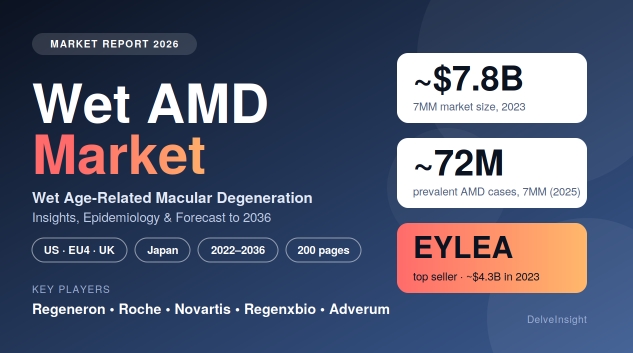
The report analyzes the current treatment landscape, standards of care and evolving therapeutic algorithms, as well as patient burden trends, revenue and market share dynamics, peak patient share and therapy uptake. It also highlights key unmet medical needs and maps the competitive and clinical landscape to uncover high-value opportunities.
Get a free sample of the Wet AMD Market Forecast
Key Facts from the Wet AMD Market Report
-
The Wet AMD market in the 7MM was valued at approximately [USD XXXX million] in 2025 and is projected to reach [USD XXXX million] by 2036, at a CAGR of [XX%] (2026–2036).
-
The United States held the largest market share in 2025, at approximately [USD XXXX million], followed by EU4, the UK and Japan.
-
The 7MM had approximately 3 million prevalent Wet AMD cases in 2025. The US alone had approximately 1.02 million.
-
Wet AMD accounts for roughly 10% of AMD cases but almost 90% of AMD-related central vision loss.
-
Anti-VEGF agents, particularly aflibercept (EYLEA HD) and ranibizumab (LUCENTIS), account for the largest market share, driven by strong efficacy, established safety and wide adoption as first-line therapy.
-
The treatment landscape is shifting toward longer-acting and dual-pathway agents such as faricimab (VABYSMO) to reduce treatment burden.
-
Key emerging assets include KSI-501 (Kodiak Sciences), RGX-314 (AbbVie/REGENXBIO), CG-P5 peptide (Caregen) and NT-101 (NexThera), along with programs from Roche, Bayer and Opthea.
-
April 2026: Regeneron announced that the US FDA approved extending EYLEA HD (aflibercept) dosing intervals to up to every 20 weeks in Wet AMD and diabetic macular edema patients after one year of response, supported by 2-year PULSAR and PHOTON data.
-
July 2026: REGENXBIO announced the pricing of a public offering of common stock and pre-funded warrants for gross proceeds of approximately USD 100 million, to fund clinical development of its gene therapy candidates, including for wet AMD.
-
November 2025: Kodiak Sciences announced completion of enrollment (approximately 690 patients) in the Phase III DAYBREAK study evaluating tarcocimab and KSI-501 in treatment-naive Wet AMD.
-
October 2025: REGENXBIO announced completion of enrollment in the pivotal ATMOSPHERE and ASCENT studies of surabgene lomparvovec (ABBV-RGX-314) using subretinal delivery.
To know more about the Wet AMD market outlook, drug uptake, treatment scenario and epidemiology trends, click here: https://www.delveinsight.com/report-store/wet-age-related-macular-degeneration-wet-amd-market
Wet AMD Overview
Wet AMD, also called neovascular AMD, is an advanced form of age-related macular degeneration in which abnormal blood vessels grow beneath the retina and leak fluid or blood, leading to rapid and severe vision loss. Symptoms include blurred or distorted central vision, dark spots and difficulty recognizing faces. Aging is the greatest risk factor. Others include cortical cataracts, cataract surgery, hypertension and hyperlipidemia.
Wet AMD Market Diagnosis
Wet AMD is diagnosed through a comprehensive dilated eye exam and imaging tests such as optical coherence tomography (OCT) and fluorescein angiography, which confirm choroidal neovascularization and retinal damage. It is often identified during routine checkups or when patients report vision changes.
Wet AMD Market Treatment Landscape
Treatment aims to preserve and improve vision, suppress abnormal choroidal neovascularization and reduce retinal fluid. Management centers on long-term intravitreal anti-VEGF therapy (e.g., ranibizumab, aflibercept) delivered through fixed, PRN or treat-and-extend regimens. For patients with suboptimal response or high injection burden, options such as faricimab and sustained delivery systems like the Port Delivery System with ranibizumab help extend dosing intervals. Photodynamic therapy with verteporfin may be used in select cases such as polypoidal choroidal vasculopathy. Regular OCT monitoring, smoking cessation and nutritional support remain essential.
Discover the current and emerging Wet AMD treatment landscape
Wet AMD Market Epidemiology Highlights
-
The 7MM had approximately 3 million prevalent Wet AMD cases in 2025.
-
In the US, prevalence rises sharply with age and is highest among people aged 85 and older.
-
In Japan, early and intermediate AMD made up the majority of stage-specific AMD cases in 2025, while late-stage AMD (nAMD and geographic atrophy) was a much smaller share.
The epidemiology chapter covers total and stage-specific AMD cases, total and diagnosed prevalent Wet AMD cases, age-specific cases and total treated cases.
Download the report to understand which factors are driving Wet AMD epidemiology trends
Key Wet AMD Market Drivers
-
Rising prevalence: Growth in the population aged 85 and older is a primary driver.
-
Targeted and long-acting therapies: The field is moving beyond conventional anti-VEGF toward dual-pathway inhibition (e.g., Ang-2/VEGF) and sustained delivery systems, offering longer dosing intervals and fewer injections.
-
Evolving pipeline: Candidates such as RGX-314, CG-P5 peptide and NT-101 aim to address frequent dosing and variable response.
Wet AMD Marketed Therapies
Aflibercept (EYLEA HD) – Regeneron Pharmaceuticals/Bayer: An 8 mg high-dose formulation of aflibercept that inhibits VEGF-driven abnormal blood vessel growth and leakage and allows dosing intervals of up to 12–16 weeks. It was approved by the US FDA in 2023 and in Europe and Japan in 2024.
Ranibizumab (LUCENTIS) – Genentech: A VEGF-A inhibitor approved in the US in 2021. Its Port Delivery System, a refillable eye implant that continuously releases ranibizumab, allows refill intervals of up to six months or longer, reducing the need for frequent injections.
Faricimab (VABYSMO) – Genentech: A bispecific antibody that dually inhibits VEGF-A and Ang-2, approved in the US, Europe and Japan in 2022.
Wet AMD Emerging Therapies
KSI-501 – Kodiak Sciences: An anti-VEGF antibody biopolymer conjugate built on Kodiak’s ABC platform, designed to prolong retinal drug exposure and reduce injection frequency. It is in Phase III for Wet AMD.
ABBV-RGX-314 – AbbVie/REGENXBIO: An AAV-based gene therapy that delivers a gene encoding an anti-VEGF antibody fragment for sustained intraocular production. The subretinal approach is in Phase III, and the suprachoroidal approach is in Phase II.
CG-P5 peptide – Caregen: An anti-angiogenic intravitreal peptide in Phase I.
NT-101 – NexThera: A topical eye drop with PEDF-modulating, anti-angiogenic and neuroprotective activity, in Phase I/IIa.
Learn more about the companies and therapies set to grab major Wet AMD market share
Wet AMD Market Recent Developments
-
April 2026: Regeneron announced that the US FDA approved extending EYLEA HD (aflibercept) dosing intervals to up to every 20 weeks in Wet AMD and diabetic macular edema patients after one year of response, supported by 2-year PULSAR and PHOTON data.
-
July 2026: REGENXBIO announced the pricing of a public offering of common stock and pre-funded warrants for gross proceeds of approximately USD 100 million, to fund clinical development of its gene therapy candidates, including for wet AMD.
-
November 2025: Kodiak Sciences announced completion of enrollment (approximately 690 patients) in the Phase III DAYBREAK study evaluating tarcocimab and KSI-501 in treatment-naive Wet AMD.
-
October 2025: REGENXBIO announced completion of enrollment in the pivotal ATMOSPHERE and ASCENT studies of surabgene lomparvovec (ABBV-RGX-314) using subretinal delivery.
Wet AMD Market Unmet Needs
-
Delayed diagnosis due to subtle early symptoms and lack of routine screening
-
High treatment burden from frequent intravitreal injections
-
Variable patient response and risk of progression despite therapy
-
Limited long-term durability of current anti-VEGF treatments
Wet AMD Market Outlook
The Wet AMD market is shifting from frequent anti-VEGF injections toward more durable approaches, including high-dose formulations, extended dosing regimens, sustained delivery systems and gene therapies. Rising prevalence from aging populations, better diagnosis rates and the launch of differentiated long-acting therapies are expected to drive steady growth in the 7MM from 2026 to 2036. The US remains the largest market, driven by high prevalence, strong reimbursement and rapid uptake of advanced therapies, followed by EU4, the UK and Japan.
Wet AMD Market Access, Reimbursement and Pricing
Reimbursement is a crucial factor in market access, and payers are considering a range of payment models to reduce the burden of high-cost therapies. The report also covers pricing and analogue assessment of Wet AMD therapies.
Scope of the Wet AMD Market Report
-
Study period: 2022–2036 (historical 2022–2025; forecast 2026–2036; base year 2026)
-
Geographies: US, EU4 (Germany, France, Italy, Spain), UK and Japan
-
Segmentation: by region and by therapy
-
Analysis: KOL views, SWOT, reimbursement, conjoint analysis, unmet needs, market drivers and barriers
-
Methodology: epidemiology-based, bottom-up forecasting; AI-enabled report with 11-year forecast
Reasons to Buy Wet AMD Market Report
-
Understand the latest trends and treatment dynamics to develop business strategies.
-
Gain patient-burden insights and a bottom-up forecast built from the affected population.
-
Identify strong upcoming players and growth potential by geography.
-
Evaluate current and emerging therapies through conjoint analysis.
-
Understand KOL perspectives on accessibility, acceptability and compliance, and the unmet needs shaping development and launch strategy.
About DelveInsight
DelveInsight is a leading healthcare business consultant and market research firm focused exclusively on life sciences. It supports pharma companies with comprehensive end-to-end solutions to improve their performance, and offers healthcare consulting services that help accelerate business growth and overcome challenges with a practical approach.
Media Contact
Company Name: DelveInsight Business Research LLP
Contact Person: Mehul Malhotra
Email: Send Email
Phone: 09650213330
Address:A-1 NV 89107
City: delhi
State: Indiana
Country: United States
Website: https://www.delveinsight.com/consulting