
Xi’an, Shaanxi, China – October 21, 2026 – Picking the right solar battery in 2026 isn’t just about price tags and capacity numbers. You’ve got lithium iron phosphate, nickel manganese cobalt, sodium-ion, lead-acid, and flow batteries now—and they all act pretty differently when it’s hot, cold, cycling every day, or dealing with patchy sunlight.
Dr. Imre Gyuk, a well-known energy storage expert, once said, “Energy storage is the key to making Renewable Energy work.” That still rings true. A battery has to soak up midday sun and then safely deliver that power after sunset. Lithium iron phosphate is a solid pick for many homes thanks to strong cycle life and steady performance. Sodium-ion might ease material supply pressure, but availability is still hit-or-miss. Lead-acid still works for simple, budget-minded projects—though it needs more upkeep and space.
Small systems need a different mindset. Solar Batteries For Solar Lights, for example, might focus on compact size, low cost, and dependable evening discharge. Bigger homes might want backup power, outdoor protection, and smart energy management. Companies like Tesla, BYD, Sonnen, and Enphase Energy show just how much product design varies from market to market. And their specs? Check them carefully—don’t just take marketing promises at face value.
Real-world conditions can throw things off. A battery rated for ten years might behave very differently in a hot garage with bad ventilation. That’s an easy assumption to miss. So buyers should look at usable capacity, warranty terms, round-trip efficiency, safety certifications, and the installer’s experience. No single chemistry wins everywhere. The best choice really depends on your climate, load patterns, budget, and plans to expand later. Even this guide has its limits, since battery prices and tech can change faster than you’d expect.

Solar Battery Basics and Their Role in Modern Energy Systems
Solar Batteries store electricity when generation exceeds demand, then release it after sunset or during grid interruptions. This simple function improves energy availability and reduces reliance on peak-hour electricity.
Lithium iron phosphate batteries suit many modern home and commercial systems. They offer stable chemistry, long cycle life, and useful thermal performance. Lithium nickel manganese cobalt batteries can provide high energy density, but temperature control and safety management require closer attention. Lead-acid batteries remain familiar and affordable, although they usually need more space and tolerate fewer deep cycles. Flow batteries are another option for larger projects requiring long-duration storage.
A reliable system needs more than a battery cabinet. The inverter must match the battery’s voltage and power range. A battery management system monitors temperature, current, and cell balance. Installers should also check depth of discharge, round-trip efficiency, warranty conditions, and local recycling rules. In a practical site review, a shaded, ventilated location can protect performance better than a larger battery in direct heat. Cold weather can also reduce charging ability.
No battery performs perfectly. A capacity figure from a laboratory may feel different in a dusty, hot installation. Buyers should compare usable capacity, not only the advertised total. I would also question unusually optimistic cycle-life claims. Real usage patterns, maintenance, and installation quality often decide the final result.
Solar Battery Basics and Their Role in Modern Energy Systems
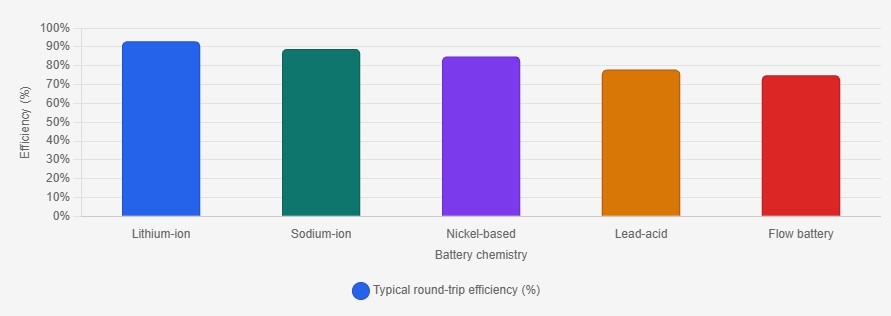
The chart compares representative round-trip efficiency values for widely used battery chemistries. Actual performance varies with temperature, depth of discharge, charging rate, system design, and operating conditions. Lithium-ion and sodium-ion systems generally provide high efficiency, while lead-acid and flow batteries can offer different advantages in cost, safety, lifespan, and scalability.
Key Solar Battery Types Available to Global Buyers in 20262026 Top Solar Battery Types for Global BuyersKey Solar Battery Types Available to Global Buyers in 2026
Global buyers can choose from several solar battery types in 2026. Lithium iron phosphate batteries remain popular for homes and small businesses. They offer strong cycle life, stable thermal performance, and useful daily storage. Their heavier weight can matter in rooftop installations with limited structural capacity. Lithium nickel manganese cobalt batteries provide high energy density. However, buyers should assess thermal controls, installation space, and maintenance requirements carefully.
Lead-acid batteries still serve budget-focused projects and backup systems. They usually cost less upfront but require more space and regular care. Their usable capacity and service life may disappoint under frequent cycling. Sodium-ion batteries are gaining attention in markets needing lower-cost materials and improved cold-weather performance. Availability remains uneven. Flow batteries can suit larger commercial projects because they support deep cycling and long-duration storage. They need more room, pumps, and professional system design.
The right choice depends on climate, electricity prices, load patterns, and local technical standards. A coastal buyer should ask about corrosion protection and enclosure ratings. A cold-region buyer needs verified low-temperature charging performance. I would not select a battery from price alone. Warranty wording, tested capacity, recycling arrangements, and installer experience deserve equal attention. A spreadsheet can still mislead. Real household loads often change with heating, cooking, and seasonal sunlight, so measured consumption data is more valuable than assumptions.
How Lithium-Ion Batteries Compare With Lead-Acid Alternatives
For global buyers, lithium-ion and lead-acid remain the main choices for Solar Batteries For Solar Panels. Lithium-ion systems usually deliver 90–95% round-trip efficiency, while lead-acid often reaches 75–85%, according to the U.S. National Renewable Energy Laboratory. That difference matters when panels produce limited winter electricity. A Lithium Battery can also use a larger share of its rated capacity without severe damage. It occupies less space beside an inverter.
Lead-acid still has practical strengths. Its established recycling networks and lower purchase price can suit small, stationary projects. However, regular deep cycling shortens its service life. The International Renewable Energy Agency reports that lithium-ion storage costs have declined sharply since 2010, although installation, safety controls, and replacement planning still affect total ownership costs. BloombergNEF reported an average lithium-ion pack price of 115 dollars per kilowatt-hour in 2024. Pack prices are not complete system prices. Buyers sometimes miss that detail.
In field assessments, temperature and charging habits often decide performance. A battery cabinet in a hot, poorly ventilated room may age faster than expected. Lithium-ion needs a battery-management system and certified protection equipment. Lead-acid needs ventilation, inspection, and careful charging. Neither option is automatically better. I would question quotations that promise a fixed lifespan without stating cycle depth, ambient temperature, and warranty conditions. The Global Solar Atlas can help estimate local sunlight, but actual household loads still need measurement. Small errors there can distort battery sizing.
2026 Top Solar Battery Types for Global Buyers – How Lithium-Ion Batteries Compare With Lead-Acid Alternatives
| Comparison Dimension | Lithium-Ion(Primarily LFP) | Flooded Lead-Acid | AGM Lead-Acid | Gel Lead-Acid |
|---|---|---|---|---|
| Typical chemistry | Lithium iron phosphate (LFP) or other lithium-ion chemistries | Lead plates with liquid sulfuric-acid electrolyte | Lead plates with an absorbed glass-mat electrolyte | Lead plates with silica-gelled electrolyte |
| Recommended maximum depth of discharge | Typically 80–100%, depending on the battery management system and warranty conditions | Typically 50% for regular cycling | Typically 50% for regular cycling | Typically 50% for regular cycling |
| Round-trip efficiency | Approximately 90–98% | Approximately 75–85% | Approximately 75–85% | Approximately 75–85% |
| Typical cycle life at moderate operating conditions | Approximately 3,000–8,000 cycles | Approximately 300–1,000 cycles | Approximately 500–1,200 cycles | Approximately 500–1,500 cycles |
| Typical service life in solar storage | Approximately 10–15 years, subject to temperature, cycling, and system controls | Approximately 3–7 years | Approximately 4–8 years | Approximately 4–8 years |
| Usable energy from a 10 kWh nominal bank | Approximately 8–10 kWh | Approximately 5 kWh | Approximately 5 kWh | Approximately 5 kWh |
| Energy density by weight | Approximately 90–160 Wh/kg, depending on the pack design | Approximately 30–50 Wh/kg | Approximately 30–50 Wh/kg | Approximately 30–50 Wh/kg |
| Charging and discharging capability | Generally supports higher continuous power and faster charging | Lower charge rates are preferred to limit heat, gassing, and plate stress | Good short-duration power delivery; charge limits remain important | Usually requires conservative charging to prevent damage |
| Low-temperature performance | Discharging is generally possible below 0°C; charging may require heating or temperature protection | Can charge below 0°C, but available capacity and performance decline | Can charge below 0°C, but available capacity and performance decline | Charging below freezing can cause permanent damage |
| Maintenance requirements | Low; requires an integrated battery management system and suitable protection settings | High; water levels, ventilation, terminal condition, and equalization may require attention | Low; sealed construction reduces routine maintenance | Low; sealed construction reduces routine maintenance |
| Ventilation and installation | Normally no routine hydrogen ventilation; installation must follow electrical and thermal safety requirements | Requires adequate ventilation because charging can release hydrogen gas | Usually minimal gas release, but appropriate ventilation is still recommended | Usually minimal gas release, but appropriate ventilation is still recommended |
| Typical initial purchase cost per usable kWh | Usually higher than lead-acid when compared at the same nominal capacity | Usually the lowest initial cost | Usually higher than flooded lead-acid | Usually higher than flooded lead-acid |
| Lifetime cost for frequent daily cycling | Often lower because of higher efficiency, deeper usable capacity, and longer cycle life | Often higher over the full system life because replacement may be frequent | Moderate to high, depending on cycling frequency and replacement needs | Moderate to high, depending on cycling frequency and replacement needs |
| Best-fit applications | Daily solar self-consumption, backup power, microgrids, and space-constrained installations | Low-cost backup systems with limited cycling and suitable ventilated spaces | Compact backup systems, mobile systems, and moderate-cycle applications | Stationary systems requiring sealed construction and moderate cycling |
| Overall suitability for frequent solar cycling | Excellent, when correctly sized and managed | Limited | Moderate | Moderate |
Note: Values are typical industry ranges for properly sized residential or small commercial solar-storage systems. Actual performance varies with battery design, operating temperature, charge and discharge rates, installation quality, inverter settings, and maintenance.
Flow, Sodium-Ion, and Emerging Battery Technologies Explained
For global solar buyers, flow batteries deserve attention when storage must last for many hours. They use liquid electrolytes in separate tanks, which can reduce degradation during repeated cycling. Their service life may be attractive for microgrids, farms, and commercial sites. However, pumps, larger footprints, and lower energy density can increase installation demands. They are rarely a simple replacement for compact home batteries. Size matters.
Sodium-ion batteries use more widely available sodium-based materials than many conventional chemistries. They can offer stable performance, strong safety potential, and useful operation in colder conditions. Yet energy density, cycle life, and manufacturing maturity vary between designs. Buyers should request independent test results, not rely on laboratory claims alone. Evidence is uneven. A 2026 procurement review should examine usable capacity, round-trip efficiency, thermal controls, warranty limits, and end-of-life handling.
Emerging technologies include solid-state, zinc-based, and iron-air systems. Some target higher safety or very long storage periods. Others remain limited to pilot projects or early commercial deployments. Their advertised potential can exceed real installation data. My own first comparison would have favored energy density too heavily; project reliability matters more than a compact enclosure. Ask for operating records across heat, cold, partial charging, and power interruptions. Local service skills also matter, especially where replacement parts travel long distances. A technically impressive battery can still perform poorly when commissioning support is weak.
Battery Capacity, Efficiency, Safety, and Lifespan Explained2026 Top Solar Battery Types for Global Buyers
Battery Capacity, Efficiency, Safety, and Lifespan Explained
For global buyers, battery capacity means more than a number on a data sheet. A 10 kWh unit may provide only 8 kWh at an 80 percent discharge limit. Daily loads matter too. A refrigerator, water pump, and evening lights create different demand patterns. Oversizing wastes money. Undersizing increases grid dependence. Lithium iron phosphate batteries often provide long cycle life and stable thermal performance. Lead-acid batteries may cost less, but they usually require more ventilation and replacement planning.
Efficiency shows how much stored energy returns after charging losses. Check round-trip efficiency, not only the inverter rating. A battery rated at 95 percent may perform differently in cold weather, partial loads, or later years. During practical site checks, cable length, loose connections, and poor installation can quietly reduce output. Safety depends on cell chemistry, a battery management system, enclosure design, and professional installation. Keep equipment away from heat, flooding, and blocked ventilation.
Lifespan is measured in cycles and years, but real usage decides the outcome. One daily cycle equals roughly 3,600 cycles over ten years. Capacity may still decline before that point. Review the warranty, operating temperature range, maintenance terms, and end-of-life capacity. I still find capacity figures easy to overread. Do not select Solar Batteries by price alone. That choice is tempting. A moderate system, correctly installed and monitored, may serve better than a larger battery used carelessly.
How to Match Solar Battery Types With Different Energy Needs
2026 Top Solar Battery Types for Global Buyers
Matching solar battery types to real energy needs requires more than comparing capacity labels. Start with daily electricity use, backup hours, and the appliances that matter most. A refrigerator may need steady power, while a water pump can demand a sharp starting surge. Measure both energy consumption and peak load.
Lithium iron phosphate batteries suit homes cycling every day because they offer strong usable capacity and long service life. They also need suitable temperature controls. Lead-acid batteries can fit smaller budgets, but frequent deep discharge may shorten their working life. Sodium-ion batteries are gaining attention in colder regions and cost-sensitive projects, although local availability remains uneven. Buyers researching Aa Solar Batteries should check usable capacity, not only the advertised battery size.
Small details matter.
A battery rated at 10 kWh may provide less than 10 kWh after reserve limits and conversion losses. For overnight backup, calculate the essential load first, then add a realistic margin. Do not size the system from a sunny summer day alone. Cloudy weeks, winter heating, and future appliances can change the result.
Field assessments often reveal another issue: the inverter cannot handle the motor’s starting surge. That mismatch is expensive and frustrating. A professional installer should review electrical compatibility, ventilation, monitoring access, warranty terms, and local service capability before purchase. Perfect matching is rare. Recheck the assumptions.
Global Buying Factors: Cost, Standards, Climate, and Installation
Global buyers should compare solar batteries through cost, standards, climate, and installation conditions. The cheapest quote can hide transport fees, replacement parts, or difficult commissioning. Ask for cycle-life data, usable capacity, warranty terms, and tested safety documents. Batteries And Solar systems should be priced by delivered energy, not only by purchase cost. A simple spreadsheet can expose weak assumptions.
Climate changes battery performance. In hot regions, high temperatures may reduce service life without ventilation or thermal control. In cold areas, charging limits can delay morning operation. Coastal sites need corrosion-resistant enclosures and careful cable sealing. Dusty farms require filters and scheduled inspections. These details matter. Yet climate ratings are not always measured under identical conditions, so buyers should question vague laboratory claims.
Standards differ across markets, so confirm local grid, fire, electrical, and recycling requirements before ordering. Use qualified installers who can verify clearances, earthing, disconnects, and emergency access. Installation quality often decides whether a good battery performs safely. Leave room for maintenance. A rushed layout may look efficient, but future repairs become expensive. Buyers should request commissioning records, staff training, and a realistic service response plan. I would not approve a project from price alone. Reliability needs evidence.
Solar Refrigerators: A Practical Guide to Clean, Reliable Cooling Solutions
Solar Refrigerators: A Practical Guide to Clean, Reliable Cooling Solutions
Solar refrigerators provide a practical way to preserve food and other temperature-sensitive supplies where grid electricity is unreliable or unavailable. Powered by solar panels and supported by batteries, they can maintain stable cooling during the day and continue operating at night. This makes them especially useful for rural homes, remote workplaces, outdoor facilities, and emergency settings. By using renewable energy instead of fuel-powered generators, they can reduce operating costs, noise, and dependence on traditional power sources.
When choosing a solar refrigerator, consider storage capacity, temperature control, insulation quality, and battery performance. Efficient models with strong insulation require less energy and can remain cold for longer during cloudy weather. A suitable solar system should include properly sized panels, a dependable battery, and a charge controller that protects the equipment from overcharging or deep discharge. For vaccine storage or other sensitive applications, built-in temperature monitoring and alarm functions can provide additional protection.
Regular maintenance helps ensure reliable performance. Keep the solar panels clean and unobstructed, check ventilation around the cooling unit, and inspect electrical connections periodically. Users should also place the refrigerator in a shaded, well-ventilated location and avoid opening the door unnecessarily. With the right setup and routine care, solar refrigeration can support safe food preservation, medical storage, and essential cooling in areas beyond the reach of conventional power networks.
Conclusion
Solar Batteries are a key part of modern energy systems, storing excess electricity from solar panels for use during nighttime, cloudy periods, or power interruptions. In 2026, global buyers can choose among lithium-ion, lead-acid, flow, sodium-ion, and other emerging technologies. Lithium-ion solutions generally offer high energy density, strong efficiency, and a longer service life, while lead-acid options may suit simpler systems with lower upfront budgets. Flow and sodium-ion batteries are gaining attention for specific applications where scalability, safety, material availability, or temperature performance are important.
Choosing the right battery requires more than comparing prices. Buyers should evaluate usable capacity, charge and discharge efficiency, expected lifespan, safety features, maintenance needs, and installation conditions. Household, commercial, and off-grid projects may require different storage sizes and operating characteristics. Climate, local electrical standards, transportation requirements, warranty terms, installer expertise, and long-term operating costs should also guide purchasing decisions. A careful comparison helps ensure reliable performance and better value across different energy needs and regions.
About Us
MH Energy specializes in advanced photovoltaic and energy storage technologies to address customer electricity needs, unlock the potential of clean energy, facilitate energy transition, and explore more possibilities for sustainable development.
Media Contact
Company Name: Meiheng Holding Group Co., Ltd.
Contact Person: Media Relations
Email: Send Email
Country: China
Website: https://www.mhsolarenergy.com/