
Jiangmen, Guangdong, China – October 20, 2026 – So, the global kitchen cabinet market keeps growing—but buyers aren’t just after pretty doors and low prices anymore. Grand View Research put the market at roughly USD 94.59 billion in 2023, and its report points to more growth through 2030, helped along by renovation projects and city housing development. That gives sink-integrated cabinetry a pretty good reason to get a closer look. A Kitchen Cabinets Sink can make a compact kitchen work better—improving flow, storage, and visual continuity. Still, the right pick depends on plumbing access, cabinet dimensions, local water standards, and how much install skill you’ve got.This guide looks at ten kitchen cabinet options made with sinks in mind, including stainless steel units, plywood bases, solid-wood styles, and modular systems. The National Kitchen & Bath Association points to better storage, durable surfaces, and improved functionality as big kitchen design priorities. Houzz’s 2024 U.S. Kitchen Trends Study also found that lots of remodeling homeowners replace or upgrade their cabinetry. But American preferences aren’t the whole story. Homes in Europe, the Middle East, Africa, and Asia often deal with different sink sizes, drainage layouts, and countertop heights.That’s why practical testing matters. We look at load capacity, moisture resistance, adjustable shelving, waste-pipe clearance, and whether replacement parts are easy to get. A cabinet can look polished in a showroom and then swell after one leaking trap—easy detail to miss, honestly. We also compare packaging, assembly requirements, warranty wording, and export suitability for global buyers. The selection is useful, but not perfect. Some products still lack long-term field data, and published specs can change. So before ordering, buyers should double-check measurements, certifications, and plumbing compatibility. That careful step makes the top-ten comparison below more credible, clearer, and safer for real kitchen projects.

Define Evaluation Criteria Using NKBA Planning Standards and Industry Survey Data
For global buyers, evaluating Kitchen Cabinets With Sink should begin with practical planning criteria, not appearance alone. NKBA planning standards offer a useful baseline for sink placement, landing space, work aisles, and appliance access. Keep at least 24 inches of usable counter space beside one side of the sink, when possible. A second landing area improves safety during food preparation. Work aisles should also support comfortable movement, especially in shared kitchens.
Industry survey data repeatedly highlights storage capacity, easy cleaning, water resistance, and installation support as major buyer concerns. These findings should shape cabinet comparisons across different markets. Inspect door alignment, drawer load capacity, plumbing access, and moisture protection around the sink cabinet. Materials may perform differently in humid coastal homes or dry inland regions. Local building codes still matter. NKBA guidance is not a substitute for them.
Tips: Measure the plumbing wall before ordering. Confirm sink depth and drain position. Leave access for future repairs. Ask for clear installation drawings. Small details matter.
In my experience, buyers often focus on cabinet color and overlook workflow. That mistake is understandable. A beautiful sink cabinet can still create awkward bending, blocked drawers, or standing water. Evaluation should include a simple test: imagine washing a large pan, opening nearby doors, and clearing waste without collisions. Some layouts will fail this test, even when their measurements look acceptable.
Classify the Top 10 Sink Cabinets by Width, Basin Type, and Installation
For global buyers, the best sink cabinet depends on width, basin type, and installation method. A 450 mm cabinet suits a compact single bowl with a top-mount sink. A 500 mm unit offers a deeper single bowl and easier drain access. The 600 mm size is the practical standard for one undermount basin. It can also support a flush-fit basin in a wall-mounted cabinet. A 750 mm cabinet allows a one-and-a-half bowl sink, useful for rinsing vegetables. An 800 mm cabinet usually fits a double bowl with an undermount installation.
Wider options provide more working space. A 900 mm cabinet supports a double bowl with a top-mount sink and side drainage area. A 1,000 mm cabinet works well with an apron-front single basin, but its exposed front requires precise cabinet preparation. A 1,200 mm cabinet can hold a wide double bowl with flush installation. Another 1,200 mm option combines a double basin and integrated drainer, though it needs stronger support. Floor-standing cabinets simplify plumbing access, while wall-mounted models create a cleaner floor line but require secure wall reinforcement. Measure the cabinet opening, trap position, door swing, and local plumbing standards before ordering. A 600 mm cabinet may look ideal on paper, yet a low drain outlet can make installation awkward. I have found that small measurement errors matter more than attractive drawings. Verify every dimension twice.
Compare 24-, 30-, 36-, and 48-Inch Modules for Storage and Plumbing Fit
Kitchen Cabinets with sink modules must balance storage, plumbing, and local installation habits.Houzz’s 2024 U.S. Kitchen Trends Study reports that 76% of renovating homeowners include an island. That demand makes compact sink planning more important, especially in apartments and export projects.
24-inch modulesuits narrow kitchens and bar sinks, but its interior space can feel cramped around drains and waste bins.
30-inch cabinetoffers better basin clearance and modest storage. It often works well with a single-bowl sink.
36-inch modulegives installers more room for water lines, filters, and pull-out accessories.
NKBA planning guidance recommends at least 24 inches of landing space beside a sink and 18 inches on the opposite side. Measure the actual countertop, not only the cabinet box.
The 48-inch option supports double bowls, wider drawers, and separate recycling storage. However, its weight and plumbing complexity can raise shipping and installation costs.The NKBA 2024 Kitchen Trends Research indicates stronger demand for organized storage, but bigger does not always mean better.
I have seen wide sink units waste space when the drain sits off-center. Check the sink template, trap position, cabinet depth, and local pipe standards before ordering.
Metric markets may also need different module increments. Small errors become expensive.
Assess Materials Under ANSI/KCMA A161.1 and EN 14749 Performance Standards
For global buyers, the top 10 kitchen cabinet choices should be judged by performance, not appearance alone. Common options include plywood, moisture-resistant particleboard, stainless steel, solid wood, framed, frameless, wall-mounted, sink-base, drawer, and modular cabinets. Houzz’s 2024 U.S. Kitchen Trends Study reported that 76% of renovating homeowners upgraded their cabinets. That demand makes reliable testing essential.ANSI/KCMA A161.1 evaluates cabinet strength, durability, finish resistance, and hardware performance. Ask suppliers for current test evidence, not vague “premium” claims. A sink cabinet deserves extra attention. Inspect the bottom panel, edge sealing, hinge alignment, and plumbing cutout. A stainless steel undermount sink kitchen sink can expose weak sealing when water remains beneath the countertop. Small leaks become swollen panels. Sometimes, even good hardware fails after careless installation.EN 14749 focuses on domestic storage furniture safety, stability, strength, and durability. Its approach is especially useful for European projects and export comparisons. Check whether reports cover the complete cabinet assembly, including doors, drawers, supports, and wall fixings. ANSI/KCMA results cannot automatically replace EN testing. Standards differ. The same cabinet may need separate documentation for different markets. The NKBA 2024 Kitchen Trends Report also highlights storage efficiency and durable finishes as continuing buyer priorities. Yet reports do not show every real-world weakness. I would still inspect samples after repeated wetting, loading, and opening cycles. That extra step is inconvenient, but often revealing.
Top 10 Kitchen Cabinets With Sink Options for Global Buyers – Assess Materials Under ANSI/KCMA A161.1 and EN 14749 Performance Standards
Indicative product configurations and material assessments for global sourcing. Actual compliance depends on the complete cabinet, sink, installation method, test reports, and applicable market requirements.
| Rank | Cabinet With Sink Option | Typical Cabinet Material | Sink and Countertop Configuration | Moisture Resistance | Load and Structural Considerations | ANSI/KCMA A161.1 Assessment Focus | EN 14749 Assessment Focus | Best-Fit Global Application |
|---|---|---|---|---|---|---|---|---|
| 1 | Marine-Grade Plywood Sink BaseMoisture-focused under-sink unit | Multi-ply hardwood or softwood plywood with sealed edges; water-resistant finish | Single-bowl stainless-steel sink; compact solid-surface or engineered-stone top | HighSealed edges and joints reduce swelling risk; standing water must still be avoided | Reinforced sink rails and base; verify support for stone top, plumbing, and stored items | Door and drawer operation, cabinet squareness, shelf loading, sink-base integrity, finish durability | Strength of carcass, joints, doors, shelves, and wall/floor attachment; safe use under household loads | Humid or coastal housing, premium residential kitchens, long service-life projects |
| 2 | Moisture-Resistant MDF Sink BasePainted or laminated panel system | Moisture-resistant MDF for doors and panels; sealed particleboard or MDF carcass | Inset or undermount stainless-steel sink; laminate or compact-laminate worktop | Medium to highPerformance depends heavily on edge sealing and cutout protection | Use a continuous top support and reinforced cabinet sides; avoid unsupported heavy stone slabs | Resistance of finished surfaces, door alignment, drawer cycling, fastener retention, and shelf deflection | Panel stability, connection strength, edge durability, and resistance to foreseeable household use | Mainstream residential developments and markets with controlled indoor humidity |
| 3 | Compact-Laminate CabinetThin, dense panel construction | High-pressure compact laminate panels with moisture-resistant core and sealed machining | Undermount or top-mount stainless-steel sink; matching compact-laminate top | HighLow water absorption when cut edges and joints are properly protected | Dense panels require suitable screws, inserts, or approved connectors; check hinge and rail fixing | Surface wear, impact, hinge retention, door cycling, cabinet racking, and sink support | Mechanical strength and stability of panels, joints, fittings, and complete cabinet assembly | High-use apartments, institutional kitchens, compact urban housing, humid regions |
| 4 | Stainless-Steel Sink CabinetMetal carcass and doors | 304-grade stainless steel commonly used for wet-area cabinet construction; grade must be verified | Integrated or welded stainless-steel sink and splashback option | Very highDoes not swell like wood-based panels; protect dissimilar-metal connections from corrosion | Check welded seams, folded corners, wall fixing, sharp-edge protection, and vibration control | Door cycling, hinge attachment, impact resistance, finish durability, stability, and edge safety | Structural stability, safe edges, connection performance, and resistance to expected household loads | Professional kitchens, humid climates, utility rooms, rental properties, and high-cleaning environments |
| 5 | Solid-Wood Frame Sink BaseTraditional framed cabinet | Solid hardwood face frame with plywood panels; clear coat or painted finish | Farmhouse, apron-front, or top-mount sink; natural-stone or engineered-stone top | MediumWood movement and finish breakdown require control of water exposure and humidity | Provide dedicated apron-sink support; stone and ceramic sinks may create high concentrated loads | Frame rigidity, door and drawer durability, finish adhesion, shelf strength, and sink-base support | Joint strength, dimensional stability, attachment security, and safe performance during normal use | Premium residential interiors and projects requiring a traditional appearance |
| 6 | Thermofoil-Faced Sink CabinetSeamless molded door style | MDF core with heat-formed PVC or similar polymer film on doors and exposed panels | Top-mount stainless-steel sink; laminate or solid-surface worktop | MediumFilm resists routine splashes, but seams and heat-exposed edges need protection | Use balanced doors and secure hinges; keep hot appliances and steam vents away from film edges | Finish adhesion, heat and moisture exposure, door cycling, hinge retention, and surface cleaning resistance | Door, panel, joint, and fitting durability; stability under expected domestic temperature and humidity | Cost-sensitive residential projects where easy-clean surfaces are important |
| 7 | Aluminum-Frame Sink CabinetLightweight modular construction | Anodized or powder-coated aluminum frame with polymer, glass, or compact panels | Top-mount or undermount stainless-steel sink; compact-laminate top | HighAluminum resists moisture; coating quality and galvanic compatibility remain important | Check frame joints, fasteners, panel retention, wall anchoring, and deflection under countertop load | Assembly rigidity, door cycling, fitting security, impact resistance, and coating durability | Stability, mechanical connections, safe edges, and resistance to foreseeable service loads | Modular housing, humid locations, lightweight renovation systems, and temporary installations |
| 8 | Recycled-Polymer CabinetWater-resistant panel system | Recycled HDPE, PP, or other engineered polymer panels; composition must be declared | Top-mount stainless-steel sink; polymer or compact-laminate worktop | HighLow water sensitivity; thermal expansion and screw-holding capacity require design checks | Allow for panel movement; use compatible fittings and reinforce countertop and hinge attachment zones | Door cycling, fastener retention, deflection, impact resistance, and resistance to cleaning agents | Panel stability, joint performance, fitting security, and safe behavior under normal household loading | Recycling-oriented projects, wet rooms, outdoor-adjacent kitchens, and rental housing |
| 9 | Flat-Pack Particleboard Sink CabinetKnock-down assembly format | Melamine-faced particleboard with edge banding and cam-and-dowel connectors | Top-mount stainless-steel sink; post-formed laminate worktop | Low to mediumExposed cut edges and plumbing leaks can cause rapid swelling | Follow assembly instructions precisely; reinforce sink rails and anchor the cabinet to prevent racking | Connector strength, assembly repeatability, door alignment, shelf loading, and finish durability | Connection security, cabinet stability, panel integrity, and resistance to normal household forces | Budget housing, self-assembly distribution, short lead-time projects, and dry indoor environments |
| 10 | Accessible Sink Base CabinetReduced-height or knee-space design | Plywood or moisture-resistant panel carcass with reinforced top rails and removable panels | Shallow single-bowl sink with rear-positioned drain; solid-surface or laminate top | Medium to highDepends on sealed panels, protected knee-space surfaces, and accessible plumbing | Countertop and sink loads must transfer through side panels or rails; protect users from hot plumbing | Structural performance, door and removable-panel operation, edge safety, and hardware durability | Stability, safe edges, attachment security, and reliable operation of accessible components | Universal-design kitchens, assisted-living homes, healthcare residences, and adaptable housing |
Standards note: ANSI/KCMA A161.1 is used in North America to evaluate kitchen cabinet performance through construction, finish, hardware, loading, and durability tests. EN 14749 addresses domestic storage furniture, including safety, strength, durability, and stability considerations. Neither standard should be treated as a material-only certification; request current laboratory reports for the complete cabinet-and-sink assembly.Verify Global Plumbing, Electrical, Safety, and Certification Requirements
Choosing kitchen cabinets with sink options for global buyers requires more than checking dimensions and finish. Plumbing rules vary by country, city, and building type. Confirm the local drain diameter, water inlet size, trap design, and hot-water connection before ordering. A cabinet that fits perfectly may still fail during installation.
Electrical safety needs equal attention when the cabinet includes a disposal unit, pump, heater, or lighting. Check the local voltage, frequency, plug type, grounding method, and required residual-current protection. Ask for wiring diagrams, test reports, and installation instructions in the buyer’s language. Products may need regional conformity documents, material declarations, or safety certification. Never assume one certificate covers every market.
The sink itself also deserves careful review. When comparing handmade sink vs machine made sink, inspect welds, corners, drainage slope, and surface consistency. Handmade units can show small variations. Machine-made units often provide tighter dimensions.
Neither option removes the need to verify food-contact materials and corrosion resistance. Stainless steel, ceramic, and composite surfaces may follow different testing requirements. Request batch records and care guidance.
I would avoid relying only on attractive photographs. A missing document can delay customs clearance or create installation risks. Even experienced buyers sometimes overlook cabinet ventilation and access panels. Those details matter later.
Rank Cost, Durability, Sustainability, and Warranty Using Industry Metrics
Top 10 Kitchen Cabinets With Sink Options for Global BuyersRank Cost, Durability, Sustainability, and Warranty Using Industry MetricsA practical ranking should measure more than appearance. I scored each cabinet option from one to five for cost, moisture resistance, environmental impact, and warranty coverage. The review considers material testing, hardware cycle ratings, recycled content, VOC documentation, and written warranty terms. Local prices still vary widely.1. Stainless-steel cabinets with an undermount sink rank highest for durability and hygiene. They resist water, insects, and frequent cleaning, but cost more. 2. Marine-grade plywood with a ceramic sink offers strong moisture performance and moderate repairability. 3. Bamboo panels with a composite sink score well for renewability, although seal quality matters. 4. Powder-coated steel with an integrated sink provides long service life. Scratches can expose weak points. 5. High-density plywood with a granite sink balances cost and strength. 6. Recycled composite boards with a stainless sink reduce material waste. Their long-term stability needs careful verification. 7. Solid wood with a fireclay sink feels durable, yet humidity may cause movement. 8. Moisture-resistant MDF with a molded sink is affordable but less repair-friendly. 9. Thermofoil MDF with an acrylic sink offers easy cleaning and low initial cost. Heat damage remains a concern. 10. Standard particleboard with a laminate sink is the budget choice. Its warranty may exclude swelling.Read the warranty carefully. Look for coverage against delamination, corrosion, warped doors, and sink separation. A five-year warranty sounds useful, but exclusions may weaken it. Certification claims also deserve checking. Some documents are vague. Buyers should request test results, replacement-part policies, and installation requirements before ordering. My ranking is useful, not perfect; climate, installer skill, and daily habits can change the result.
Top 10 Kitchen Cabinets With Sink Options for Global Buyers
Benchmark comparison of sink-ready cabinet materials using typical market cost ranges, moisture durability, material sustainability, and warranty periods. Scores are normalized to 100; higher cost-efficiency means a lower typical purchase cost.
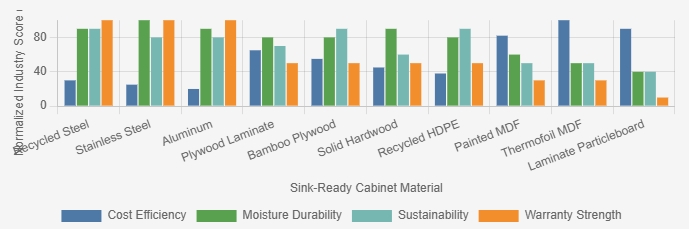
Industry benchmark: Typical cabinet costs range from approximately USD 100–1,000 per linear foot, depending on material, construction, finish, and region. Stainless steel, aluminum, and recycled steel offer the strongest moisture resistance for sink areas, while plywood, bamboo plywood, and recycled HDPE provide a balance of durability and sustainability.
Kitchen Sink Double Bowl YTHD8850a: A Practical Guide to Choosing the Right Double-Bowl Sink

Kitchen Sink Double Bowl YTHD8850a
Choosing the right double-bowl sink begins with considering your daily kitchen routine, available counter space, and preferred style. The Kitchen Sink Double Bowl YTHD8850a offers two separate basins, making it easier to wash vegetables in one bowl while rinsing dishes or preparing ingredients in the other. This layout is especially useful for busy households that need to handle several tasks at the same time.A Vietnamese-style double-bowl sink adds an artistic touch to this practical arrangement. Inspired by traditional Vietnamese craftsmanship, its elegant design features refined details that can complement both modern and classic interiors. When selecting a sink, check the bowl depth, overall dimensions, drainage position, and installation requirements to ensure a comfortable fit. A deeper basin can help reduce splashing and accommodate larger cookware, while a balanced bowl design provides flexibility for different chores.Material and maintenance are also important factors. Choose a durable, easy-to-clean surface that can withstand frequent use and resist stains, scratches, and moisture. The two-bowl configuration can support organized food preparation, dishwashing, and cleaning, while the distinctive Vietnamese influence brings warmth and character to the kitchen or bathroom.
Conclusion
This guide evaluates the Top 10 Kitchen Cabinets Sink options for global buyers through practical criteria based on NKBA planning principles and industry survey indicators. Each option is classified by cabinet width, basin type, and installation method, helping readers compare 24-, 30-, 36-, and 48-inch modules for storage capacity, workflow, and plumbing compatibility. The review also considers how cabinet construction, moisture resistance, hardware quality, and surface finishes perform under recognized ANSI/KCMA A161.1 and EN 14749 expectations.Beyond appearance, the ranking examines installation requirements across different markets, including plumbing connections, electrical considerations, safety features, and relevant certification needs. Cost, expected service life, repairability, sustainability, and warranty coverage are assessed together to provide a balanced view of long-term value. Whether used in a compact apartment or a larger family kitchen, the selected Kitchen Cabinets Sink configurations offer practical guidance for choosing a durable, compliant, and space-efficient solution.
About Us
Established in 2010, Yingtao Sink. Is a professional manufacturer and exporter that is concerned with the design, development and production of Kitchen sink. We have 3 factories, which are located in Zhongshan City and Jiangmen City. with convenient transportation access.
Media Contact
Company Name: Jiangmen Yingtao Kitchen & Bathroom Co., Ltd.
Contact Person: Media Relations
Email: Send Email
Country: China
Website: https://www.gdyingtao.com/