
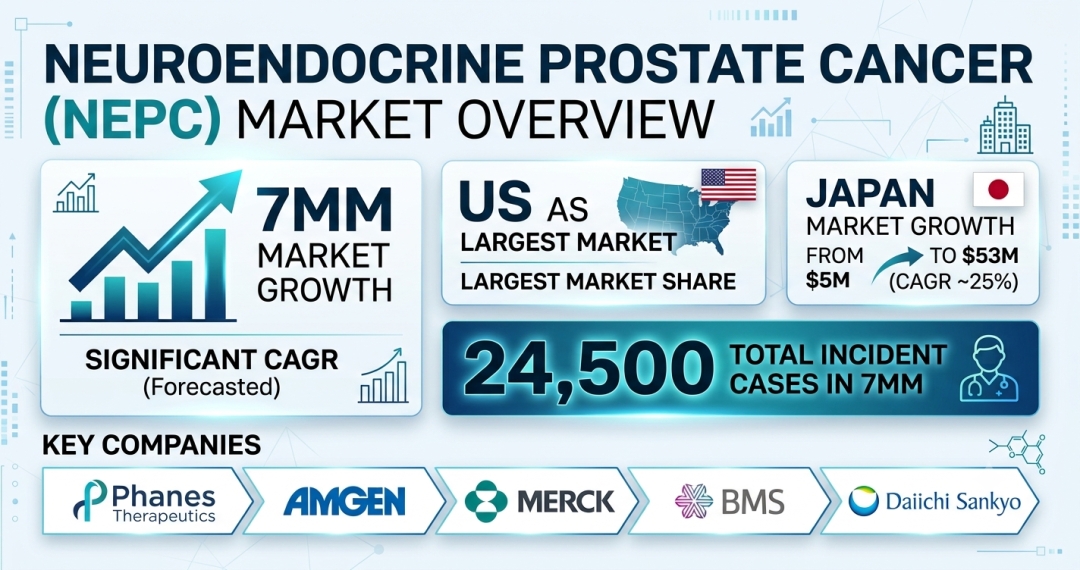
(Albany, US), October 15, 2026 – DelveInsight’s ‘Neuroendocrine Prostate Cancer (NEPC) Market Insights, Epidemiology and Market Forecast – 2036’ report delivers an in-depth understanding of Neuroendocrine Prostate Cancer, historical and forecasted epidemiology, as well as the Neuroendocrine Prostate Cancer market trends in the United States, EU4 (Germany, Spain, Italy, and France) and the United Kingdom, and Japan.
Explore the intricate details of the Neuroendocrine Prostate Cancer Market Report @ Neuroendocrine Prostate Cancer Treatment Market Size
Key Takeaways from the Neuroendocrine Prostate Cancer Market Report
-
According to DelveInsight’s analysis, among the 7MM NEPC market, the United States was found to be the largest contributor in 2025.
-
In Japan, the NEPC market size was ~USD 5 million in 2025 and is projected to reach ~USD 53 million by 2036, growing at a CAGR of ~25% during 2026-2036.
-
According to DelveInsight’s estimates, the total incident cases of NEPC in the 7MM were approximately 24,500 in 2025.
-
Approximately 18,600 incident cases of NEPC were estimated to express DLL3 in 2025 across the 7MM, highlighting a substantial biomarker-defined population eligible for emerging targeted therapies.
-
A significant proportion of NEPC develops through treatment-induced lineage plasticity in patients with advanced prostate adenocarcinoma, highlighting the need for early detection, biomarker-driven diagnosis, and targeted therapies to improve clinical outcomes.
-
NEPC remains substantially underdiagnosed in routine clinical practice because diagnosis depends on histopathological confirmation from metastatic tumor biopsies, which are infrequently performed in patients with advanced mCRPC, and the true prevalence of NEPC is therefore likely underestimated.
-
There are no approved therapies specifically indicated for NEPC, and treatment is largely based on off-label regimens extrapolated from small-cell lung cancer.
-
The leading Neuroendocrine Prostate Cancer Companies include Phanes Therapeutics, Amgen, Merck Sharp & Dohme, Bristol-Myers Squibb, Merck, Daiichi Sankyo, Moonlight Bio, SystImmune, and others.
-
Promising Neuroendocrine Prostate Cancer Therapies include Peluntamig (PT217), Tarlatamab (AMG 757), Pembrolizumab (KEYTRUDA), Nivolumab (OPDIVO), Sacituzumab Tirumotecan (sac-TMT), Gocatamig, ML26, and others.
Get a Free sample for the Neuroendocrine Prostate Cancer Market Forecast, Size & Share Analysis Report @ Neuroendocrine Prostate Cancer Therapeutics Market
Neuroendocrine Prostate Cancer Overview
Neuroendocrine Prostate Cancer (NEPC) is a rare and highly aggressive subtype of prostate cancer characterized by neuroendocrine differentiation and loss of androgen receptor signaling. It most commonly develops as a treatment-emergent disease following prolonged androgen deprivation therapy (ADT) and androgen receptor pathway inhibitor (ARPI) treatment in patients with metastatic castration-resistant prostate cancer (mCRPC), although it can rarely occur as de novo disease. NEPC is associated with rapid progression, frequent visceral metastases, poor prognosis, and limited treatment options, with platinum-based chemotherapy remaining the current standard of care. NEPC is diagnosed through clinical evaluation, histopathological examination, immune-histochemical (IHC) assessment, and molecular characterization. Diagnostic evaluation typically includes serum prostate-specific antigen (PSA) and neuroendocrine biomarkers (e.g., chromogranin A, synaptophysin, and neuron-specific enolase), multiparametric imaging, tissue biopsy with histopathological confirmation, and IHC staining for neuroendocrine markers. In selected cases, molecular profiling and liquid biopsy may be performed to identify genomic alterations, assess lineage plasticity, and guide therapeutic decision-making.
Neuroendocrine Prostate Cancer Epidemiology Segmentation in the 7MM
-
Total Incident Cases of Neuroendocrine Prostate Cancer
-
De novo Neuroendocrine Prostate Cancer Cases
-
T-NEPC Cases
-
Stage-specific Cases of Neuroendocrine Prostate Cancer
-
DLL3-expressing Cases of Neuroendocrine Prostate Cancer
-
Histology Subtype-specific Cases of Neuroendocrine Prostate Cancer
-
Age-specific Cases of Neuroendocrine Prostate Cancer
-
Total Treated Cases of Neuroendocrine Prostate Cancer
Download the report to understand which factors are driving Neuroendocrine Prostate Cancer Epidemiology trends @ Neuroendocrine Prostate Cancer Prevalence
Neuroendocrine Prostate Cancer Epidemiology Key Findings
-
Among the EU4, Germany accounted for the highest number of incident cases of Neuroendocrine Prostate Cancer, followed by France, whereas Spain accounted for the lowest number of cases in 2025.
-
In 2025, distant-stage disease accounted for 78% of the incident NEPC population in the United States, followed by early-stage (22%) disease. This stage distribution is expected to remain largely stable through 2036.
-
In 2025 in Japan, patients aged >65 years accounted for the largest number of incident NEPC cases (approximately 1,770 cases), followed by those aged 60–65 years (approximately 1,000 cases) and those aged
-
T-NEPC represents the predominant subtype, whereas de novo NEPC accounts for only a small proportion of incident prostate cancer cases.
Approved Therapies for Neuroendocrine Prostate Cancer
Currently, no therapies are specifically approved for the treatment of Neuroendocrine Prostate Cancer. Clinical management primarily relies on platinum-based chemotherapy (e.g., carboplatin or cisplatin combined with etoposide or docetaxel) as the standard first-line treatment, while second-line options include cabazitaxel-based regimens, lurbinectedin, topotecan, temozolomide-based therapies, and platinum rechallenge in selected patients. Despite these treatments, responses are often short-lived, highlighting a significant unmet need for effective targeted therapies.
Neuroendocrine Prostate Cancer Pipeline Analysis
-
Peluntamig (PT217): Phanes Therapeutics
Peluntamig (PT217) is a first-in-class native IgG-like bispecific antibody targeting DLL3 and CD47, designed to selectively bind DLL3-expressing tumor cells while blocking the CD47 “do not eat me” signal, thereby enhancing macrophage-mediated phagocytosis and anti-tumor immune responses. The therapy is being developed for the treatment of SCLC and NECs, including NEPC. PT217 has received FTD for metastatic de novo or treatment-emergent NEPC. The ongoing Phase I/II SKYBRIDGE trial is evaluating the safety, tolerability, pharmacokinetics, pharmacodynamics, and preliminary efficacy of PT217 as both a monotherapy and in combination regimens in patients with advanced or refractory DLL3-expressing cancers.
-
Tarlatamab (AMG 757): Amgen
Tarlatamab (AMG 757) is a first-in-class DLL3-targeted BiTE immunotherapy developed by Amgen for the treatment of SCLC and NEPC. The therapy redirects CD3-positive T cells to DLL3-expressing tumor cells, promoting targeted T-cell-mediated cytotoxicity. Tarlatamab is being investigated in the ongoing Phase II study in patients with DLL3-positive metastatic prostate cancer, including NEPC, assessing its safety, tolerability, pharmacokinetics, and preliminary antitumor activity.
Discover more about therapies set to grab Major Neuroendocrine Prostate Cancer Market Share @ Neuroendocrine Prostate Cancer Market Drivers and Barriers
Neuroendocrine Prostate Cancer Market Outlook
The Neuroendocrine Prostate Cancer market is evolving from a treatment landscape dominated by platinum-based chemotherapy toward the development of biomarker-driven targeted therapies that address the unique molecular characteristics of this aggressive disease. Current management primarily relies on platinum-based regimens, with limited benefit from existing second-line therapies and no approved treatments specifically indicated for NEPC. Increasing research into novel approaches, including DLL3-targeted therapies, antibody-drug conjugates (ADCs), bispecific antibodies, CAR-T cell therapies, Aurora kinase inhibitors, EZH2 inhibitors, and immunotherapy-based combinations, reflects a shift toward precision medicine and more durable treatment strategies. The advancement of targeted pipeline therapies, increasing recognition of treatment-emergent NEPC, improvements in molecular diagnostics, and continued investment in precision oncology are expected to drive moderate growth in the 7MM NEPC market during the forecast period. The United States dominates the NEPC market due to higher diagnosis rates and clinical trial activity, while Europe and Japan are experiencing steady growth driven by improved diagnosis and adoption of emerging therapies.
Neuroendocrine Prostate Cancer Treatment Landscape
The primary goals of Neuroendocrine Prostate Cancer treatment are to control disease progression, prolong survival, relieve symptoms, and maintain quality of life. Management primarily relies on platinum-based chemotherapy, with carboplatin or cisplatin combined with etoposide or docetaxel serving as the standard first-line treatment. Following disease progression, second-line options include cabazitaxel, topotecan, lurbinectedin, temozolomide-based regimens, and platinum rechallenge in selected patients. Key factors driving the market include rising NEPC incidence, particularly among individuals aged 75–84 years, and growing opportunities in biomarker-driven targeted therapies supported by advances in understanding lineage plasticity and neuroendocrine differentiation.
To know more about Neuroendocrine Prostate Cancer Companies working in the treatment market, visit @ Neuroendocrine Prostate Cancer Market Access and Reimbursement
Scope of the Neuroendocrine Prostate Cancer Market Report
-
Coverage- 7MM
-
Study Period- 2022-2036
-
Forecast Period- 2026-2036
-
Neuroendocrine Prostate Cancer Companies- Phanes Therapeutics, Amgen, Merck Sharp & Dohme, Bristol-Myers Squibb, Merck, Daiichi Sankyo, Moonlight Bio, SystImmune, and others.
-
Neuroendocrine Prostate Cancer Therapies- Peluntamig (PT217), Tarlatamab (AMG 757), Pembrolizumab (KEYTRUDA), Nivolumab (OPDIVO), Sacituzumab Tirumotecan (sac-TMT), Gocatamig, ML26, and others.
-
Neuroendocrine Prostate Cancer Market Dynamics: Neuroendocrine Prostate Cancer market drivers and market barriers
-
Neuroendocrine Prostate Cancer Competitive Intelligence Analysis: SWOT Analysis, Conjoint Analysis
-
Neuroendocrine Prostate Cancer Unmet Needs, KOL Views, Reimbursement
Table of Contents
-
Key Insights
-
Report Introduction
-
Executive Summary of NEPC
-
Key Events
-
Epidemiology and Market Forecast Methodology
-
NEPC Market Overview at a Glance
-
Disease Background and Overview
-
Treatment
-
Epidemiology and Patient Population of NEPC
-
Patient Journey
-
Emerging Therapies
-
NEPC: 7MM Analysis
-
Unmet Needs
-
SWOT Analysis
-
KOL Views
-
Market Access and Reimbursement
-
Appendix
-
DelveInsight Capabilities
-
Disclaimer
-
About DelveInsight
Media Contact
Company Name: DelveInsight Business Research
Contact Person: Abhishek kumar
Email: Send Email
Phone: 9193216187
Address:304 S. Jones Blvd #2432
City: Las Vegas
State: Nevada
Country: United States
Website: https://www.delveinsight.com/report-store/neuroendocrine-prostate-cancer-market