
Beijing,China- October 08, 2026
Is Propylene Glycol Safe for Your Aluminium Plates? A Straight Answer for Specifiers
Propylene glycol seldom attacks aluminium on its own. The pH window, the inhibitor package and one suffix in the grade number decide whether your plates last three years or fifteen.
Aluminium does not need a special base fluid. It needs a formula whose inhibitor package was built with aluminium in mind, and a loop that stays inside the pH window where aluminium keeps its film. Those are two different requirements, and most specifications only cover the first one.
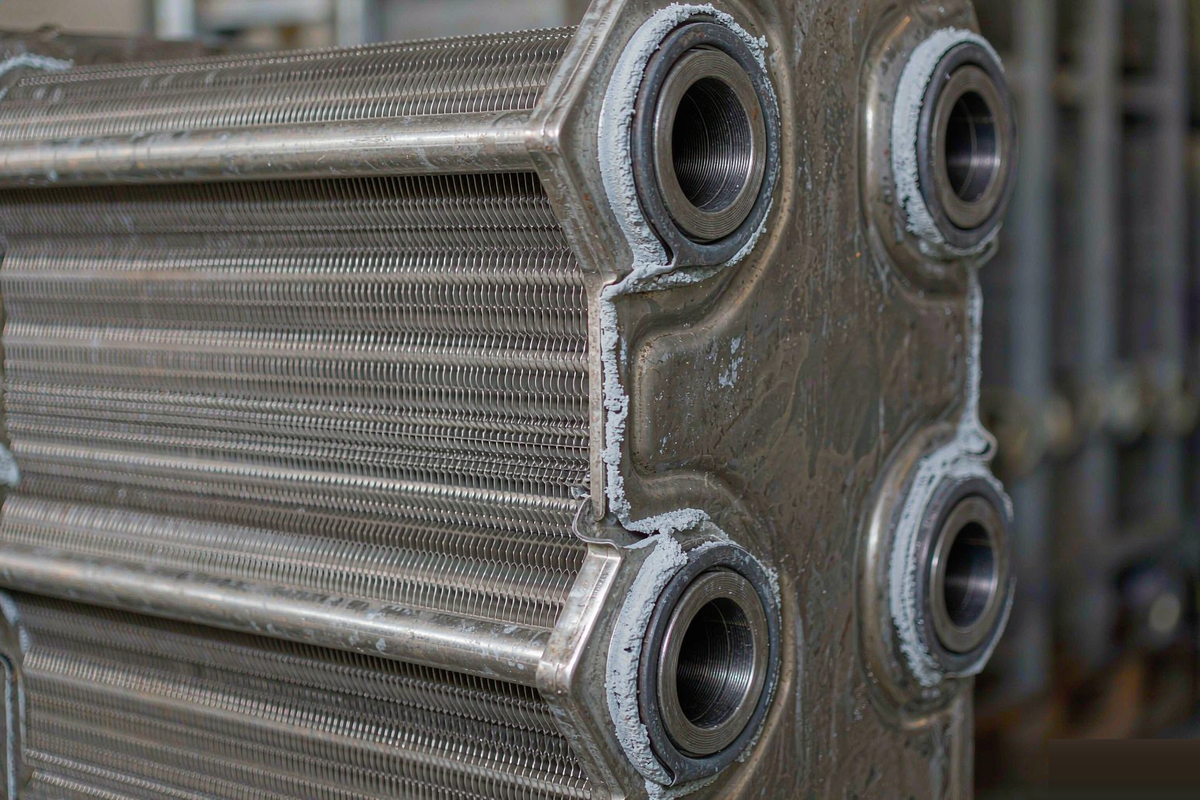
Is propylene glycol safe for aluminium? As a base fluid, generally yes. The trouble is that nobody buys a base fluid. What goes into the loop is inhibited coolant, and it is the inhibitor package, the make-up water quality and the pH drift that decide whether aluminium survives. An inhibited propylene glycol validated on steel tells you nothing about aluminium.
Do you need a special coolant for an aluminium plate exchanger? If the loop is aluminium-containing, yes — specify it deliberately rather than accepting whatever inhibited glycol is already on the truck. In our range that means a grade whose number ends in L. The letter is not decoration.
At Glacier Coolant we have spent thirty years matching formulas to metallurgy, because most of what we get called about is not a fluid failure. It is a specification that never asked about the metal.
Three ways aluminium actually fails
Aluminium behaves differently from steel, and most maintenance habits are inherited from steel loops. Three mechanisms account for nearly all of it.
| Mechanism | What drives it | Where it shows up |
|---|---|---|
| Film dissolution | pH drifting outside the window where the oxide film is stable | Uniform thinning, white or grey surface deposits, general metal loss |
| Halide pitting | Chloride and fluoride breaking the film locally | Deep narrow pits, often under deposits or in stagnant zones |
| Galvanic coupling | Aluminium electrically connected to a more noble metal | Attack concentrated near the joint, typically where the two metals touch |
The first one deserves attention, because it runs opposite to intuition. Aluminium oxide is amphoteric: it dissolves in strong acid and in strong alkali. General materials references put the stable window at roughly pH 4 to 8.5, and above roughly pH 9 the film starts going back into solution.
So a pH that creeps upward is the dangerous direction for aluminium. For carbon steel it is the other way round. Crews who learned their trade on steel loops reach for alkali when pH falls, and on an aluminium loop that correction overshoots straight into the range where aluminium loses its protection.
We are quoting textbook ranges here, not our own measurements. We have not run a pH-threshold study on aluminium in our own grades. But the direction of the effect is well established, and it is enough to change how you read a monthly pH sheet.
Why glycol takes the blame
When plates fail, glycol is the obvious suspect because it is the thing that was bought. Three other things are usually doing the work.
The inhibitor package was selected for steel. Most commercial inhibited glycols are optimised, tested and marketed against ferrous systems. Silicates, borates, nitrites, azoles — each behaves differently on aluminium, and plenty of packages simply have no aluminium data behind them. Untested is not the same as safe.
The make-up water was never tested. Cloride rides in with top-up water. So does hardness. Both cause trouble downstream: halides start pits, and scale creates the stagnant pocket under which pitting continues unseen.
Nobody owned the pH. Inhibitor gets consumed. Concentration drifts with top-ups and leaks. A loop commissioned at pH 7.5 can sit at 9.2 two years later, and by then the plates have already paid for it.
Notice that none of those is “propylene glycol attacked aluminium”. The base fluid does the heat transfer. Everything else is what it was mixed with and how it was looked after.
The suffix nobody told you about
Here is the part that is genuinely ours, and genuinely invisible from outside.
In our naming system, a trailing letter in the grade number tells you what the formula was inhibited for. The letters ride on top of a temperature band, and the full mapping from temperature band to grade family is the other half of the code:
| Suffix | Meaning | Typical use |
|---|---|---|
| L | Inhibited for aluminium and aluminium alloys | Any loop with aluminium wetted parts |
| G | Formulated for the high-temperature end of the range | Duty above roughly 50 °C |
| GL | Both: high temperature and aluminium | Hot loops with aluminium plates |
| D | Low conductivity | Fuel cells, data centre cold plates, immersion |
So LM-4 and LM-4L are not the same product with different marketing. The L version is the one specified for aluminium-containing loops. If your loop has aluminium in it and your grade carries no L, you have asked for a formula intended for steel, copper or both — not for your metal.
The aluminium-compatible grades, and the temperatures they cover:
| Grade | Temperature range | Notes |
|---|---|---|
| LM-4L | -35 to 50 °C | General industrial duty with aluminium wetted parts |
| LM-4GL | -35 to 130 °C | Same protection at the high-temperature end |
| LM-4ABL | -20 to 50 °C | Where the AB base is preferred |
| LM-8L | -50 to 100 °C | Non-flammable series, no flash point |
| LM-8GL | -50 to 100 °C | Non-flammable and high temperature |
Ranges shown are family figures from our product data; the exact envelope for your duty is something we confirm per enquiry rather than guess.
One consequence worth stating plainly: picking the aluminium grade costs you nothing in thermal performance at the same duty point. You are not trading heat transfer for compatibility. You are simply asking for the inhibition that actually matches the metal.
Reading “aluminium-compatible” on someone else’s datasheet
You will meet plenty of products claiming aluminium compatibility. Four questions separate a real claim from a marketing one:
- What is the test method? A coupon immersion result, an electrochemical measurement, or nothing at all? “Compatible” without a method behind it is not evidence.
- Over what temperature range? Compatibility established at ambient says nothing about 80 °C.
- What pH range does it assume? A package holding aluminium at pH 7 to 8 may not hold it at 9. If the datasheet gives no pH envelope, the claim has no operating boundary.
- What happens when it depletes? Every inhibitor package depletes. Ask what the reserve is and what the refill interval looks like.
A supplier who answers all four has done the work. One who answers with “it is fine for aluminium” has not.
Plates, brazing and the crevice you cannot see
A brazed plate unit is not a homogeneous block. It is plates, braze filler and ports in contact, and the filler metal differs from the plate — which is a galvanic couple inside the unit, before you add anything external. Add locations where flow stagnates: behind gasket edges, in port corners, at the bottom of a vertical pass.
Those are where crevice attack starts. It needs no defect in the fluid, only a geometry where solution stops moving.
The practical consequences for a specifier:
- Keep velocities inside the plate maker’s window. Too low and you get stagnation; too high and the protection gets stripped.
- Include aluminium-specific additive dosing in the maintenance plan from day one, not after the first leak.
- Do not ignore the small alarms. A pH sheet drifting steadily is cheaper to fix than a plate pack.
We supply fluids and the additive programme around them. Braze selection, plate metallurgy and joint design belong to the plate manufacturer, and we do not advise on them as though we did.
Keeping an aluminium loop aluminium-safe
Our recommended rhythm borrows from how the rest of the range is maintained, with two additions.
| Action | Interval | Why |
|---|---|---|
| Log pH | Monthly | Catch upward drift before it leaves the film-stable window |
| Full sample analysis | Every six months | Inhibitor reserve, metals in solution, water content, halides |
| Top up with aluminium-grade additive | Every three to six months | Packages deplete; this restores the reserve |
| Check make-up water quality | Before it enters the loop | Cheapest place to stop halides and hardness |
A note on that additive line. For aluminium loops the additive has to be the one specified for aluminium rather than the general-purpose product, which is intended for stainless, carbon steel and copper. It is also the step most often skipped, because nothing looks wrong until something leaks.
One more cross-reference, since it comes up in nearly every aluminium enquiry. Of the industrial secondary loops we attended, roughly a quarter of the service calls were corrosion-driven. Aluminium loops sit inside that share. The figure covers all metals together — we do not have it broken down by metal, and we will not imply aluminium-specific numbers from it.
What we settle before an aluminium specification goes out
Four things worth fixing while the spec is still on paper — each one is cheaper there than after the plates are in.
- Deep cold with aluminium. Below about -70 °C we carry no grade with the L designation. A duty at -85 °C with aluminium in the loop gets a specific review, and the answer may well be that aluminium is the wrong metal at that temperature. Better to hear it at specification than in a year-two leak.
- Halides in your make-up water. We read the sample you send and tell you what it holds. Set the make-up water as your control point and the chloride question stops being a guessing game.
- Which numbers actually apply to aluminium. A corrosion-rate figure quoted against inhibited glycol describes a standard coupon, not an aluminium plate, and the pH window above is a general materials-reference range. We give you the direction from both, and a grade-specific figure wherever we hold one. If you are diagnosing a leaker rather than writing a spec, the three things that actually set the corrosion rate matter more than any single number.
- The alloy and the braze. Those sit with your exchanger maker. What we supply is the fluid side: what our fluid sees at the surface, and what it needs the metallurgy and the braze to tolerate.
What comes with an aluminium grade
Specifying the L variant should not be where the job stops.
- A compatibility read across your whole wetted list. Plates, braze, pumps, valves, fittings, expansion tank. Send the materials list with the enquiry; the L suffix only helps if every aluminium surface is accounted for.
- The suffix mapping on the quote itself — L for aluminium, G for sustained high temperature, GL for both — so the drawing office can verify it without another round of emails.
- The make-up water panel: halides and hardness in what you are putting in today, and a recommendation on where to set the control point. Fixing this at the tap is cheaper than fixing it in the plates.
- The additive programme for aluminium, with the dose and the interval stated, plus the reserve alkalinity to hold. Skipping it is the single most common reason an otherwise correct specification still leaks.
- The freezing-point curve and a concentration-and-pH log template, ready for commissioning, so nobody logs “is it still salty” into a carboxylate loop.
- A sample at one month to confirm where the pH has actually settled, then the interval for re-dosing.
And the point that usually settles the budget question: choosing the aluminium-specific grade costs you nothing in heat transfer. Same base fluid, same thermal duty at your conditions — the difference is which inhibitor package came with it.
Final thoughts
The summary version: aluminium needs its inhibitor validated for aluminium, a pH that stays in the window, make-up water that is not carrying halides, and a metal pairing that does not make it the anode. Check those four at specification stage and the plates usually outlive the equipment around them.
Where we fit: at Glacier Coolant we build aluminium-inhibited versions across the ranges that most industrial duties sit in, and we would rather put the L on the grade now than argue about failure causes in three years. Send us your duty temperatures, the metals in the loop and whether the make-up water is treated. We will tell you which grade fits, and — just as useful — whether aluminium is the right metal for that temperature at all.
Samples are free, including the analysis. If you want to check which of our grades carry the L designation before you write, they are in the grade list along with their temperature ranges.
About us
Building on this initial success, Glacier Coolant expanded its product line, developing anti-corrosion solutions tailored for a wide range of applications. By 2023, the company had introduced over 40 unique formulations, catering to diverse industries with an extensive temperature range of -110°C (-166°F) to 340°C (644°F). Our solutions now serve sectors such as food and beverage, HVAC, cold storage, data centers, and fuel cell cooling, with products including silicone oils, thermal oils, and phase change materials (PCMs) complementing our core offerings.
Media Contact
Company Name: Glacier Coolant Technology (Beijing) Co., Ltd.
Contact Person: Media Relations
Email: Send Email
Country: China
Website: https://www.glacierthermal.com/