
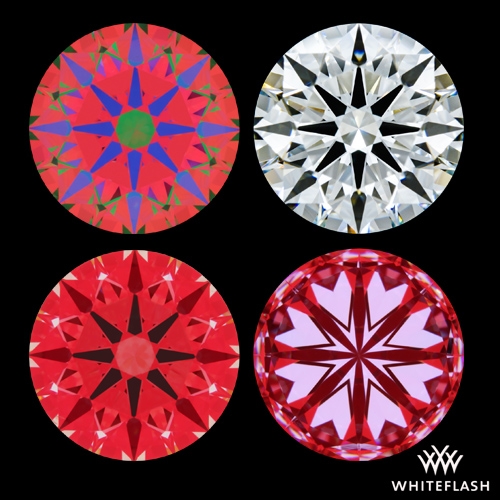
Houstan, Texas – September 25, 2026 – Three grades appear together on a GIA report for a round brilliant diamond that describe different aspects of the diamond. Cut grade, polish, and symmetry each describe a different quality factor of the finished diamond. For shoppers comparing natural diamonds online, treating the three grades as interchangeable can lead to a poor comparison. Excellent grades in all three categories are the goal. But each category answers a separate question. The report becomes more useful when those grades are read comprehensively alongside performance images and other cut-quality evidence.
Cut Grade Addresses the Diamond as a System
For a round brilliant diamond, the overall cut grade considers how the proportions and facet angles operate together in handling light. Facet angles, relative dimensions (percentages), durability considerations, and visual factors all contribute to light performance. Cut grade therefore covers more than polish or symmetry, which are considered finish grades.
GIA also limits the overall cut grade by shape. GIA provides an overall cut grade for round brilliant diamonds, while fancy shapes such as ovals, cushions, pears, radiants, and emerald cuts do not currently receive an overall cut grade. For those shapes, shoppers must rely on the available measurements, photography, HD video, 360-degree viewing, and expert guidance in order to evaluate light performance. Diamond cut quality depends on the facet arrangement that directs light through the stone. The report records measurements, proportions and finish grades. Images and other diagnostics show optical features that are not contained on a GIA report for non-round diamond shapes
GIA does however now provide AGS Ideal reports on qualifying round and fancy shape diamonds. This report is an addendum to the standard GIA report providing evidence that the diamond is cut to the highest level of the GIA Excellent grade.
Polish Describes the Facet Surfaces
Polish evaluates the finish of the diamond’s facets after cutting. It addresses surface characteristics left by the polishing process, including polishing lines, abrasions, pits, or other finish marks that may be visible under magnification. A high polish grade indicates that the facet surfaces were crafted to a mirror finish. The polish grade says nothing about the diamond’s proportions, facet pattern, or light performance. A diamond with Excellent polish may still return light poorly if proportions or facet precision is faulty. Polish is a finish grade. Shoppers still need the cut grade and direct evidence of optical performance.
Symmetry Is Not the Same as Optical Symmetry
Symmetry on a grading report refers to contiguous facets meeting at the proper points around the diamond. It is referred to as “meet point’ symmetry. It considers whether corresponding facets align properly, whether the table and culet are centered, and whether the outline and facet junctions are consistent. Optical symmetry (better termed optical precision) sets a higher bar. It describes the level of three-dimensional alignment of corresponding facets responsible for a distinct pattern of light and contrast in a precision-cut round diamond. A crisp Hearts & Arrows pattern provides visible evidence of that optical precision. Excellent symmetry on the grading report does not prove that level of alignment.
“When shoppers see three Excellent grades, it is easy to read them as an endorsement of top cut quality. But factors not contained on a GIA report are also importantThe report is most useful when each factor is understood on its own and then considered together with advanced light performance images,” said Bryan Boyne, VP at Whiteflash.
Triple Excellent Still Requires Context
The term GIA Triple Excellent means that a round brilliant diamond received Excellent grades for overall cut, polish, and symmetry. That is a useful threshold. The GIA Excellent cut category still includes a range of proportion combinations and does not document actual light return or optical precision. This limitation matters online, where shoppers cannot place several diamonds under the same lighting before making a selection. Shoppers looking for the very best in cut quality should look for GIA Ex diamonds with the AGS Ideal addendum report.A GIA grading report documents the diamond’s identity and general quality characteristics. Detailed images and video show the individual diamond. For Whiteflash in-house natural round diamonds, ASET imaging light maps document how the diamond gathers and returns light. Shoppers should read the three cut-related grades separately, and in combination with advanced light performance imaging that fills in the blanks of a GIA report.
About Whiteflash
Whiteflash is a modern jeweler specializing in precision cut diamonds, designer engagement rings, and fine diamond jewelry. As the exclusive home of A CUT ABOVE® Super Ideal natural diamonds, Whiteflash is internationally recognized for scientific light-performance analysis, including ASET, Ideal-Scope, and Hearts & Arrows imaging. Based in Houston, Texas, Whiteflash serves a global clientele and is an authorized retailer for the finest brand name designers including Tacori, Verragio, Simon G., A. Jaffe, and Vatche. Whiteflash offers the Lifetime Upgrade Program on individually certified loose A CUT ABOVE® diamonds.
Media Contact
Company Name: Whiteflash Inc.
Contact Person: Tiffany Moore
Email: Send Email
Phone: 8322526770
Address:2150 Town Square Place Suite 330
City: Sugar Land
State: TX
Country: United States
Website: Whiteflash.com