
Mumbai, India – September 21, 2026 – What are the lawyers and legal teams spending too much time on today? which parts of legal work can genuinely be streamlined or automated? And, perhaps most importantly, what does an AI-enabled legal function actually look like in practice?
What are lawyers and legal teams spending too much time on today? Which parts of legal work can genuinely be streamlined or automated? And, perhaps most importantly, what does an AI-enabled legal function actually look like in practice?
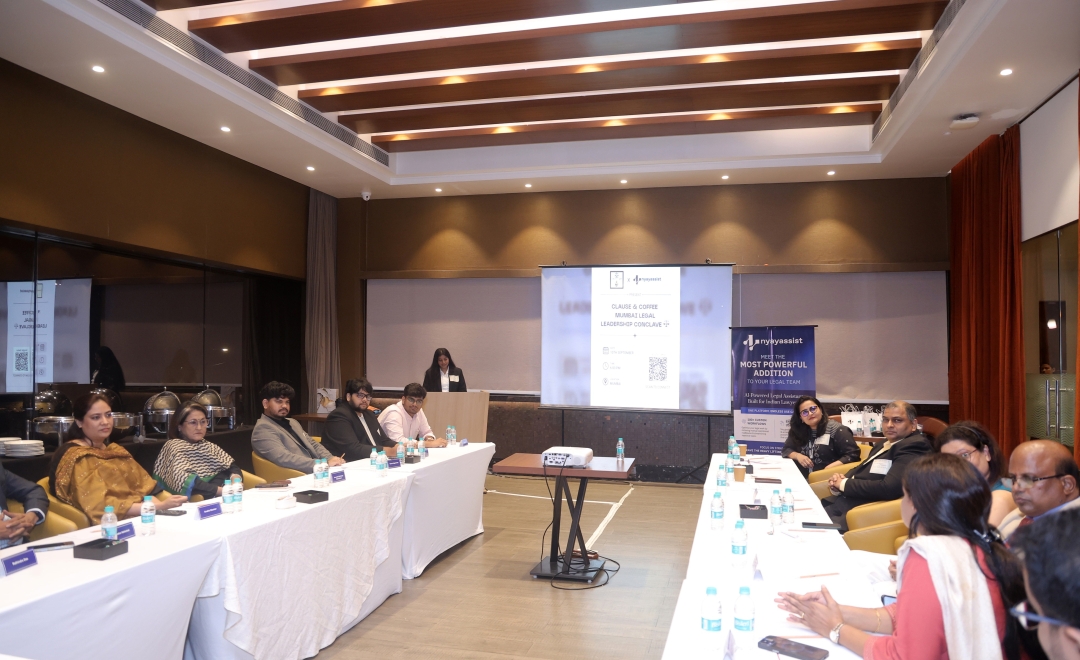
These were some of the questions at the heart of a recent panel discussion organised by NyayAssist, which brought together legal professionals from across the industry to discuss how legal work is changing and where it could go next.
The discussion, organised in association with Clause & Coffee, brought together perspectives from across different domains of the legal ecosystem. Rather than looking at AI simply as the next piece of technology for lawyers to adopt, the conversation focused on something more fundamental: understanding how legal teams actually work, where they face friction, and what technology can do to make that work better.
The conversation began with the realities of the present.
Across legal functions, professionals continue to spend significant time on tasks that are necessary but often repetitive, operational or information-heavy. The panel explored where this friction exists, how it differs across legal teams, and what could potentially be done differently.
That naturally led to a larger question: what should legal professionals be spending their time on?
As AI capabilities become increasingly sophisticated, the opportunity is no longer limited to making individual tasks faster. There is growing potential to rethink entire workflows & identify how processes can be streamlined. The diversity of the discussion was particularly valuable. Perspectives varied across different legal functions and working environments, highlighting that the challenges of a law firm, an in-house legal team, a law school where future legal professionals are being shaped or another part of the legal ecosystem are not necessarily the same.
And that distinction matters.
A technology solution that works well in one context may not necessarily translate into another. Understanding these nuances is therefore becoming increasingly important as legal technology moves from experimentation towards deeper adoption.
The discussion also looked ahead at what an AI-enabled legal function could eventually look like. Rather than a future where lawyers simply interact with a collection of AI tools, the conversation explored the possibility of intelligent workflows that work alongside legal teams, supporting them across different stages of their work and allowing professionals to focus more of their time on analysis, judgement, strategy and client outcomes.
The NyayAssist team also conducted a live demonstration during the session, giving participants an opportunity to see the platform’s capabilities firsthand and discuss them in the context of their own experiences.
The demonstration became an extension of the larger conversation, with participants sharing feedback and perspectives on how AI could be applied to real-world legal workflows.
For NyayAssist, this was an important part of the exercise.
As the company continues to expand its capabilities, it is increasingly focused on developing custom workflows designed around the way legal teams actually work. The objective is not simply to add more AI capabilities, but to understand where those capabilities can genuinely reduce friction, augment professionals and help legal teams function better.
The discussion offered a particularly useful perspective because there was no single answer to what the future of legal work should look like. Different professionals brought different priorities, challenges and expectations to the table.
Yet, one thing came through clearly in the discussion: law is more than a profession or a set of processes – it is a culture, with its own ways of thinking, working and exercising judgement. For AI to truly become part of that world, it will have to understand and respect that culture rather than simply ask lawyers to work differently.
For NyayAssist, that makes conversations with the legal ecosystem an important part of the building process. The insights from the discussion will help inform how the company develops its capabilities and custom workflows as it works towards a more contextual, practical and deeply integrated approach to AI in legal work.
The question, ultimately, may no longer be whether AI will change the legal function.
It is how thoughtfully the legal industry chooses to shape that change.
About the Product and Service
NyayAssist is not just another AI tool. It works with you as an intelligent legal assistant. Tasks that often take hours can now be completed in minutes, without loss of quality or control. The platform has dedicated feature sets for practicing professionals and law students.
Media Contact
Company Name: NyayAssist
Contact Person: Akshit Pithadia
Email: Send Email
Phone: 9820674931
City: Mumbai
State: Maharashtra
Country: India
Website: https://nyayassist.ai/