
Shenzhen, Guangdong, China – September 21, 2026
Trying to pick the best HDMI to DisplayPort adapter supplier in China? Well, honestly, the key isn’t about flashy packaging or dirt-cheap prices — it’s about the technical stuff backed by solid evidence.
A good, experienced supplier should be able to clearly explain how the signal is converted. There’s a big difference between just plugging in an HDMI source and expecting it to work with a DisplayPort monitor. For most reliable results, you’ll want an active adapter that either needs external power or both that and proper conversion. Passive adapters? They tend to be kinda flaky because HDMI and DisplayPort signals operate differently. So, paying attention to details really matters — like supported resolutions, refresh rates, HDCP support, how they handle EDID, connector build quality, and thermal performance.
As connectivity engineer Mark Chen puts it, “A stable adapter isn’t just about what the specs say — it shows itself through how well it performs in real life.” His advice is rooted in hands-on testing experience. A trustworthy supplier should be willing to share test reports, chipset info, burn-in test results, and compatibility details with various monitors, GPUs, laptops, and docking stations. Don’t just take vague claims at face value — ask if the adapter can handle 1080p, 4K, HDR, or high refresh rates under real-world conditions.
Also, look for suppliers who are transparent about their quality control processes. They should be able to show inspections of incoming components, automated soldering lines, cable strain tests, and final testing to make sure everything works as it should. Before ordering in bulk, get a sample, and test it out for several hours on different screens. Keep an eye out for flickering, black screens, audio issues, or any sudden reconnections — these are signs of potential problems.
Remember, the cheapest factory isn’t always the best one. Often, it’s the company that’s honest about potential flaws and documents their limitations transparently. That kind of honesty actually shows you can trust them more. Some suppliers overhype their products or overlook crucial power needs — so a professional supplier won’t hide these issues; instead, they’ll acknowledge and work to fix them. That kind of honesty isn’t perfect, but it’s way more trustworthy in the long run.
 HDMI to DisplayPort Adapters: Purpose, Standards, and Applications
HDMI to Displayport Adapters connect an HDMI source, such as a laptop or media player, to a DisplayPort monitor. They are useful when the computer lacks a native DisplayPort output. Most HDMI-to-DP models are active adapters, not simple passive plugs. They convert the signal internally. Many also need USB power for stable operation. A Displayport Adapter is usually directional, so it cannot automatically convert DisplayPort back to HDMI.
Standards matter during selection. HDMI 2.0 can support 4K at 60Hz under suitable conditions, while HDMI 2.1 offers higher bandwidth. DisplayPort 1.2 and 1.4 provide different resolution, refresh rate, and compression capabilities. The final result depends on every link in the system. Check the source port, monitor input, cable length, HDCP support, and audio requirements. A high specification on the package cannot improve a limited laptop port.
In practical testing, a short certified cable often produces a cleaner result than a long, poorly shielded one. I have also seen black screens caused by insufficient USB power, not a defective monitor. Real installations are less tidy than specification sheets. Some adapters work at 4K but lose high refresh rates. Others pass video but not sound. For offices, digital signage, classrooms, and gaming desks, test the complete setup before volume purchasing. Compatibility tables help, but hands-on verification remains necessary.
Key Features of a Reliable HDMI to DisplayPort AdapterChina Best HDMI to DisplayPort Adapter Supplier?
A reliable HDMI to DisplayPort adapter must perform active signal conversion. Passive wiring usually cannot translate HDMI timing into DisplayPort output. HDMI 2.1 supports bandwidth up to 48 Gbps, while DisplayPort 2.1 can reach 80 Gbps under UHBR20. The adapter must state its real conversion limit clearly. Higher numbers do not guarantee better performance.
Stable EDID communication matters during startup. It helps the computer recognize resolution, refresh rate, and audio correctly. Look for support for 4K at 60Hz, HDCP compatibility, and reliable audio transmission. Thermal control is also important. A compact metal shell can reduce heat near the connector, but only modestly. Continuous 4K output exposes weak designs quickly. According to Grand View Research, the global computer monitor market was valued at about USD 44.67 billion in 2023, increasing demand for dependable display connectivity.Source: Computer Monitor Market Size Report, 2024.
Connector direction deserves attention. HDMI source to DisplayPort monitor is not the same as DisplayPort source to HDMI screen. A supplier should label direction, power requirements, cable length, and tested operating systems. Some adapters need USB power, especially at higher resolutions. A Usb Type C Displayport connection may offer a cleaner setup, but it still requires compatible video output from the host device. Field testing should include sleep recovery, hot-plugging, and several hours of playback. Specification sheets can still mislead. I would ask for test records, not promises.
How to Evaluate Chinese HDMI to DisplayPort Adapter Suppliers
When evaluating a Chinese HDMI to DisplayPort adapter supplier, begin with technical evidence, not attractive pricing. HDMI Licensing Administrator reports over 10 billion HDMI-enabled products shipped worldwide, so compatibility claims must be precise. Check whether the adapter converts HDMI output to DisplayPort input. Many passive models only work in the opposite direction. Ask for test results covering resolution, refresh rate, EDID handling, HDCP support, and audio transmission. Confirm the connector shell, cable strain relief, and Hdmi Jack alignment through close-up samples.Bandwidth is another practical checkpoint. HDMI 2.1 supports up to 48 Gbps, according to HDMI specifications, while VESA’s DisplayPort 2.1 ecosystem includes DP40 and DP80 certified cables. A supplier should state the tested limit, not simply advertise “8K.” Request screenshots from a monitor test, including 4K at 120 Hz, sleep-wake recovery, and two-hour thermal operation. Look for stable casing temperatures and no intermittent black screen. Small details matter.Factory credibility needs physical verification. Review ISO 9001 records, component traceability, incoming inspection data, and corrective-action reports. Independent laboratory reports are stronger than edited videos. Request three samples from different production batches. Compare firmware behavior and connector fit. One sample passing is not enough. In my experience, suppliers often provide polished prototypes but weaker production units. That gap deserves attention. Use a written specification, random pre-shipment inspection, and a clear failure-replacement clause. These controls are consistent with VESA compliance practices and HDMI certification requirements.
Manufacturing Quality, Compatibility, and Certification Requirements
China Best HDMI to DisplayPort Adapter Supplier?A reliable supplier must prove conversion performance, not merely show a polished enclosure. HDMI sends video differently from DisplayPort, so passive wiring usually fails. An active adapter needs stable signal conversion, EDID handling, and dependable power management. The HDMI Forum specifies up to 48 Gbps for HDMI 2.1, while VESA lists up to 80 Gbps for DisplayPort 2.1 UHBR20. These figures expose weak chipsets quickly, especially at 4K or high refresh rates. Test samples should run for several hours, with repeated sleep and wake cycles.Compatibility needs careful inspection. The term Hdmi Type Cis often used loosely. It may describe Mini Hdmi Type C, or a USB Type-C device using DisplayPort Alt Mode. Those are not interchangeable. A supplier should publish connector direction, supported resolutions, refresh rates, HDCP behavior, and power requirements. VESA’s DisplayPort Alt Mode guidance confirms that USB Type-C hosts require suitable alternate-mode support. A small label error can create a large return rate.Certification is more than a printed logo. Ask for current HDMI compliance evidence, DisplayPort certification records, EMC test reports, and safety documentation for the destination market. The IEC 62368-1 framework is widely used for audio-video and ICT equipment safety. RoHS evidence also matters for restricted substances. I would inspect test dates, laboratory scope, and model numbers carefully. Certificates can look convincing while covering a different product revision. Suppliers should also provide production inspection records, cable strain tests, and sample-to-batch consistency data. The weak point is often documentation, not hardware.
Supplier Comparison: Pricing, Customization, and Production Capacity
China Best HDMI to DisplayPort Adapter Supplier?Price comparisons can mislead when adapters use different conversion chips. A low quotation may exclude testing, shielding, packaging, or active conversion components. Grand View Research estimates the global HDMI cable market reached about USD 2.57 billion in 2023. That scale supports competitive sourcing, but not every factory offers equal engineering depth. Ask for samples, chipset details, thermal test records, and failure-rate data before comparing unit prices.Customization changes the real cost. A capable supplier should adjust cable length, connector plating, shell design, labels, firmware, and packaging. For commercial displays, request stable 4K output, refresh-rate verification, HDCP compatibility, and repeated plug-cycle testing. VESA states that DisplayPort 2.1 can provide up to 80 Gbps of raw bandwidth, while HDMI 2.1 supports up to 48 Gbps. The adapter must handle the target signal, not just advertise “8K.” That wording is too simple.Production capacity needs evidence. Review monthly output, assembly-line photographs, component lead times, and inspection checkpoints. A supplier reporting 100,000 units monthly should show purchase records and recent batch data. Ask about defect rates after aging tests. A practical benchmark is less than 1% incoming failure, though product complexity can change it. This target needs verification, not trust. IDC reported 2024 global PC shipments at approximately 262.7 million units, indicating sustained demand for display connectivity. Still, forecasts do not replace factory audits. I would recheck every figure.
China HDMI to DisplayPort Adapter Supplier Comparison
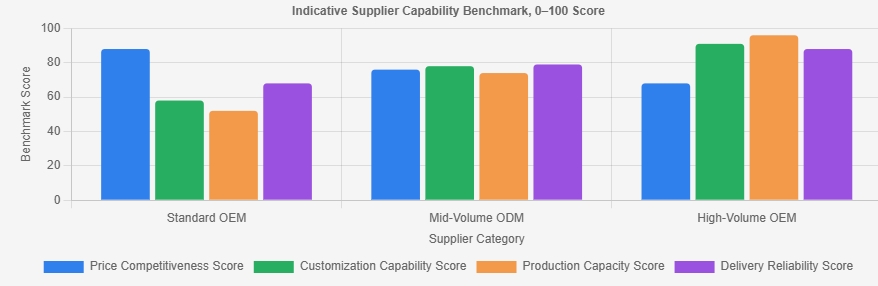
This benchmark compares common China OEM/ODM supplier tiers using indicative market-reference ranges for HDMI to DisplayPort adapter projects. Lower pricing and shorter lead times improve commercial competitiveness, while higher customization scores and monthly production capacity indicate stronger OEM/ODM capability.
Ordering Process, Quality Control, and After-Sales Support
China Best HDMI to DisplayPort Adapter Supplier?Choosing a reliable China-based HDMI to DisplayPort adapter supplier requires more than comparing prices. The ordering process should confirm direction, resolution, refresh rate, power needs, packaging, and certification documents. HDMI to DisplayPort conversion is usually directional and often requires an active adapter. A professional supplier should provide a written specification sheet before sampling. It should also confirm whether the product supports 4K at 60Hz, HDR, or higher refresh rates. Mistakes often begin with unclear purchase orders.Quality control needs measurable checkpoints. Factory staff should test every unit for signal stability, audio output, connector fit, and heat performance. They should record test results by batch and retain samples for later comparison. HDMI 2.1 supports bandwidth up to 48 Gbps, while DisplayPort 2.1 can support up to 80 Gbps under suitable conditions. The adapter cannot automatically deliver those maximum figures. Its chipset and design decide the real performance. The Global E-waste Monitor 2024 reported 62 million tonnes of electronic waste in 2022, with only 22.3% formally recycled. Longer product life matters.After-sales support should include a defined response time, replacement rules, and troubleshooting evidence. Ask for serial-number traceability and remote testing guidance. A useful supplier can analyze photos, monitor logs, and failed samples instead of blaming installation immediately. Even good factories experience occasional failures. That is why corrective-action reports are valuable. A 30-day pilot order may reveal packaging damage, unstable displays, or inconsistent cables before large-scale purchasing.
Conclusion
Choosing the right Hdmi To Displayport adapter supplier requires more than comparing prices. A dependable adapter should support stable signal conversion, suitable resolution and refresh rates, secure connectors, reliable power design, and broad compatibility with computers, monitors, projectors, and other display equipment. Buyers should also examine manufacturing processes, component quality, testing procedures, and relevant certification requirements to reduce compatibility and performance risks.When evaluating suppliers in China, consider their production capacity, customization options, sample service, minimum order quantities, lead times, packaging, and long-term supply stability. A professional supplier should provide clear technical specifications, inspection records, functional testing, and consistent quality control before shipment. Transparent communication throughout inquiry, sampling, order confirmation, and delivery is equally important. Responsive after-sales support, warranty terms, and efficient handling of technical issues can further protect purchasing decisions and help establish a reliable, long-term business relationship.
About Us
ELITE POWER, It is a subsidiary of GRACE DEVELOPERS CO., LIMITED. We have branches in Hong Kong, Shenzhen and Dongguan, China. As a new energy production enterprise integrating scientific research, design, manufacturing and sales, we focus on intelligent green new energy storage solutions. Our products include household energy storage systems, industrial and commercial energy storage cabinets, energy storage containers, super capacitor jump starters, portable power stations, truck lithium batteries, furniture batteries, and so on.
Media Contact
Company Name: Elite Power New Energy (Hong Kong) Co., Limited
Contact Person: Media Relations
Email: Send Email
Country: China
Website: https://www.hkelitepower.com/