
Dongguan, Guangdong, China – September 20, 2026
A pilot line runs a new cathode recipe, the coating looks clean, the roll press holds the density target, and then during slitting the coating lifts off the foil in flakes along the edge. The instinct is to blame the calender. Most of the time the calender only made a problem visible that was created thirty meters upstream, in the oven.
Adhesion at the foil interface is set during coating and drying. Calendering tests it. This is why teams that keep chasing roll pressure end up with a line that passes at low density and fails again the moment they try to reach the target.
Adhesion Is Decided Before the Electrode Reaches the Calender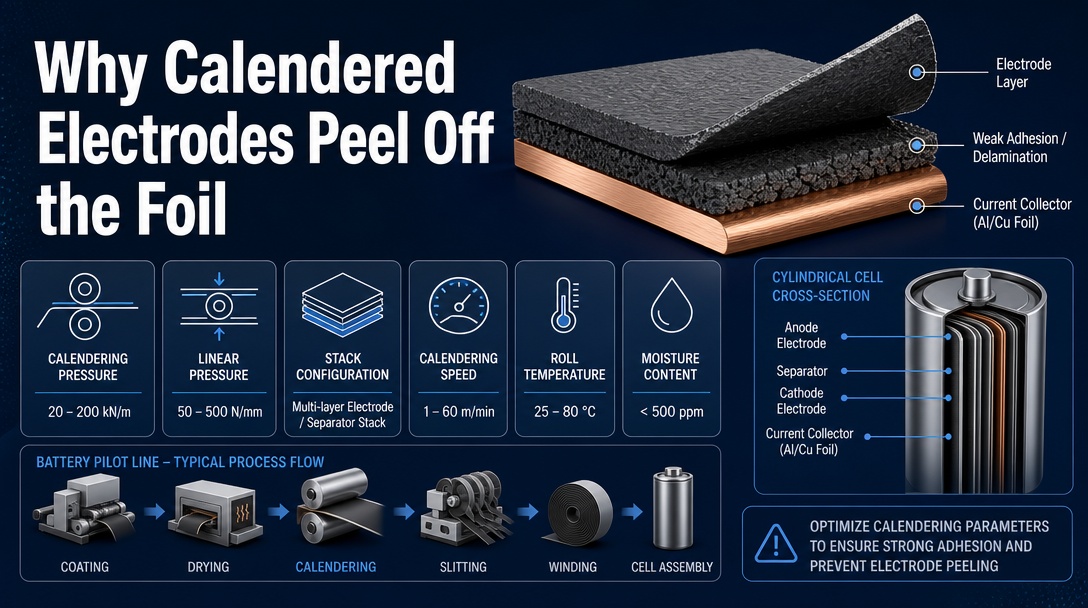
The bond you care about is between the coating and the foil, and it is created by the binder fraction that ends up sitting at that interface. In a well-behaved electrode, binder is distributed through the coating thickness with enough of it remaining near the foil.
During drying, solvent leaves from the top surface first. Binder travels with the solvent. Draw the drying too fast and the binder migrates upward with the evaporating front, and the bottom of the coating – the part touching the foil – ends up binder-poor. The coating still looks dense and uniform. It still measures the right loading. It simply has less adhesive where it needs it.
So the first question when an electrode peels is not “how hard did we press it” but “what did the oven profile look like for this recipe.” If you have raised solids content to increase output, or increased zone temperatures to raise line speed, you changed binder distribution without changing anything about the calender. Our earlier piece on drying after coating covers how zone balance drives that migration.
What Calendering Actually Takes Away
Calendering improves adhesion up to a point, which is why it is easy to assume more pressure means more bonding. It does not work that way at the top of the range.
Compression increases particle-to-particle contact and presses the coating into the foil’s surface profile. That helps. But three things start working against you as density rises:
- Crushed binder domains. Binder needs some free volume to deform and hold. Past a certain compression, the binder phase is squeezed into thin films between particles and loses its ability to absorb peel stress.
- Cathode particle fracture. Hard oxide particles crack under high linear pressure. Fractured particles create fine debris that weakens the coating’s internal cohesion, so the electrode fails inside the coating rather than at the foil.
- Springback. Anode coatings, especially graphite, rebound after the roll gap. If springback is large and uneven, the coating is pulled away from the foil across the width, and you see lifting in the middle of the web rather than at the edge.
The practical rule in most pilot work: reach target density in two lighter passes rather than one heavy pass. It takes longer, and it costs you a second pass through the machine, but it separates the “compression” effect from the “damage” effect. If your line only has a single-pass press, that trade-off is a real reason to consider a two-roll configuration.
Roll Temperature, Gap Control, and the Foil Surface
Three variables get less attention than pressure and cause a disproportionate share of peel failures.
Roll temperature. Warm rolls soften the binder enough to let it flow into the foil profile under pressure. Cold rolls press a stiff coating against the substrate and leave the interface weak. The catch is that the temperature that helps a water-based anode is too high for some cathode recipes with low-melting binder systems, so it has to be set per recipe, not per line.
Gap versus pressure control. Pressure-controlled presses drift as web thickness varies; gap-controlled presses hold thickness and let pressure float. For adhesion work, gap control is usually the better choice because the foil-to-roll relationship stays stable through thickness variations. Wangsheng builds pilot-scale cylindrical lines around a hydraulic twin-roll configuration with independent gap and pressure adjustment precisely so recipe development can separate those two variables instead of guessing at a single number.
Foil surface condition. Copper and aluminium foil arrive with a controlled roughness and a residual rolling-oil or oxide layer. Wipe-test the foil if you have never done it on this material lot. A contaminated or over-polished foil surface will not hold coating no matter how the calender is set, and it is one of the few adhesion causes you can diagnose without touching the machine.
Water-Based Anode Lines Peel Earlier, and For a Predictable Reason
Graphite on copper is the hardest common combination in a pilot line. The anode coating is porous, the binder system based on SBR and CMC behaves differently from PVDF cathodes, and copper is not naturally as adhesive a substrate as aluminium.
Two consequences follow. First, water-based anodes need their drying curve reviewed separately from cathodes – SBR migrates differently and can concentrate where you do not want it. Second, the acceptable density window is narrower, and the cost of going past it is higher. If your lab switches between a water-based anode campaign and an NMP cathode campaign on the same coating line, do not carry the cathode oven profile over. Teams that do usually see the anode peel first, and then spend a week replacing calender settings that were never the cause.
There is more on the process differences in our notes on what changes with water-based anode coating.
Measure Adhesion, Do Not Judge It By Eye
Peel failures that reach slitting have been growing for days. Put a number on adhesion early enough that you can catch the trend.
The standard method is a 180-degree peel test on a fixed-width strip: tape or fix the coating side, pull the foil at a controlled rate, and record peel force per unit width. What matters more than the absolute value is repeatability:
- Sample the web at fixed positions – two edges and center, start, middle and end of the roll. Edge-to-center variation tells you about drying uniformity; start-to-end variation tells you about roll buildup or foil lot change.
- Test after calendering, not before. An electrode that peels acceptably green can still fail pressed.
- Log it per recipe, not per line. The threshold you accept for a thin low-loading anode is not the threshold for a thick cathode.
- Include a soak check if the cell will see electrolyte before assembly validation. Some coatings lose adhesion on wetting even though they survive dry handling.
For a pilot line, this is a 15-minute test per roll. Set the expectation with your own team that it runs on every new recipe and every new foil lot, not just when something breaks.
Questions to Put to the Supplier Before You Blame the Equipment
When adhesion fails, the calender supplier and the coating equipment supplier will each point at the other. A short list of questions resolves it faster than a site meeting:
- Can the machine hold a specified gap at temperature, and what is the documented drift over a shift? If the answer is only a pressure range, your first pass will not be repeatable.
- What is the roll surface finish and hardness, and how is it maintained? Chrome condition changes peel behavior measurably over a few hundred hours.
- Is roll temperature controlled per roll or as a pair, and over what range? Anode and cathode needs differ.
- For the coater: how many drying zones, and what is the airflow control resolution per zone? Binder migration is a zoning problem before it is a temperature problem.
- What adhesion test does the supplier’s own acceptance protocol use, and at what web position?
If the supplier cannot describe the interface between the coating station, the oven and the calender as one process, expect to own that integration yourself. This is the kind of gap Wangsheng’s team spends most of its commissioning time on when a customer’s own recipes are introduced to a new pilot line – and it is usually solved with profile settings, not with new hardware.
When It Is Genuinely the Equipment
Push back on the equipment only after you have eliminated binder distribution, foil condition and pass strategy. The failures that really are machine-side look different: peel force varies with web position in a repeatable pattern that follows the roll, not the recipe; adhesion changes after a roll change; or the coating is fine at the edges and fails only where the roll crown is highest. Those are alignment, crown or temperature-control problems, and they should be fixed under the acceptance protocol rather than worked around with a lower density target.
The cheap move is to lower the density target until the peeling stops. It works, and it costs you volumetric energy density for the life of the product. The right move is to find out whether the interface failed because of the oven, the foil, or the press – and then fix that one thing. Our overview of calendering density, pressure and roll gap is a useful reference for the parameter side once you know where the problem is.
If you are specifying a coating and calendering section for a new pilot line and want the foil-to-roll interface treated as one system rather than two machines, contact Wangsheng and send us your current recipe and failure mode.
About Us
Dongguan Wangsheng Automation Equipment Co., Ltd. is a high-tech company that specializes in developing, producing, and selling laboratory equipment line(Pilot production line) for Li-ion batteries and Sodium-ion battery. We have an advanced mold processing workshop that provides various equipment consumables, which include Slot dies,Hardware punching and Stamping molds, Aluminum-plastic film punching and shell molds.
Media Contact
Company Name: Dongguan Wangsheng Automation Equipment Co., Ltd.
Contact Person: Media Relations
Email: Send Email
Country: China
Website: https://www.wsbatteryline.com/