
Shenzhen, Guangdong, China – September 20, 2026
China has really become a go-to place for sourcing small, compact data-capture devices. These days, global buyers aren’t just looking at price—they’re also taking into account things like scan speed, decoding range, durability, firmware support, and how easy it is to export data. It’s all about getting a better overall package.
According to Grand View Research, the worldwide barcode scanner market hit around USD 7.1 billion in 2023, and it’s expected to keep growing through to 2030. But keep in mind, MarketsandMarkets gives different numbers, mainly because they’re looking at a broader range of hardware. So, yeah, the figures can vary quite a bit, and that’s something to keep in mind. Markets like retail, healthcare, logistics, and light manufacturing all have their own specific needs when it comes to mini barcode scanners.
Size really does matter here. A scanner weighing just 55 grams can easily sit next to a busy checkout counter without taking up much space. Plus, a USB-C cable makes installation super simple, and having a good Bluetooth connection can help clear up clutter on the counter. But don’t get lulled into thinking that lightness alone means high performance—you should ask for test records especially for tough barcodes, like damaged ones or those printed in low contrast or curved forms.
David Krebs, the EVP at VDC Research, pointed out that scanning isn’t just about capturing data—it’s about making the whole workflow smoother. And that’s a point worth remembering for every Barcode Scanner Mini you evaluate. When dealing with suppliers, they should clearly explain things like battery life, trigger lifespan, IP ratings, SDK support, and warranty details. If they’re vague, that’s a red flag.
In this guide, I’m focusing on Chinese suppliers that serve customers worldwide. I look at their manufacturing skills, quality control, customization options, certifications, and how they handle after-sales support. Some are really sharp at OEM projects, while others are better at offering ready-to-ship models. No single supplier is perfect for every situation, so the best pick really depends on your order size, environment, integration needs, and how costly any failure might be. Always test samples first and come to the table with some solid evidence before negotiating.

GS1 Sunrise 2027: Why Global Retailers Need 2D Barcode Scanners
GS1 Sunrise 2027 is pushing retailers toward broader acceptance of 2D barcodes at checkout. These codes can carry product details, batch information, and expiration dates in one compact symbol. A one-dimensional scanner may miss this data. A reliable 2D mini barcode scanner can read both formats during the transition.In practical retail testing, scanners face glare, curved packaging, low contrast, and damaged labels. A good device should capture codes from several angles without forcing cashiers to pause. USB, Bluetooth, and stable software integration also matter. Buyers should check scanning speed, decoding accuracy, operating distance, and compatibility with existing point-of-sale systems. Small size helps at crowded counters. It does not guarantee performance.Global retailers should ask suppliers for sample testing before placing large orders. Test the scanner on glossy bottles, wrinkled cartons, and screens with reduced brightness. Ask for documented quality controls, firmware support, warranty terms, and replacement procedures. Suppliers with clear technical documentation are easier to trust. Cost still matters, but the cheapest unit may create slower queues and hidden service work. I have seen specifications look impressive while real scanning feels inconsistent. That gap deserves honest review. A careful supplier can provide test samples, integration guidance, and measurable results for different store environments.
ISO/IEC 15415 Grading: Evaluating 2D Symbol Quality from 0 to 4
For global buyers comparing China’s top mini barcode scanner suppliers, ISO/IEC 15415 grading offers a practical quality reference. It evaluates 2D symbols from 0 to 4, using factors such as contrast, modulation, defects, and decoding reliability. A dependable supplier should provide test records, not only claims about scanning speed. In real warehouse checks, a Mini Bluetooth Barcode Scanner must read labels under ordinary lighting, slight angles, and moderate surface wear.
Grade 4 represents excellent symbol quality, while Grade 3 is generally strong for demanding applications. Grade 2 may work in controlled conditions, but it deserves closer testing. Grade 1 indicates weak quality, and Grade 0 signals a serious reading risk. The grade describes the printed symbol, not the scanner alone. A fast scanner cannot repair poor contrast or a damaged quiet zone. This distinction is often overlooked. I have seen small labels scan successfully during demonstrations but fail after repeated handling.
Tips:Ask suppliers for ISO/IEC 15415 reports from representative labels. Test glossy, curved, and low-contrast samples. Check connection stability across several meters. Record first-pass and repeated-scan results. Do not judge from one perfect sample. A compact scanner may be convenient, yet its optics, lighting, and decoding software still need careful review. Some evaluation results can vary between verifiers, so independent confirmation is worth the extra effort.
IEC 60529 IP65: Dust-Tight and Water-Jet Protection RequirementsChina Top Mini Barcode Scanner Suppliers for Global Buyers
IEC 60529 IP65 is a practical requirement for a Mini Scanner Barcode used in dusty stores, workshops, and packing areas. The first digit, 6, means the enclosure is dust-tight. Dust must not enter during the specified test. Fine powder around a scan window can still expose weak sealing.
The second digit, 5, indicates protection against water jets from any direction. It does not approve immersion. That difference matters. A scanner may survive a hose-like spray but fail after being dropped into a sink. Buyers should request the test method, water pressure, duration, and product configuration. A loose cable cover can change the result.
Look closely at the housing joints. Even gaps around buttons, trigger openings, and charging contacts deserve attention. Rubber seals should sit evenly, without cuts or flattening. During supplier checks, ask whether the tested sample included its cable, stand, battery cover, and accessories. Sometimes only the bare enclosure is tested. That is not enough for real purchasing decisions.
A reliable supplier should provide an IEC 60529 test report from a competent laboratory, with model details matching the proposed shipment. Check the report date and photographs. Do not trust a rating printed on a carton alone. In practice, sealing can weaken after repeated drops, cleaning, or cable bending. This point is easy to overlook. A small pre-shipment spray inspection may reveal poor assembly, although it cannot replace formal certification.
Connectivity Benchmarks: USB 2.0 at 480 Mb/s and Bluetooth 5.x
China Top Mini Barcode Scanner Suppliers for Global BuyersConnectivity should be tested, not accepted from a specification sheet. A Mini Wireless Barcode Scanner using USB 2.0 can advertise transfer speeds up to 480 Mb/s. That figure is theoretical. Real performance depends on the cable, controller, firmware, and host device. For barcode work, data volume is small, but stable recognition matters more than peak speed. During supplier evaluations, connect scanners to different computers and measure repeated scans. Watch for dropped characters, delayed input, or unwanted duplicate reads. Small details expose weak quality control.Bluetooth 5.x can improve range, power efficiency, and connection stability. However, results vary with antenna design, metal shelving, nearby wireless traffic, and the selected Bluetooth profile. Test the scanner across a working aisle, not only beside a laptop. A practical trial should include fast batch scanning, sleep-mode recovery, and reconnection after temporary signal loss. Battery performance also deserves attention. A device may pair quickly but drain unexpectedly during continuous use. That is inconvenient. Suppliers should provide clear test conditions, firmware information, and sample records. I would also repeat the same checks after transport vibration, because an attractive first sample can change. This is an imperfect benchmark, but repeated evidence is more reliable than impressive numbers.
China Top Mini Barcode Scanner Suppliers for Global Buyers – Connectivity Benchmarks: USB 2.0 at 480 Mb/s and Bluetooth 5.x
| Evaluation Dimension | Industry-Accurate Benchmark | Buyer Relevance | Recommended Verification Point |
|---|---|---|---|
| USB wired connectivity | USB 2.0 High-Speed has a nominal signaling rate of 480 Mb/s. | Provides a stable plug-and-play connection for POS terminals, computers, and embedded systems. | Confirm the USB operating mode, connector type, cable length, and operating-system compatibility. |
| USB practical data transfer | Actual application throughput is lower than the 480 Mb/s theoretical signaling rate because of protocol overhead and device limitations. | Barcode scanners transmit short decoded strings, so scan performance is normally limited by decoding and workflow speed rather than USB bandwidth. | Request a live test showing scan-to-host latency and continuous scanning stability. |
| Bluetooth version range | Bluetooth 5.x includes versions 5.0 through 5.4; supported features vary by device implementation. | Allows cordless operation with tablets, mobile computers, laptops, and compatible host terminals. | Verify the exact Bluetooth version and whether the scanner uses Bluetooth Classic, Bluetooth Low Energy, or both. |
| Bluetooth Low Energy performance | Bluetooth LE 2M PHY can provide a 2 Mb/s theoretical physical-layer rate when supported by both devices. | Supports efficient wireless communication, but the nominal radio rate should not be interpreted as application throughput. | Confirm host support, selected PHY mode, connection interval, and performance in the intended operating environment. |
| Bluetooth operating distance | Usable range depends on transmit power, antenna design, receiver sensitivity, obstacles, and radio interference. | Important for retail counters, warehouses, inventory checks, and mobile point-of-sale applications. | Evaluate connection stability at the required distance with metal shelving, walls, and nearby wireless equipment present. |
| Host communication modes | Common modes include USB HID keyboard, USB virtual COM, Bluetooth HID keyboard, and Bluetooth serial-style communication. | HID modes generally reduce software integration requirements, while serial-style modes support application-controlled workflows. | Request configuration barcodes or software for switching modes and setting suffixes, prefixes, and delimiters. |
| Barcode coverage | Typical 1D support may include Code 128, Code 39, EAN/UPC, and Interleaved 2 of 5; 2D models commonly support QR Code, Data Matrix, and PDF417. | The required scan engine should match the buyer’s labels, mobile displays, tickets, and logistics documents. | Obtain the complete supported-symbology list and test damaged, reflective, small, and low-contrast codes. |
| Mobile-device scanning | Imaging-based 2D scanners can generally read barcodes from paper and illuminated screens when focus, lighting, and decoding settings are suitable. | Useful for e-tickets, mobile coupons, returns, parcel labels, and digital inventory workflows. | Test screen brightness, viewing angle, barcode size, and scan speed on the target mobile devices. |
| Power and charging interface | Wired models can receive operating power through USB; cordless models require an internal rechargeable battery and a charging method. | Charging design affects uptime, fleet management, replacement planning, and warehouse usability. | Verify battery capacity, rated scan cycles or operating time, charging time, battery replacement policy, and charging accessories. |
| Miniature form factor | Compact scanners prioritize low weight and portability; dimensions and mass vary by scan engine, battery, enclosure, and trigger design. | Suitable for handheld counting, checkout counters, kiosks, service desks, and space-constrained equipment. | Compare verified product dimensions, net weight, grip comfort, trigger durability, and mounting options. |
| Supplier qualification evidence | Relevant documentation should include datasheets, interface specifications, firmware details, test reports, and applicable regulatory declarations. | Reduces integration, compliance, quality, and after-sales risks for international buyers. | Request samples, production quality records, warranty terms, customization limits, lead times, and export packaging specifications. |
Note: USB 2.0 at 480 Mb/s and Bluetooth 5.x figures are theoretical interface or physical-layer benchmarks. Actual scanner performance depends on decoding speed, firmware, host compatibility, radio conditions, and application design.
Compliance Checklist: CE, FCC Part 15, RoHS, and UN 38.3 Standards
When evaluating mini barcode scanner suppliers, global buyers should request compliance evidence before discussing volume pricing. A polished sample proves little. Ask for the EU Declaration of Conformity, applicable CE test reports, and product labeling photos. The documents should identify the exact model, hardware version, and responsible manufacturer. CE compliance may involve EMC, safety, and radio requirements, depending on the scanner’s design.Check FCC Part 15 records for scanners sold in the United States. Wireless versions need closer review because Bluetooth or Wi-Fi functions can change testing requirements. For RoHS, request material declarations or technical files covering restricted substances, not only a one-page statement. Confirm that the report matches cables, charging docks, batteries, and updated components. Small changes matter.Battery models need special attention. Ask for the UN 38.3 test summary, battery specifications, packaging instructions, and transport documentation. During supplier audits, I compare the serial label with the test report and inspect warning marks on the carton. It often reveals gaps. A certificate folder can look convincing and still be incomplete. Some suppliers provide old reports after changing the battery cell or scanner board. That is easy to miss. Buyers should also test a production sample, retain photographs, and record firmware and accessory details. Requirements can change, so independent laboratory verification and current legal review remain necessary before shipment.
Compliance Coverage for Mini Barcode Scanners
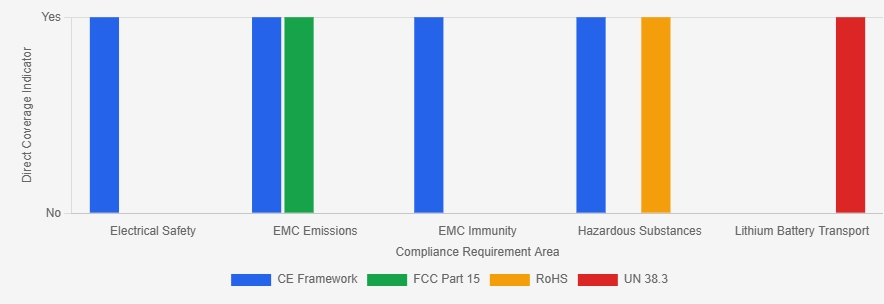
Coverage indicator: 1 means the requirement is directly addressed by the framework; 0 means it is not the primary focus. CE marking is an EU conformity framework that may rely on applicable directives such as EMC and RoHS. FCC Part 15 focuses on radio-frequency emissions, RoHS restricts hazardous substances in electrical and electronic equipment, and UN 38.3 applies to the safe transport testing of lithium cells and batteries.
China’s Top Mini Scanner Suppliers: OEM/ODM, MOQ, Lead Time, and Warranty
China’s mini barcode scanner market serves retail counters, warehouses, clinics, and mobile service teams. Fortune Business Insights valued the global barcode scanner market at about USD 7.61 billion in 2023. Its report projects continued growth through 2032, driven by automation and inventory visibility. This demand makes supplier verification more important than attractive catalog photos.
For a Mini Usb Barcode Scanner, ask for OEM or ODM evidence before approving samples. OEM projects usually change labels, casing colors, cables, or packaging. ODM work may alter firmware, trigger design, scan engines, and housing dimensions. A practical MOQ can range from 100 to 1,000 units. Custom tooling may require more. Start smaller if possible. A 20-unit pilot can reveal weak USB joints, slow decoding, or poor performance under warehouse lighting.
Typical stock lead times may be 3–10 working days, while customized orders often need 20–45 days. Confirm the timeline in writing, including sample approval and production inspection. A 12–24-month warranty is common, but its value depends on repair procedures and replacement rules. Request scan-rate tests for Code 128, QR, and damaged labels. GS1 guidance emphasizes accurate identification and data quality across supply chains, not merely scanning speed. One overlooked detail is cable strain relief. It fails quietly. Suppliers should provide test reports, serial tracking, firmware records, and clear after-sales contacts. I would not accept a low MOQ without checking component continuity and warranty response times.
Conclusion
As global retail moves toward GS1 Sunrise 2027, retailers are preparing for wider adoption of 2D barcodes that can store more product and traceability information than traditional linear codes. A reliable Mini Barcode Scanner should support accurate 2D reading and provide consistent performance across different symbol sizes and printing conditions. ISO/IEC 15415 grading, rated from 0 to 4, offers a practical way to assess symbol quality, while an IP65 enclosure indicates protection against dust and water jets under specified test conditions.For global buyers, key selection factors include USB 2.0 connectivity at up to 480 Mb/s, Bluetooth 5.x options, and documentation for CE, FCC Part 15, and RoHS compliance. Battery-powered models may also require UN 38.3 testing for transportation. China’s leading mini scanner suppliers can support OEM and ODM projects, with product choices shaped by MOQ, lead time, customization scope, after-sales service, and warranty terms. A complete technical and compliance checklist helps buyers reduce sourcing risks and choose a scanner suited to retail, logistics, and service applications.
About Us
Shenzhen Yuhengda Technology Co.,Ltd. is a Barcode Scanner & Thermal Printer & POS products manufacturer supplier founded in 2013. We have a professional development team and a team of experienced technicians and sales service team, which can provide OEM and ODM solutions and services to customers worldwide.
Media Contact
Company Name: Shenzhen Yuhengda Technology Co.,Ltd.
Contact Person: Media Relations
Email: Send Email
Country: China
Website: https://www.yhdaa.com/