
Daxing, Beijing, China – September 20, 2026
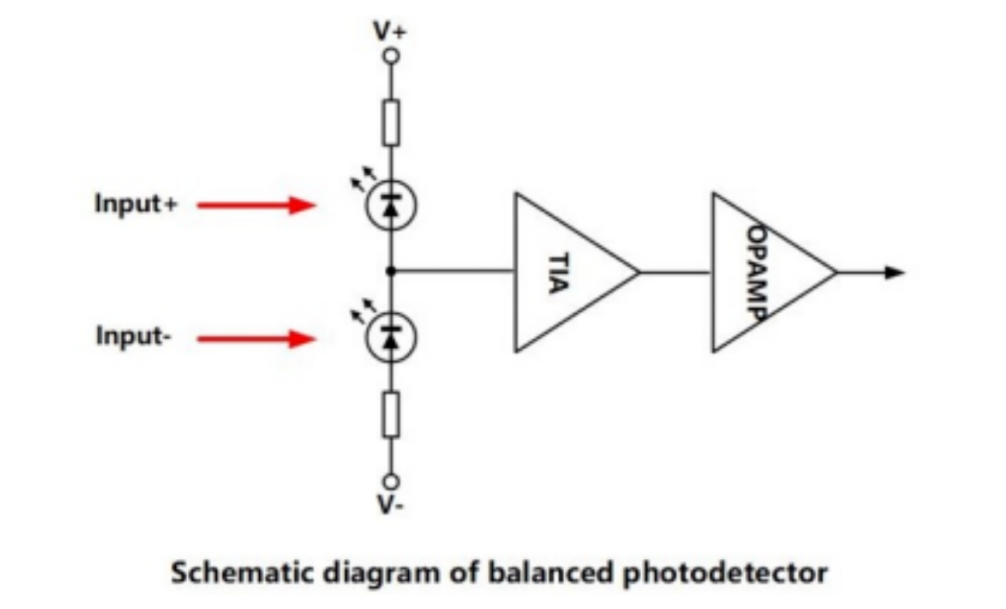
How to choose the type of balanced photodetectorA balanced photodetector consists of two photodiodes and a differential amplifier. The optical signal is first split into two paths by a beam splitter and input into two photodiodes. These two photodiodes work in the same way, but the phase of the input optical signal is opposite. When two photodiodes receive light signals of the same intensity but opposite phase, their output currents will also be opposite, so their output signals can be subtracted to obtain a differential signal. Can the signal-to-noise ratio be further improved when the background noise or common mode interference is large enough to overwhelm the signal? The answer is yes, only a Balanced Photodetector (BPD photodetector) is needed.
1. Selection and usage points:
1.1 Matching working wavelength
The wavelength range of balanced photodetectors is one of the most important parameters when selecting. Photodiodes (PDs) made of different materials are suitable for different wavelength ranges. Visible light: Si based detectors are suitable for a wavelength range of 400 nm-1100 nm and are commonly used in visible and near-infrared (NIR) applications. Near infrared: InGaAs based detectors are suitable for the wavelength range of 800 nm-1700 nm and are commonly used in mid infrared (MIR) and long wave infrared (LIR) applications.
1.2 BPD photodetector Bandwidth
The bandwidth determines the frequency range of signals that the detector can process. Common bandwidth options include: DC-100MHz: suitable for low-speed signal processing, such as spectral analysis, OCT, etc. DC-200MHz: Suitable for medium speed signal processing, such as LiDAR, OCT, etc. DC-350MHz: Suitable for high-speed signal processing, such as quantum state tomography, terahertz detection, etc.
1.3 Common mode rejection ratio
Common mode rejection ratio is an important indicator for measuring the detector’s ability to suppress common mode noise. Generally, the higher the CMRR, the stronger the noise suppression ability of the detector. Common CMRR values include:>20 dB: suitable for general applications. >25 dB: Suitable for high-precision measurement. >30 dB: Suitable for high sensitivity applications to avoid saturation.1.4 Input optical power
Low power (10 mW): Suitable for high-power laser detection, requiring built-in attenuator
1.5 Noise Performance
High sensitivity (NEP
Medium sensitivity (NEP 1-10 pW/√ Hz): suitable for laser frequency stabilization and optical communication.
Low sensitivity (NEP>10 pW/√ Hz): suitable for high-power laser noise detection.1.6 BPD photodetector Gain
The gain determines the detector’s ability to amplify the input signal. The common gain range includes 10 kV/A, which is suitable for low-noise amplification. 100 kV/A: Suitable for high gain amplification.
1.7 Operating temperature range
The working temperature range determines the applicability of the detector in different environments. The common working temperature range includes -20~65 ℃, suitable for general industrial environments. -40-85 ℃: Suitable for extreme environments.
In summary, when choosing a balanced photodetector, seven dimensions are mainly considered:
Wavelength range (visible light 400 nm-1100 nm, near-infrared 800 nm-1700 nm); Bandwidth (DC-100MHz for low-speed signal processing, DC-200MHz for medium speed signal processing, DC-350MHz for high-speed signal processing); Common mode rejection ratio (the higher the CMRR, the stronger the noise suppression ability of the detector, and a CMRR value>25 dB is suitable for high-precision measurements); Input optical power (low power10 mW); Noise performance (the smaller the noise equivalent power, the higher the sensitivity, and NEP
About Us
Beijing Rofea Optoelectronics Co., Ltd. located in China’s “Silicon Valley” – Beijing Zhongguancun, is a high-tech enterprise dedicated to serving domestic and foreign research institutions, research institutes, universities and enterprise scientific research personnel. Our company is mainly engaged in the independent research and development, design, manufacturing, sales of optoelectronic products, and provides innovative solutions and professional, personalized services for scientific researchers and industrial engineers.
Media Contact
Company Name: Beijing Rofea Optoelectronics Co., Ltd.
Contact Person: Media Relations
Email: Send Email
Country: China
Website: https://www.bjrofoc.com/