
Xi’an, Shaanxi Province, China-September 18, 2026
When we talk about autonomous agricultural machinery, accurate positioning is often the first thing that comes to mind.
But knowing where a machine is does not automatically mean it knows where to go, how to move, or how to complete a task.
For agricultural equipment to operate autonomously, positioning is only the starting point. The machine also needs to follow planned paths, control its movement accurately, respond to field conditions, complete turns at the end of each row, and allow operators to monitor the entire operation.
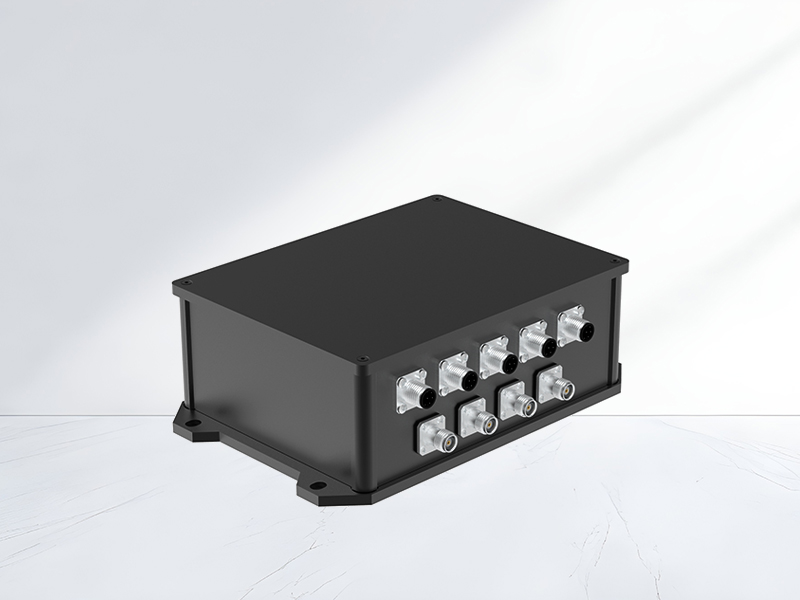
This is the idea behind the Qianxing® Autonomous Navigation and Driving System.
Instead of functioning as a simple positioning module, Qianxing® connects positioning, navigation, vehicle control, obstacle avoidance and communication capabilities into one integrated system—helping agricultural machines move from assisted operation toward autonomous operation.
Step 1: Know Exactly Where the Machine Is
Every autonomous operation starts with one basic question:
Where am I?
Qianxing® uses high-precision RTK positioning to provide centimeter-level location information for agricultural machinery.
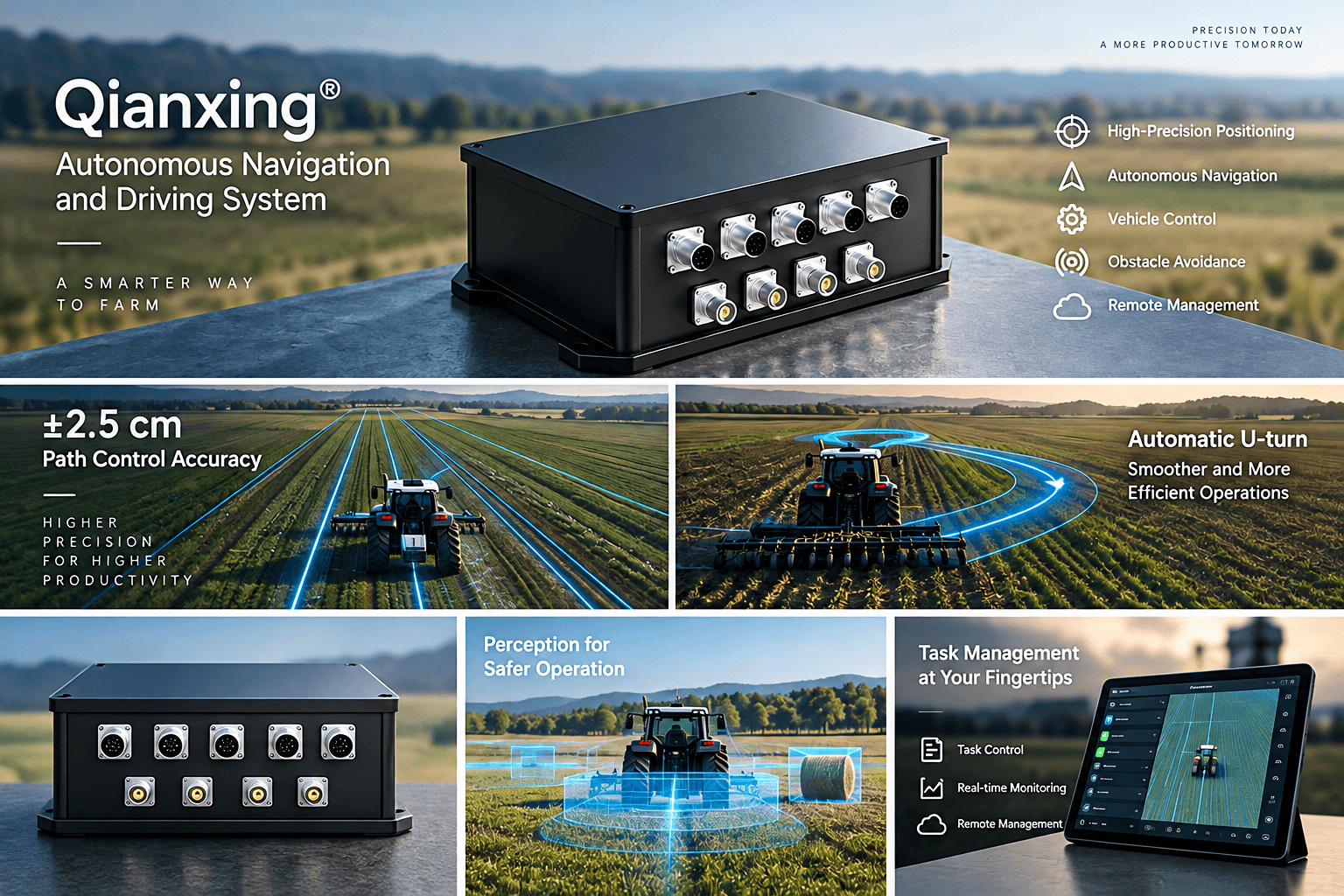
With path control accuracy of up to ±2.5 cm, the machine can maintain a stable trajectory during operations such as spraying, mowing and field transportation.
This level of positioning accuracy is especially important in repetitive agricultural operations.
When a machine follows the same field rows over and over again, even small deviations may lead to overlapping passes, missed areas, unnecessary input consumption or inconsistent operation quality.
Accurate positioning provides the foundation for everything that comes next.
Step 2: Know Where to Go
Positioning tells the machine where it is.
Navigation tells it where it should go.
Once an operation route has been created, Qianxing® allows the machine to follow the planned path automatically rather than relying on continuous manual steering.
This changes the operator’s role.
Instead of constantly controlling the steering wheel, the operator can focus more on setting the task, monitoring progress and managing the overall operation.
At the headland, the system can also support automatic U-turns, allowing the machine to transition from one working row to the next and continue the task.
For large fields and highly repetitive operations, reducing these repeated manual actions can make the entire workflow simpler and more consistent.
Step 3: Turn Navigation Commands into Machine Movement
There is another important step between “knowing the route” and actually driving along it:
vehicle control.
A navigation system may calculate the correct path, but the machine still needs to translate that information into steering, acceleration, braking and other control actions.
Qianxing® integrates navigation and autonomous driving capabilities and can communicate with different vehicle control systems through interfaces including CAN and RS-485.
In simple terms:
Positioning tells the machine where it is.
Navigation tells the machine where to go.
Vehicle control makes it move accordingly.
Only when these functions work together can agricultural equipment move beyond guidance and toward real autonomous operation.
Step 4: Maintain Stable Operation in Real Working Conditions
Agricultural environments are rarely perfect.
Fields may be uneven. Machines may vibrate. Satellite signals may temporarily fluctuate. Operating conditions may change throughout the day.
For this reason, autonomous agricultural machinery needs more than satellite coordinates alone.
Qianxing® integrates a MEMS inertial measurement unit with its positioning and navigation system. Its combined navigation data can be updated at up to 100 Hz, allowing the system to continuously track vehicle movement and support stable path control.
The system is also designed for demanding working environments, with an IP65 protection rating and an operating temperature range from -10°C to +60°C.
For autonomous machines, reliability is just as important as accuracy.
Because in real agricultural operations, the goal is not simply to follow a line once.
The goal is to follow it accurately, repeatedly and consistently.
Step 5: Add Perception for Safer Autonomous Operation
A planned route tells the machine where it should travel.
But the real world may contain unexpected obstacles.
Qianxing® can be integrated with obstacle-avoidance radar and other perception devices, adding environmental awareness to autonomous navigation.
This creates another important layer of machine intelligence:
Positioning — Where am I?
Navigation — Where should I go?
Control — How should I move?
Perception — Is the path ahead clear?
By connecting these capabilities, autonomous equipment can move from simply following coordinates toward understanding and responding to its operating environment.
Step 6: Make Autonomous Operation Easier to Manage
Autonomy is not only about removing the driver from the machine.
It is also about making the entire operation easier to manage.
Through the Qianxing® system, users can operate and monitor equipment through an intelligent application, including functions such as task control, automatic turning and real-time job progress monitoring.
Communication options including 4G, Bluetooth Low Energy and Ethernet also provide the connectivity required for equipment communication and remote management.
This means that operators can gradually move from:
“I drive the machine.”
to
“I assign and monitor the task.”
That shift is an important part of autonomous farming.
 One Navigation System, Different Machines
Agriculture involves many different machines and many different jobs.
The objective of Qianxing® is therefore not to create intelligence for only one specific vehicle.
Its highly integrated architecture is designed to support intelligent equipment upgrades across different platforms and applications.
Typical agricultural applications include:
-
Autonomous mowing
-
Precision spraying
-
Field inspection
-
Material transportation
-
Other repetitive route-based operations
For equipment manufacturers and system integrators, this also provides another path toward automation: instead of developing every navigation, communication and control function independently, an integrated navigation platform can provide the foundation for intelligent equipment development.
From Accurate Positioning to Autonomous Farming
RTK answers an important question:
Where is the machine?
But autonomous farming requires several more questions to be answered:
Where should it go?
How should it move?
What is happening around it?
How can the operation be monitored and managed?
The Qianxing® Autonomous Navigation and Driving System brings these capabilities together, connecting positioning, navigation, control, perception and communication into a unified foundation for intelligent machinery.
Because the future of agricultural automation is not simply about making machines more accurate.
It is about enabling machines to understand the task, follow the plan and complete the work with less human intervention.
That is the journey from positioning to autonomous operation.
About US
Senyta Intelligent Equipment Co., Ltd. is a national high-tech enterprise dedicated to advancing the unmanned transformation of agricultural production. Guided by our mission — Let machines free human hands, let intelligence change the world — we focus on technological innovation and practical application to deliver intelligent solutions for modern agriculture.
Media Contact
Company Name: Senyta Intelligent Equipment Co., Ltd
Contact Person: Media Relations
Email: Send Email
Country: China
Website: https://www.sydauto.com/