
Shanghai, China-September 18, 2026
Freeze drying is one of the most effective food preservation methods available today. Unlike dehydration or air drying, freeze drying removes moisture through vacuum sublimation, allowing food to retain its original shape, color, flavor, nutrients, and shelf life.
Whether you’re preserving strawberries, meat, vegetables, candy, coffee, or complete meals, understanding the correct freeze-drying process helps improve product quality and reduce drying failures.
This guide explains how freeze drying works, how to freeze dry food step by step, common mistakes, processing times, and how to choose the right freeze dryer for home or commercial production. The freeze-drying process removes water by freezing the product first and then sublimating ice under vacuum, preserving the product’s physical structure and nutritional value.
What Is Freeze Drying?
Freeze drying (also called lyophilization) is a low-temperature dehydration process.
Instead of heating water until it evaporates, freeze drying:
1. Freezes food below its freezing point.
2. Creates a deep vacuum.
3. Converts ice directly into water vapor (sublimation).
4. Captures the vapor inside a cold condenser.
Because liquid water never passes through the food during drying, the cellular structure remains largely intact, helping preserve texture, flavor, color, vitamins, and heat-sensitive compounds. This principle is the basis of vacuum freeze-drying equipment used in food, pharmaceutical, and biological applications.
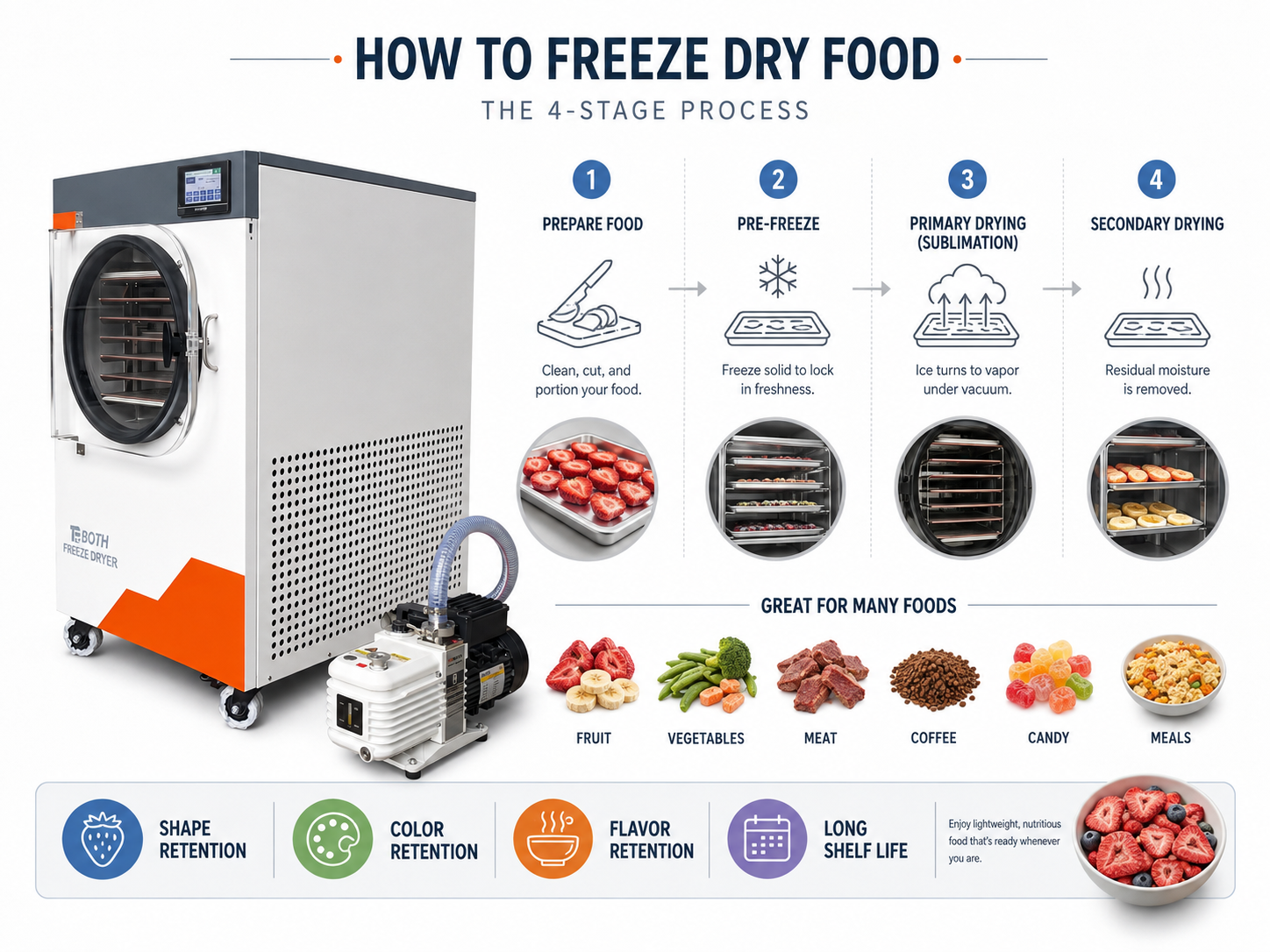
How Do You Freeze Dry Food? (Step-by-Step)Step 1. Prepare the Food
Good preparation directly affects drying efficiency.
Best practices:
- · Cut food into uniform pieces (generally under 10 mm thick for faster drying)
- · Remove excess fat where possible
- · Avoid overloading trays
- · Spread food in a single layer
Uniform thickness allows moisture to leave the product more evenly, reducing total cycle time.
Step 2. Pre-Freeze the Food
Food should be completely frozen before vacuum drying begins.
Most materials require the product core temperature to reach at least −20°C, while sensitive products may require temperatures below their eutectic point.
Proper pre-freezing:
- · Prevents product collapse
- · Improves sublimation efficiency
- · Produces a better final texture
Insufficient pre-freezing is one of the most common causes of poor freeze-drying results.
Step 3. Primary Drying (Sublimation)
After freezing:
- · Vacuum pressure decreases
- · Shelf temperature gradually increases
- · Ice sublimates directly into vapor
- · The cold trap captures moisture
This stage removes approximately 90–95% of the product’s water.
It is also the longest stage of the freeze-drying cycle.
Step 4. Secondary Drying
After visible ice disappears, residual bound moisture remains inside the food.
Secondary drying:
- · Raises shelf temperature gradually
- · Removes remaining moisture
- · Improves shelf stability
- · Extends storage life
For most foods, the final moisture content should typically be below 3% before packaging. Moisture verification is commonly used to confirm complete drying.
How Long Does Freeze Drying Take?
Processing time depends on:
- · Food type
- · Moisture content
- · Slice thickness
- · Batch size
- · Shelf temperature
- · Vacuum level
Typical drying times include:
|
Food Type |
Typical Freeze Drying Time |
| Fruits | 12–24 hours |
| Vegetables | 12–24 hours |
| Meat | 18–30 hours |
| Seafood | 18–30 hours |
| Ready meals | 20–36 hours |
| Pharmaceuticals | 24–48 hours |
Actual processing time varies depending on loading amount, moisture content, and recipe optimization.
What Foods Can Be Freeze Dried?
Modern freeze dryers can process hundreds of products, including:
Fruits
- · Strawberries
- · Bananas
- · Mangoes
- · Apples
- · Blueberries
- · Corn
- · Peas
- · Broccoli
- · Mushrooms
- · Carrots
- · Beef
- · Chicken
- · Fish
- · Shrimp
- · Eggs
- · Yogurt
- · Cheese
- · Ice cream
- · Pasta
- · Soups
- · Rice dishes
- · Camping meals
- · Coffee
- · Herbs
- · Pet food
- · Candy
- · Nutraceutical ingredients
VegetablesProtein FoodsDairy ProductsPrepared MealsOther Products
Freeze dryers are also widely used for pharmaceuticals, biological samples, vaccines, enzymes, cosmetics, herbal extracts, and laboratory materials.
Common Freeze Drying Mistakes
Many freeze-drying failures result from process control rather than equipment issues.
The most common mistakes include:
- · Inadequate pre-freezing
- · Slices that are too thick
- · Overloaded trays
- · Vacuum leaks
- · Drying time that is too short
- · High-sugar or high-fat products requiring recipe adjustments
- · Delayed or improper packaging after drying
Monitoring vacuum stability and the temperature difference between the product and shelves helps determine when drying is complete.
Home Freeze Dryer vs Commercial Freeze Dryer
|
Feature |
Home Freeze Dryer |
Commercial Freeze Dryer |
| Batch Size | 3–10 kg | 10–1000+ kg |
| Daily Output | Small | Continuous production |
| Control System | Automatic recipes | PLC + HMI programmable control |
| Applications | Home use, hobby, small business | Food factories, contract manufacturing, pharmaceuticals |
| Customization | Limited | Available |
Manufacturers typically offer household, laboratory, pilot, and industrial freeze dryers, with model selection based on material type, batch size, chamber dimensions, cold trap temperature, vacuum level, and production requirements.
Choosing the Right Freeze Dryer
When selecting a freeze dryer, consider:
- · Daily production capacity
- · Product type
- · Moisture content
- · Shelf area
- · Cold trap temperature
- · Vacuum performance
- · Automation level
- · Energy efficiency
- · Future production expansion
Industrial users often benefit from pilot testing before scaling up to full production. Manufacturers may also provide application testing, customized equipment, and turnkey production-line design for commercial projects.
Frequently Asked QuestionsCan you freeze dry food without a freeze dryer?
No. True freeze drying requires both deep vacuum and low-temperature sublimation. A household freezer alone cannot remove moisture through sublimation.
Does freeze-dried food keep its nutrients?
Yes. Because the process operates at low temperatures, freeze drying helps retain more nutrients, flavor, and structure than conventional hot-air drying.
How long can freeze-dried food last?
When packaged in airtight, moisture-proof containers such as vacuum bags or aluminum foil pouches, freeze-dried foods can typically remain stable for 1–2 years under suitable storage conditions.
Is freeze drying better than dehydrating?
Freeze drying generally offers better retention of texture, color, flavor, and nutritional quality, while dehydration is often less expensive and faster for certain applications.
Freeze Drying Solutions for Every Production Scale
Whether you are preserving food at home, validating a new product in the laboratory, scaling up pilot production, or building a commercial freeze-dried food factory, selecting equipment that matches your production goals is essential.
BOTH provides a complete range of freeze dryers—including household, laboratory, pilot, commercial, and industrial systems—with customization, technical support, and turnkey production-line solutions available for different industries. The company also offers sample testing, process optimization, and application support for freeze-drying projects.
About us
BOTH INSTRUMENT & INDUSTRIAL EQUIPMENT (SHANGHAI) CO.,LTD. established in 2007 and located in Shanghai, China. The company is a technical innovation enterprise integrating Research & Development, Design, and Manufacturing of top quality Lab Instruments, Pilot Apparatus and Commercial Production Line for pharmaceutical, chemical bio-pharmaceuticals, polymer materials development field.
Media Contact
Company Name: BOTH Instrument & Industrial Equipment (Shanghai) Co., Ltd.
Contact Person: Media Relations
Email: Send Email
Country: China
Website: https://www.bothsh.com/