
Ningbo, Zhejiang, china-September 16, 2026
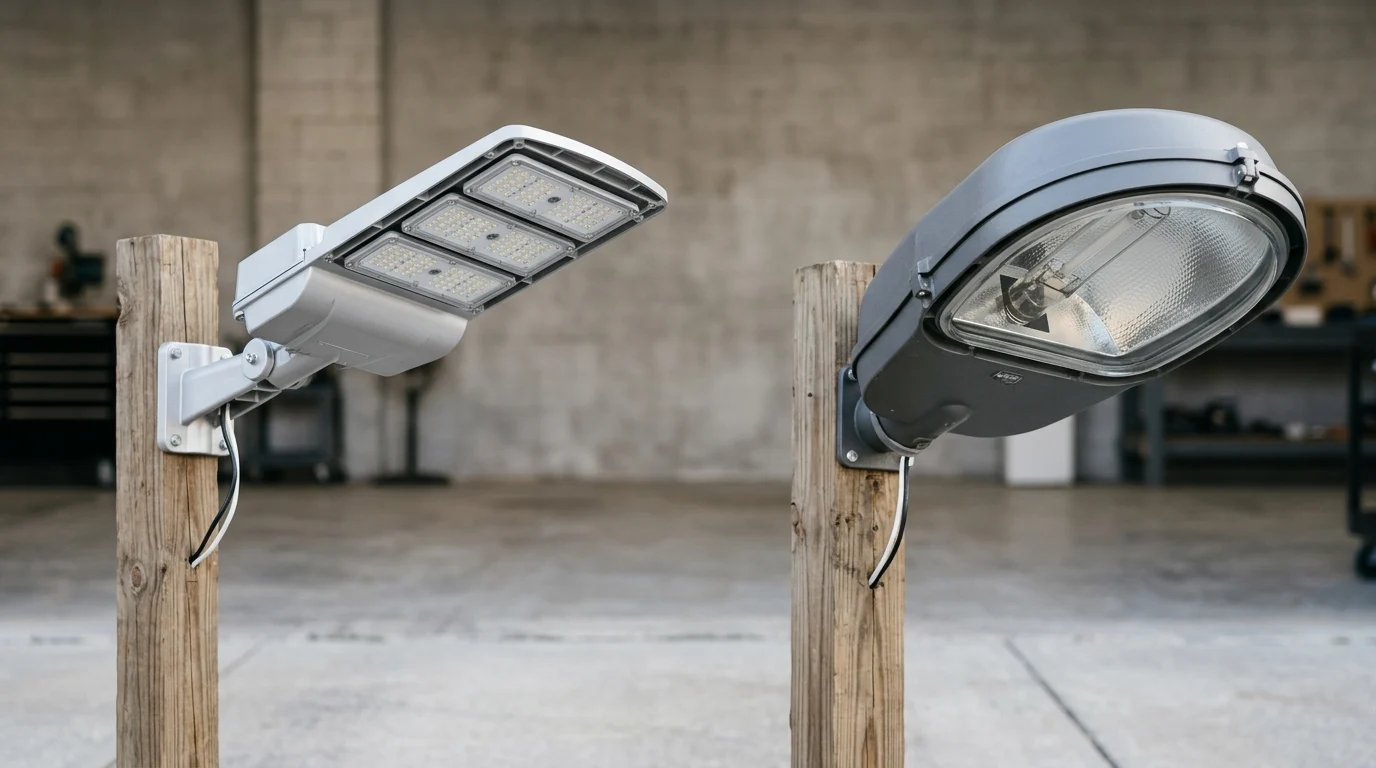
Street lighting budgets are under pressure in 2026 as electricity rates, labor costs, and infrastructure expectations continue to rise. For municipalities, developers, and commercial facility managers, the real question is no longer whether LED fixtures are more efficient, but how quickly the numbers justify replacing HPS systems. This comparison breaks down the cost drivers that matter most: wattage, annual operating hours, energy rates, fixture pricing, maintenance cycles, and service life. By using a consistent baseline—1,000 poles, dusk-to-dawn operation, and common utility assumptions—you can see where upfront savings from HPS fade and where long-term LED value begins to dominate.
LED vs HPS Street Lights: Key Assumptions
When planning a municipal or commercial lighting upgrade in 2026, procurement teams should look beyond the initial purchase order. Evaluating the true financial impact of Light Emitting Diode (LED) versus High-Pressure Sodium (HPS) street lights requires standardizing baseline metrics. Without a controlled comparison of specifications, total cost projections will fail to capture the long-term realities of infrastructure management, especially given recent utility rate inflation and regional labor shortages.
Define fixture types and project scope
To create an accurate cost breakdown, municipalities must first establish parity between the technologies. A standard High-Pressure Sodium (HPS) street light produces omnidirectional output with a poor Color Rendering Index (CRI of ~20), resulting in significant light loss and reduced visibility. Due to higher luminous efficacy and precise optical lenses, facilities can replace this legacy unit with a lower-wattage LED fixture to achieve identical or superior ground-level illuminance, while boosting the CRI to 70 or higher. For this financial analysis, assume a medium-scale project scope involving the retrofit or new installation of 1,000 street light poles along standard two-lane municipal roadways.
Set baseline usage, rates, and lifespan
Next, analysts should lock in the operational variables that drive long-term expenses. Street lights typically run from dusk to dawn, averaging 12 hours per day, which totals 4,380 operating hours annually. Assuming a baseline commercial electricity rate of $0.12 per kWh (though 2025 utility inflation may push this higher locally), the divergence in lifecycle expectations becomes immediately clear.
| Specification | 250W HPS Fixture | 120W LED Fixture |
|---|---|---|
| System Wattage (w/ Ballast) | 280W | 120W |
| Annual Operating Hours | 4,380 hours | 4,380 hours |
| Rated Lifespan | 24,000 hours (Burnout) | 100,000+ hours (L70) |
| Years to Replacement | ~5.5 years | ~22.8 years |
By setting these rigid baselines, organizations can accurately project both the immediate capital requirements and the long-term operational drain on infrastructure budgets. The table above highlights the fundamental technological gap, particularly noting that HPS fails via burnout or cycling, whereas LED lifespan is measured by lumen depreciation (L70).
Cost Drivers That Affect Total Ownership
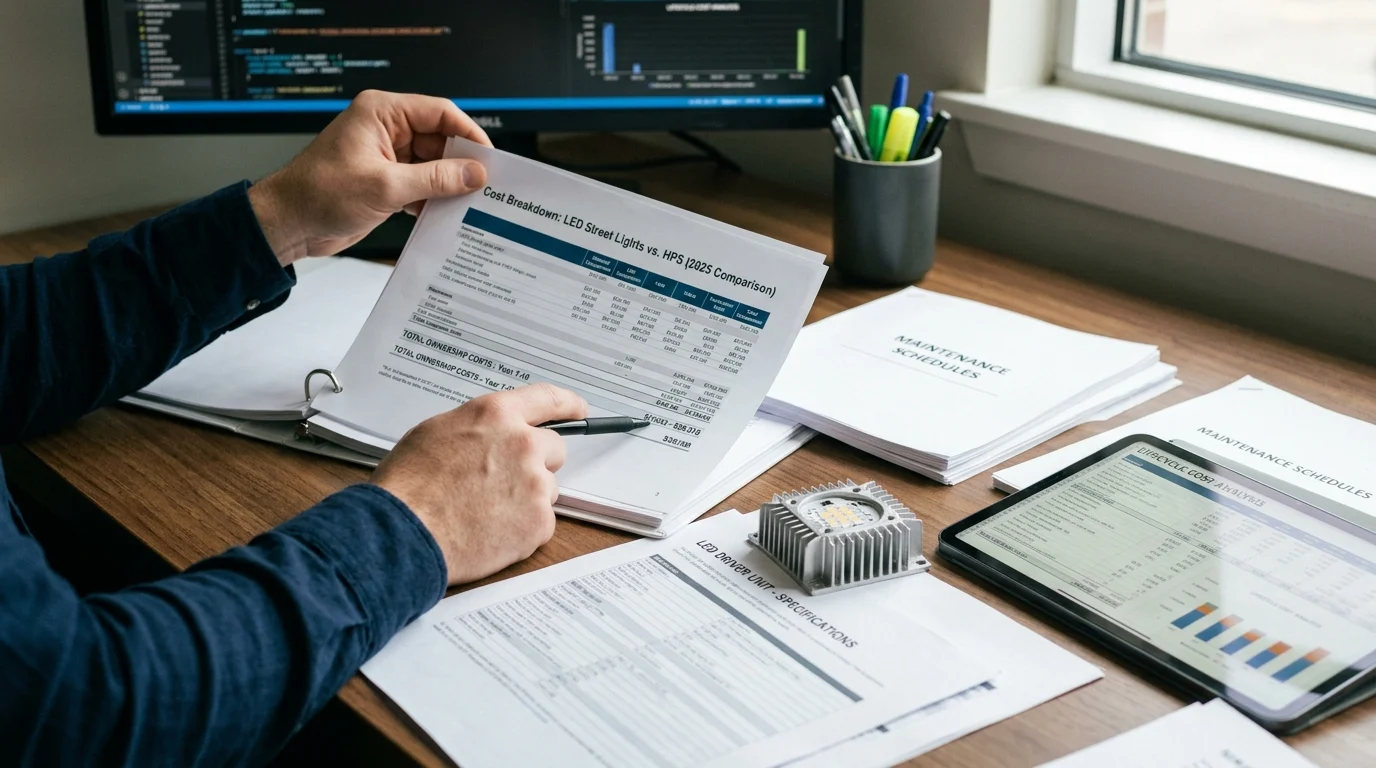
Understanding the Total Cost of Ownership (TCO) requires dissecting the specific financial drivers that accumulate over the lifespan of a lighting network. Decision-makers should weigh immediate capital expenditures against ongoing operational costs and liabilities, ideally validated by third-party lifecycle standards from organizations like the DOE or IESNA.
Compare upfront equipment and installation costs
In 2026, the upfront cost gap between legacy and solid-state lighting has narrowed significantly, though HPS retains a slight edge in raw hardware pricing. A standard 250W HPS luminaire generally costs $120 to $150. In contrast, a high-quality 120W LED street light from a reputable manufacturer like Ningbo Leboda Lighting typically ranges from $180 to $250, depending on surge protection ratings, modularity, tariff impacts on components, and die-cast aluminum housing specifications.
However, installation labor is a critical factor. Hiring a bucket truck and certified electrical crew averages $100 to $150 per pole. While installation is often viewed as a fixed capital expenditure (CapEx), labor parity is not guaranteed. LED retrofits may require housing, bracket, or wiring upgrades, whereas simple HPS relamping is less complex. These figures serve as a baseline; hardware and labor costs vary drastically by region, but the initial hardware savings of HPS are often diluted by broader project requirements.
Estimate energy, maintenance, and replacement costs
The true financial divergence happens after the lights are turned on. As detailed in the baseline table, the HPS fixture’s higher system wattage costs significantly more annually in energy compared to the LED counterpart—a reduction in energy spend of over 55% for the LED. Implementing smart dimming controls during off-peak hours can push those LED energy savings past 70%.
Furthermore, inflationary maintenance and environmental liabilities heavily penalize HPS systems. Because HPS lamps typically fail every 5.5 years, crews must be dispatched at least twice per decade. At an estimated $150 to $200 per truck roll for labor and replacement parts, this adds upwards of $300 to $400 in maintenance per pole over 10 years. Environmental disposal liabilities also apply; recycling mercury-containing HPS bulbs adds compliance costs that increasingly influence municipal procurement decisions.
While LEDs boast a 100,000-hour diode rating, they are not entirely maintenance-free. Realistic caveats include driver and electronic component failure rates that often occur before L70, potential cold-climate derating, and the need for periodic cleaning to maintain optical clarity. Nevertheless, their overall maintenance burden remains a fraction of legacy HPS systems, rapidly neutralizing their higher initial purchase price.
How to Choose the Better Street Lighting Option
Armed with precise CapEx and OpEx data, procurement teams can build a compelling financial model to determine which lighting technology aligns with strategic objectives. The final decision hinges on balancing immediate budget constraints against guaranteed future dividends.
Calculate payback period and lifetime savings
To justify the procurement of Led Street Lights, calculating the exact payback period is essential. Using the previous metrics, upgrading a single pole to LED requires an upfront premium of roughly $80 to $100 in hardware. However, the annual energy savings yield a simple payback period of just 1.2 to 1.5 years. When factoring in avoided maintenance costs and potential utility rebates for green upgrades, the payback often accelerates to under 12 months in many jurisdictions.
To illustrate the title’s promise of a true cost breakdown, the following table models a consolidated 15-year Total Cost of Ownership per pole:
| 15-Year TCO per Pole | 250W HPS | 120W LED |
|---|---|---|
| Hardware & Installation | $250 | $350 |
| Energy Costs ($0.12/kWh) | $2,207 | $946 |
| Maintenance & Replacements | $450 | $100 |
| Disposal & Compliance | $50 | $0 |
| Total 15-Year Cost | $2,957 | $1,396 |
Over a conservative 15-year lifecycle, a single LED fixture delivers a net savings of over
Key Takeaways
- Compare LED and HPS using system wattage, operating hours, electricity rates, lifespan, and maintenance costs rather than purchase price alone.
- A 120W LED can replace a 280W HPS system in the article’s baseline while improving visibility with a CRI of 70 or higher.
- At 4,380 annual operating hours and $0.12 per kWh, switching 1,000 fixtures from HPS to LED can save about $84,096 per year in electricity.
- HPS fixtures may need replacement after about 5.5 years, while Led Street Lights rated at 100,000+ hours can operate for about 22.8 years at dusk-to-dawn usage.
- Procurement teams should factor in labor shortages, utility inflation, surge protection, housing durability, certifications, and warranty support before choosing a street lighting system.
Frequently Asked QuestionsHow much energy can a 120W LED street light save compared with a 250W HPS fixture?
Using the article’s assumptions, a 250W HPS system draws about 280W with ballast, while the LED uses 120W. At 4,380 hours per year, the LED saves about 700.8 kWh per fixture annually.
What is the annual electricity cost difference for 1,000 street lights?
At $0.12 per kWh, 1,000 HPS fixtures cost about $147,168 per year to operate, while 1,000 LED fixtures cost about $63,072. That creates an estimated annual energy saving of about $84,096.
Why does LED have a lower total cost of ownership than HPS?
LED fixtures typically use less power, last longer, require fewer replacements, and provide better optical control. Even if the upfront fixture price is higher, lower energy and maintenance costs often offset the difference.
How long do LED street lights last compared with HPS?
In the article’s baseline, HPS fixtures last about 24,000 hours, or roughly 5.5 years at dusk-to-dawn operation. Led Street Lights are rated at 100,000+ hours to L70, or about 22.8 years.
Are HPS street lights cheaper to buy in 2026?
Usually, yes. A typical 250W HPS luminaire may cost about $120 to $150, while a quality 120w Led Street Light may range from $180 to $250. However, purchase price alone does not reflect lifetime cost.
About us
LEBODA LIGHTING is a professional manufacturer and exporter focusing on outdoor & industrial lightings, LED street lights, garden light, high-bay lights and floodlights etc. including Solar LED street light.
Media Contact
Company Name: Ningbo Leboda Lighting Technology Co., Ltd.
Contact Person: Media Relations
Email: Send Email
Country: China
Website: https://www.lebodaworld.com/