
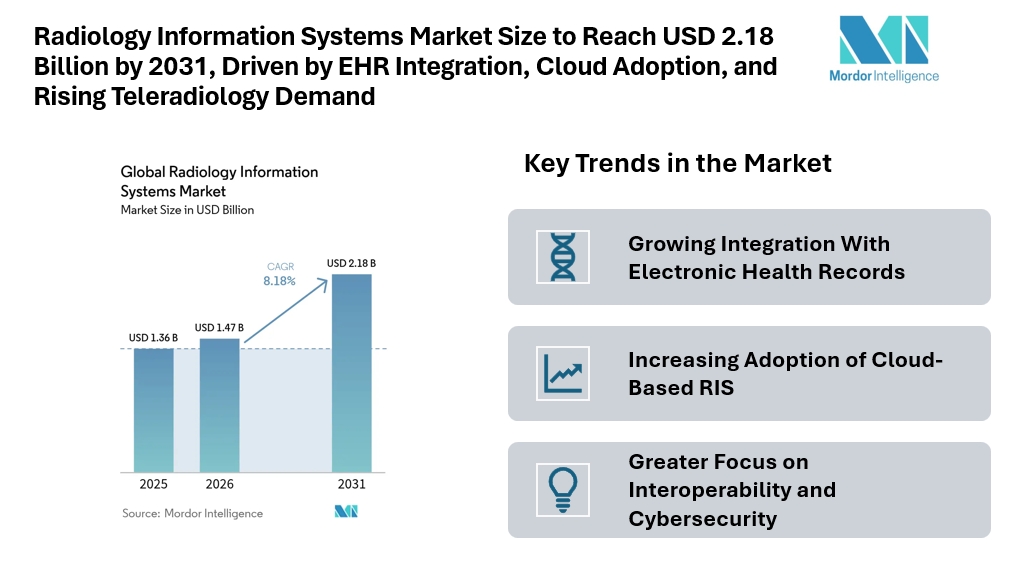
Hyderabad, India 5 September 2026 – According to Mordor Intelligence, the Radiology Information Systems Market size is estimated at USD 1.47 billion in 2026 and is projected to reach USD 2.18 billion by 2031, growing at a CAGR of 8.18% during the forecast period. North America holds the largest market share, while Asia Pacific is expected to register the fastest growth. The market is supported by enterprise-wide healthcare digitization, tighter integration with electronic health records, interoperability requirements, rising imaging workloads, and growing demand for efficient radiology workflows.
Radiology information systems are used to manage radiology operations, including patient scheduling, worklists, workflow activities, reporting, basic analytics, and billing-related tasks within imaging departments. The Radiology Information Systems Market growth is being supported by healthcare providers seeking better coordination between radiology departments, imaging systems, and broader hospital information technology infrastructure.
The market is also benefiting from increasing adoption of cloud-based and web-hosted systems, although on-premise deployments continue to serve healthcare organizations with specific data-sovereignty and infrastructure requirements. Growing radiologist workload pressures and the expansion of remote reporting are further increasing demand for systems that can support distributed imaging operations.
Report Overview: https://www.mordorintelligence.com/industry-reports/radiology-information-systems-market?utm_source=abnewswire
Radiology Information Systems Market Trends
Growing Integration With Electronic Health Records
One of the key Radiology Information Systems Market trends is the increasing integration of RIS platforms with electronic health records. Healthcare organizations are seeking connected systems that allow patient information, imaging orders, reports, and related workflow information to move efficiently across clinical environments.
Tighter integration can reduce duplicate data entry and support smoother communication between radiology departments and other hospital functions. The growing focus on interoperability is also encouraging vendors to develop systems that support standardized data exchange and connection with existing healthcare information technology platforms.
Increasing Adoption of Cloud-Based RIS
Cloud-based and web-hosted platforms are gaining interest within the Radiology Information Systems industry as healthcare organizations look for scalable infrastructure and flexible deployment models. Cloud environments can help providers manage changing imaging workloads while reducing reliance on dedicated local infrastructure.
On-premise systems continue to have an important position because some healthcare organizations require greater control over data storage and infrastructure. However, demand for cloud and hybrid approaches is increasing as providers seek flexible capacity, managed security, and easier access to radiology workflows across multiple locations.
Rising Demand for Teleradiology Workflows
The expansion of teleradiology is another factor supporting the Radiology Information Systems Market. Healthcare organizations increasingly rely on remote radiologists to provide reporting services, particularly where specialist availability is limited.
RIS platforms can support the routing of imaging studies, reporting workflows, scheduling, and communication between imaging facilities and remote radiologists. This makes teleradiology providers an important customer group as healthcare networks expand distributed imaging services and seek more efficient ways to manage radiology workloads.
Greater Focus on Interoperability and Cybersecurity
Healthcare providers are placing greater emphasis on interoperability and cybersecurity when selecting radiology information systems. Increasing connections between RIS, electronic health records, PACS, and other imaging technologies require dependable data exchange and strong security controls.
The growing importance of data protection is also influencing procurement decisions. Vendors are responding with platforms that support secure data management, audit capabilities, standardized interfaces, and architectures designed to meet the requirements of increasingly connected healthcare environments.
Radiology Information Systems Market Segmentation
The Radiology Information Systems Market is segmented by type, deployment mode, component, end user, and geography.
By Type
-
Integrated RIS
-
Stand-alone RIS
By Deployment Mode
-
On-premise
-
Cloud-based / Web-hosted
By Component
-
Hardware
-
Software
-
Services
By End User
-
Hospitals & Health Systems
-
Diagnostic Imaging Centers
-
Ambulatory Surgical Centers
-
Teleradiology Providers
By Geography
-
North America
-
United States
-
Canada
-
Mexico
-
Europe
-
Germany
-
United Kingdom
-
France
-
Italy
-
Spain
-
Rest of Europe
-
Asia-Pacific
-
China
-
Japan
-
India
-
South Korea
-
Australia
-
Rest of Asia-Pacific
-
Middle East
-
GCC
-
South Africa
-
Rest of Middle East
-
South America
-
Brazil
-
Argentina
-
Rest of South America
The Radiology Information Systems Market share varies across regions based on healthcare digitization, imaging infrastructure, interoperability requirements, and investment in healthcare information technology. North America remains the largest regional market, while Asia Pacific offers strong opportunities due to increasing adoption of digital healthcare infrastructure and web-based radiology workflows.
Radiology Information Systems Market Competitive Landscape
The competitive landscape of the Radiology Information Systems industry includes healthcare information technology companies and medical imaging technology providers competing across integrated platforms, specialized radiology workflows, cloud deployment, analytics, interoperability, and cybersecurity.
Key Players
Allscripts Healthcare Solutions Inc.
Cerner Corporation
IBM (Merge Healthcare Incorporated)
Koninklijke Philips N.V.
Siemens Healthineers
The market remains moderately concentrated, with major providers competing through established healthcare technology relationships, integrated imaging platforms, specialized workflows, cloud capabilities, and analytics. Smaller and specialized vendors are also targeting outpatient imaging and teleradiology providers with modular and browser-based systems.
Conclusion
The Radiology Information Systems Market forecast reflects continued demand for systems that improve radiology workflow management, information exchange, reporting, scheduling, and coordination across healthcare organizations. Growing integration with electronic health records, cloud adoption, interoperability requirements, and expanding teleradiology services are expected to remain important factors influencing the market.
As healthcare providers manage increasing imaging workloads and seek more connected digital infrastructure, the Radiology Information Systems Market size is expected to benefit from demand for integrated and flexible workflow solutions. Cloud-based deployment, secure information exchange, specialized teleradiology workflows, and services supporting system implementation are likely to remain important areas of opportunity for vendors serving the global radiology information systems market.
Industry Related Reports
The High Acuity Information Systems Market is projected to grow from USD 11.58 billion in 2026 to USD 18.76 billion by 2031, registering a CAGR of 10.12%, driven by rising ICU workloads, increasing patient acuity, demand for real-time clinical data, and growing adoption of interoperable and cloud-ready healthcare systems.
The Pharmacy Automation Market is expected to expand from USD 7.81 billion in 2026 to USD 11.79 billion by 2031, at an 8.60% CAGR, supported by pharmacy workforce shortages, medication safety requirements, increasing adoption of robotics and AI, and the expansion of e-pharmacy and automated dispensing workflows.
https://www.mordorintelligence.com/industry-reports/pharmacy-automation-market?utm_source=abnewswire
The Medical Imaging Analysis Software Market is projected to register a CAGR of 7.60%, supported by growing demand for advanced medical imaging, AI-assisted image interpretation, rising diagnostic volumes, and the integration of imaging analytics into clinical workflows.
About Mordor Intelligence:
Mordor Intelligence is a trusted partner for businesses seeking comprehensive and actionable market intelligence. Our global reach, expert team, and tailored solutions empower organizations and individuals to make informed decisions, navigate complex markets, and achieve their strategic goals.
With a team of over 550 domain experts and on-ground specialists spanning 150+ countries, Mordor Intelligence possesses a unique understanding of the global business landscape. This expertise translates into comprehensive syndicated and custom research reports covering a wide spectrum of industries, including aerospace & defense, agriculture, animal nutrition and wellness, automation, automotive, chemicals & materials, consumer goods & services, electronics, energy & power, financial services, food & beverages, healthcare, hospitality & tourism, information & communications technology, investment opportunities, and logistics.
For any inquiries or to access the full report, please contact:
media@mordorintelligence.com
https://www.mordorintelligence.com/
Media Contact
Company Name: Mordor Intelligence Private Limited
Contact Person: Jignesh Thakkar
Email: Send Email
Phone: +1 617-765-2493
Address:11th Floor, Rajapushpa Summit, Nanakramguda Rd, Financial District, Gachibowli
City: Hyderabad
State: Telangana 500008
Country: India
Website: https://www.mordorintelligence.com/