
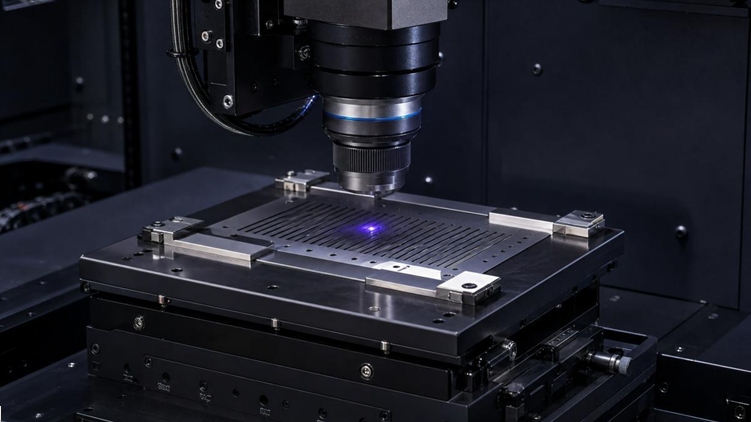
Shenzhen, China – 3 September, 2026 – Some metal parts fail long before anyone tries to cut them, because the feature the drawing asks for is smaller than the material is thick, or finer than a die can hold, or sensitive enough that a little stray heat ruins it. Those are the parts LaserMicroFab is built to make, and the precision laser micromachining company is expanding that work for customers in the semiconductor, electronics, medical, and aerospace industries.
The company’s case rests on a single idea: control over where the energy goes. A laser cuts the pattern straight from a digital file, with no tool standing between the design and the part, so a slot, a sharp corner, or a complex contour that would demand expensive tooling elsewhere becomes a matter of pointing a beam, and a design revision becomes a new file rather than a new die.
That control shows up in numbers. Features are held down to roughly 0.015 mm and placed to within 0.005 mm under vision alignment. Edges come off burr-free and oxide-free, clean enough that many parts skip secondary finishing altogether. The heat-affected zone is kept to a small, controlled band, which is what protects a thin foil or a heat-sensitive alloy from the distortion that undoes a precision part.
The ability that customers notice most is cutting apertures and holes finer than the material is thick. Chemical etching runs into a thickness limit and leaves an undercut, so it cannot reach the same fine geometry in thin metal. Laser cutting can, and that opens up parts that other processes simply cannot produce.
Material range is wide. LaserMicroFab works across more than thirty metal grades, among them stainless steel, copper alloys, aluminum, titanium, nickel alloys, and low-expansion alloys such as Invar and Kovar. Every job runs under an ISO 9001 quality system with full lot traceability, and dimensions are checked on optical comparators and profile projectors. A quotation comes back within one working hour, a simple prototype can be ready in as little as three, and the same design carries through to volume without being re-engineered.
The company is direct about where the process fits and where it does not. Laser micromachining is the right call for prototyping, fast iteration, custom or complex geometry, and low-to-mid volume work. For a mature part made in high volume to a fixed design, stamping is usually cheaper, and LaserMicroFab says so rather than steering a customer toward the wrong process.
“I spend a lot of my day looking at a drawing and asking not whether we can cut a feature, but whether we can hold it, part after part, without causing a problem somewhere else,” said Zora Li, a manufacturing engineer at LaserMicroFab. “A clean edge and a controlled heat zone are what let a part go from a single sample to a real production run without a redesign in the middle.”
A quotation starts with a drawing or CAD file that gives the material, the thickness, and the features required.
About LaserMicroFab
LaserMicroFab provides precision laser micromachining of metal components for the semiconductor, electronics, medical, and aerospace industries. Its capabilities include laser cutting, drilling, and micro-feature machining of thin and medium metal, with controlled heat input, burr-free edges, and features held to micron tolerances, from prototype sampling through volume production. Work is carried out under an ISO 9001 quality system with full lot traceability. More information is available at LaserMicroFab.
Media Contact
Company Name: LaserMicroFab
Contact Person: Zora Li
Email: Send Email
Country: China
Website: https://www.lasermicrofab.com/