
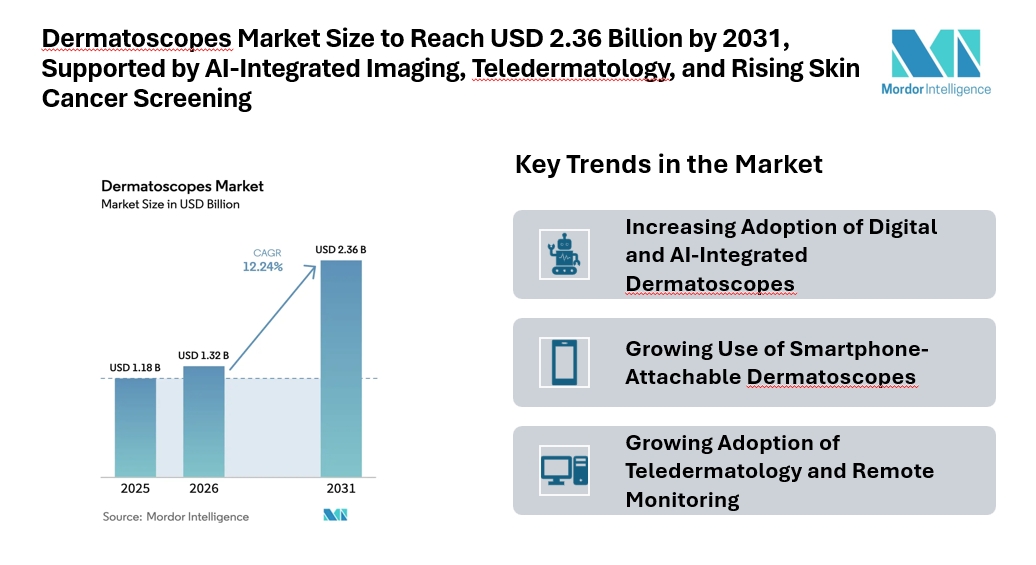
Hyderabad, Telangana, India – September 02, 2026 – According to Mordor Intelligence, the Dermatoscopes Market size is estimated at USD 1.32 billion in 2026 and is projected to reach USD 2.36 billion by 2031, growing at a CAGR of 12.24% during the forecast period. The market is supported by the rising incidence of skin cancer, growing demand for early non-invasive diagnostics, wider use of digital dermatoscopes, and increasing adoption of teledermatology and remote monitoring. North America currently represents the largest regional market, while Asia-Pacific is expected to record the fastest growth.
Dermatoscopes are increasingly being used to support the visualization and assessment of skin lesions in clinical settings. The Dermatoscopes Market growth is also being supported by greater use of smartphone-attachable devices, cloud-connected imaging platforms, and solutions that can assist remote consultations. Dermatology clinics remain an important end-user group, while hospitals, ambulatory surgical centers, and academic institutions also contribute to market demand.
Report Overview: https://www.mordorintelligence.com/industry-reports/dermatoscopes-market?utm_source=abnewswire
Dermatoscopes Market Trends
Rising Demand for Early Skin Cancer Detection
One of the leading Dermatoscopes Market trends is the growing demand for early and non-invasive assessment of suspicious skin lesions. Dermatoscopy provides clinicians with a closer view of skin structures that may not be clearly visible through a routine examination. The increasing burden of skin cancer is encouraging healthcare providers to strengthen screening and diagnostic pathways, supporting demand for dermatoscopes across clinical settings.
The continued focus on earlier diagnosis is particularly relevant in dermatology clinics and other healthcare facilities where clinicians regularly assess pigmented and non-pigmented lesions. As awareness of skin cancer screening increases, dermatoscopes are becoming an important tool within broader skin examination workflows.
Increasing Adoption of Digital and AI-Integrated Dermatoscopes
Digital imaging is becoming an important part of the Dermatoscopes industry. Digital dermatoscopes allow clinicians to capture, store, and review images of skin lesions, while connected platforms can support image management and remote consultation.
AI-assisted imaging is also receiving greater attention as manufacturers and healthcare organizations explore software that can assist lesion assessment and clinical decision-making. These systems are encouraging demand for dermatoscopes that combine image capture with software-based analysis and data management.
Growing Use of Smartphone-Attachable Dermatoscopes
Smartphone-attachable devices are gaining interest because they can support portable image capture without requiring a dedicated display system. These products are particularly relevant to teledermatology and remote screening, where images can be shared with specialists for further review.
The increasing use of smartphones in healthcare is creating opportunities for portable dermoscopy solutions in primary care, rural healthcare facilities, and other settings where specialist dermatology services may be limited. This trend is contributing to the expansion of the Dermatoscopes Market size and supporting wider use of dermoscopy outside specialist clinics.
Growing Adoption of Teledermatology and Remote Monitoring
Teledermatology is another important factor influencing the Dermatoscopes Market forecast. Smartphone-ready and wireless dermatoscopes can allow healthcare professionals to capture lesion images and share them with dermatologists for remote assessment.
This approach can support referrals and follow-up care while reducing the need for patients to travel to specialist centers for an initial assessment. The growing use of remote healthcare services, particularly in emerging markets, is therefore creating additional opportunities for portable and connected dermatoscopy devices.
Dermatoscopes Market Segmentation
The Dermatoscopes Market is segmented by product type, technology, modality, end user, and geography.
By Product Type
The market includes:
-
Handheld Dermatoscopes
-
Desktop/Table-top Dermatoscopes
-
Smartphone-attachable Dermatoscopes
Handheld dermatoscopes continue to account for a large portion of demand because of their portability and established use in clinical practice. Smartphone-attachable devices are gaining attention because of their suitability for remote imaging and teledermatology applications.
By Technology
The market covers:
-
LED Illumination
-
Xenon/Halogen
-
Ultraviolet
-
Polarised Digital Imaging
LED illumination remains widely used in dermatoscopes, while ultraviolet imaging and polarized digital systems are gaining interest for applications requiring additional visualization capabilities.
By Modality
The market is divided into:
-
Contact Dermatoscopes
-
Non-Contact Dermatoscopes
-
Hybrid Dermatoscopes
Contact dermatoscopes remain widely used in clinical practice, while non-contact systems offer benefits in situations where direct skin contact is less suitable. Hybrid devices provide clinicians with the flexibility to use different imaging approaches within the same workflow.
By End User
The market includes:
-
Dermatology Clinics
-
Hospitals
-
Ambulatory Surgical Centers
-
Academic and Research Institutes
Dermatology clinics represent an important end-user segment because dermatoscopy is closely integrated into specialist skin examinations. Hospitals and ambulatory centers also use these devices for lesion assessment and patient triage, while academic and research institutions support clinical evaluation and training.
By Geography
The Dermatoscopes Market share is analyzed across:
-
North America
-
Europe
-
Asia-Pacific
-
South America
-
Middle East and Africa
North America currently holds the largest market share, supported by established healthcare infrastructure, insurance coverage, and mature telehealth services. Asia-Pacific is the fastest-growing regional market, supported by increasing healthcare digitization, expanding dermatology training, and greater use of portable devices for remote care.
Dermatoscopes Market Competitive Landscape
The competitive landscape of the Dermatoscopes industry includes manufacturers offering handheld, digital, smartphone-compatible, and advanced imaging systems for clinical dermoscopy. Companies are focusing on portable designs, image management, cloud connectivity, and software-supported assessment to meet the needs of dermatology professionals and other healthcare providers.
Key Players
-
FotoFinder Systems GmbH
-
DermLite LLC
-
HEINE Optotechnik GmbH & Co. KG
-
Canfield Scientific Inc.
-
Illuco Corporation Ltd.
-
MetaOptima Technology Inc.
-
Firefly Global
-
AMD Global Telemedicine Inc.
-
Welch Allyn Inc. (Hillrom)
-
Opticlar Vision Ltd.
-
Rudolf Riester GmbH
-
KaWe (Kirchner & Wilhelm)
-
Dino-Lite Europe / IDCP B.V.
-
Carl Zeiss Meditec AG
-
VisioMed Group SA
-
Skyscope Digital Imaging Ltd.
Conclusion
The Dermatoscopes Market forecast reflects continued demand for imaging devices that support skin lesion visualization, early assessment, and dermatology workflows. Rising skin cancer incidence, wider use of digital imaging, growing adoption of teledermatology, and increasing interest in AI-assisted assessment are supporting market development across healthcare settings.
As healthcare providers continue to strengthen skin cancer screening and diagnostic pathways, the Dermatoscopes Market size is expected to benefit from greater adoption of handheld, digital, smartphone-attachable, and hybrid systems. The expansion of remote consultations is also creating opportunities for portable dermatoscopes that can capture and share clinical images beyond specialist centers.
Industry Related Reports
Vestibular Testing Systems Market
The vestibular testing systems market is expected to grow from USD 250.93 million in 2026 to USD 344.28 million by 2031, registering a CAGR of 6.53% during 2026–2031. Growth is supported by the aging population, rising need for objective assessment of dizziness and balance disorders, and increasing adoption of advanced testing technologies. AI- and ML-enabled systems are expected to gain traction, while rehabilitation and physical therapy centers represent an expanding end-user segment.
Report Overview: https://www.mordorintelligence.com/industry-reports/vestibular-testing-systems-market?utm_source=abnewswire
Ferritin Testing Market
The ferritin testing market is estimated to grow from USD 1.03 billion in 2026 to USD 1.37 billion by 2031, advancing at a CAGR of 5.78%. Market growth is driven by the increasing prevalence of iron-deficiency anemia, growing demand for ferritin testing in chronic kidney disease management, expansion of maternal health screening programs, and adoption of point-of-care ferritin testing. Asia-Pacific is projected to be the fastest-growing regional market.
Report Overview: https://www.mordorintelligence.com/industry-reports/ferritin-testing-market?utm_source=abnewswire
Vascular Screening Market
The vascular screening market is estimated at USD 1.93 billion in 2026 and is projected to reach USD 2.49 billion by 2031, registering a CAGR of 5.28% during 2026–2031. Growth is supported by the rising prevalence of cardiovascular and peripheral vascular conditions, increasing emphasis on early disease detection, and growing adoption of non-invasive vascular assessment technologies.
Report Overview: https://www.mordorintelligence.com/industry-reports/vascular-screening-market?utm_source=abnewswire
About Mordor Intelligence:
Mordor Intelligence is a trusted partner for businesses seeking comprehensive and actionable market intelligence. Our global reach, expert team, and tailored solutions empower organizations and individuals to make informed decisions, navigate complex markets, and achieve their strategic goals.
With a team of over 550 domain experts and on-ground specialists spanning 150+ countries, Mordor Intelligence possesses a unique understanding of the global business landscape. This expertise translates into comprehensive syndicated and custom research reports covering a wide spectrum of industries, including aerospace & defense, agriculture, animal nutrition and wellness, automation, automotive, chemicals & materials, consumer goods & services, electronics, energy & power, financial services, food & beverages, healthcare, hospitality & tourism, information & communications technology, investment opportunities, and logistics.
For any inquiries or to access the full report, please contact:
media@mordorintelligence.com
https://www.mordorintelligence.com/
Media Contact
Company Name: Mordor Intelligence Private Limited
Contact Person: Jignesh Thakkar
Email: Send Email
Phone: +1 617-765-2493
Address:11th Floor, Rajapushpa Summit, Nanakramguda Rd, Financial District, Gachibowli
City: Hyderabad
State: Telangana 500008
Country: India
Website: https://www.mordorintelligence.com/