
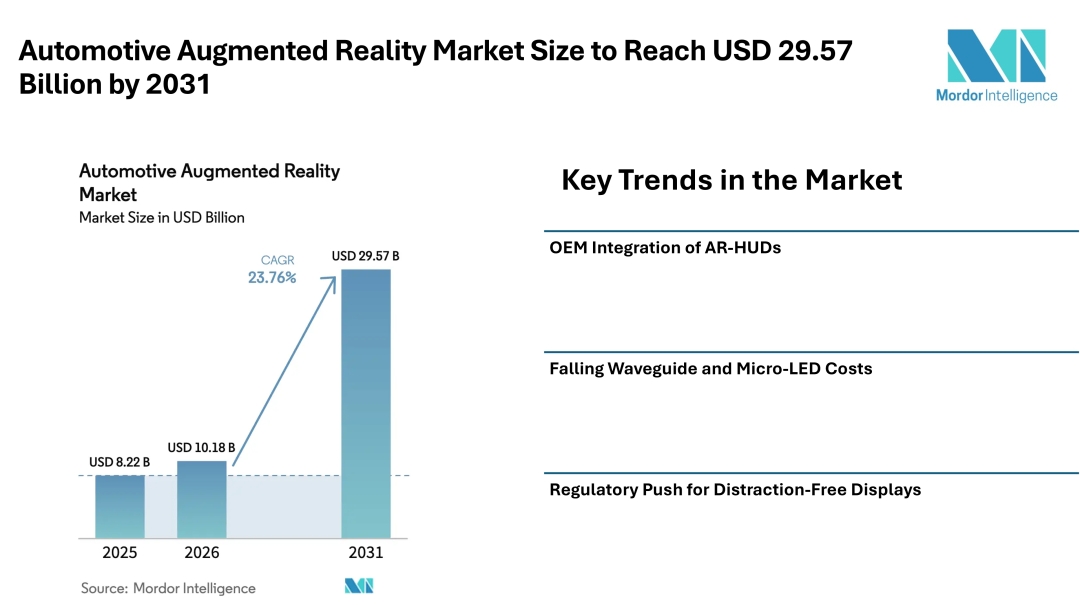
Hyderabad, August 26, 2026: According to Mordor Intelligence, the automotive augmented reality market size is expected to grow from USD 10.18 billion in 2026 to USD 29.57 billion by 2031, registering a CAGR of 23.76% during the forecast period. The market is led by North America, while Asia-Pacific is the fastest-growing region.
The automotive augmented reality industry is gaining momentum due to the growing adoption of advanced driver assistance systems (ADAS), software-defined vehicle platforms, and safety regulations emphasizing distraction-free human-machine interfaces. Augmented reality systems are increasingly being integrated into vehicle cockpits to provide navigation, safety warnings, and other information within the driver’s forward field of view.
At the same time, advancements in holographic projection, waveguide optics, and micro-LED technology are supporting the development of more advanced automotive AR displays. Falling component costs are also encouraging manufacturers to expand augmented reality technology beyond premium vehicles toward higher-volume vehicle segments.
Key Trends Shaping the Automotive Augmented Reality Market
Growing ADAS Adoption Supporting Automotive Augmented Reality Market Growth
One of the key automotive augmented reality market trends is the growing adoption of ADAS. Cameras, radar, and LiDAR systems generate data that can be used to provide augmented visual cues for lane keeping, hazard alerts, and navigation. This integration is increasing the role of AR systems in improving driver awareness and supporting automated driving functions.
OEM Integration of AR-HUDs Driving Automotive Augmented Reality Market Size Expansion
Automotive manufacturers are increasingly integrating augmented reality head-up displays into premium vehicle models. Large-format displays and advanced projection technologies are helping manufacturers position AR systems as both safety features and advanced cockpit technologies. The adoption of these systems in premium vehicles is also supporting their eventual expansion into mainstream segments.
Falling Waveguide and Micro-LED Costs Accelerating Automotive Augmented Reality Market Adoption
Declining costs for waveguide components and micro-LED technology are improving the commercial viability of automotive augmented reality systems. Lower component costs are enabling manufacturers to consider AR packages for a wider range of vehicles, supporting broader market adoption.
Regulatory Push for Distraction-Free Displays Supporting Automotive Augmented Reality Industry Expansion
Increasing regulatory emphasis on driver attention, lane-keeping, and intelligent speed assistance is supporting demand for displays that provide critical information within the driver’s forward line of sight. Automotive AR systems can integrate safety-related information into the driver’s view, aligning with the industry’s focus on distraction-free interfaces.
Automotive Augmented Reality Market Segmentation Analysis
By Function
-
Standard AR-HUD
-
AR Navigation
-
AR Adaptive Cruise Control
-
AR Lane-Departure Warning
By Sensor Technology
-
Radar
-
LiDAR
-
Image Sensors
-
Sensor Fusion
By Display Technology
-
Combiner
-
Windshield
-
Wave-guide
By Level of Autonomy
-
Non-Autonomous (L0-L2)
-
Autonomous (L3-L5)
By Vehicle Type
-
Passenger Vehicles
-
Commercial Vehicles
By Sales Channel
-
OEM-fitted
-
Aftermarket Retrofit
By Geography
-
North America
-
South America
-
Europe
-
Asia-Pacific
-
Middle East and Africa
Automotive Augmented Reality Market Key Players and Competitive Landscape
The automotive augmented reality market has a moderate level of concentration, with established automotive technology and Tier-1 suppliers competing alongside specialized optics and display technology companies. Market participants are focusing on optical systems, sensor integration, software, holographic displays, and cockpit technologies to strengthen their positions.
Key players include:
-
Continental AG
-
Denso Corporation
-
Panasonic Connect
-
Visteon Corporation
-
Robert Bosch GmbH
Conclusion
The automotive augmented reality market forecast indicates strong growth through 2031, supported by increasing ADAS adoption, OEM integration of AR-HUD systems, declining waveguide and micro-LED costs, and regulatory efforts to promote distraction-free displays.
However, high upfront system costs, limitations related to eye-box and field of view, limited windshield space, and supply-chain shortages of automotive-grade waveguides remain important challenges. Addressing these factors will be essential for expanding AR technology across a broader range of vehicles.
Overall, the automotive augmented reality market is positioned for significant expansion as automakers increasingly integrate advanced visualization technologies into vehicle cockpits. Continued developments in holographic projection, waveguide displays, micro-LEDs, sensor fusion, and software-defined vehicle architectures are expected to support the industry’s growth throughout the forecast period.
Industry Related Reports
Automotive Voice Recognition System Market: The Automotive Voice Recognition System Market is projected to grow from USD 5.08 billion in 2026 to USD 9.86 billion by 2031, registering a CAGR of 14.17% during the forecast period. The market’s growth is driven by increasing demand for connected and intelligent vehicles, rising adoption of voice-enabled automotive technologies, growing integration of advanced infotainment systems, and the increasing focus on improving in-vehicle convenience, safety, and user experience.
Automotive Navigation System Market: The Automotive Navigation System Market is projected to grow from USD 27.13 billion in 2026 to USD 37.54 billion by 2031, registering a CAGR of 6.71% during the forecast period. The market’s growth is driven by increasing demand for connected vehicles, rising adoption of advanced navigation and infotainment technologies, growing integration of real-time traffic and location-based services, and the increasing focus on enhancing driving convenience and safety.
Get More information: https://www.mordorintelligence.com/industry-reports/automotive-navigation-system?utm_source=abnewswire
Automotive Night Vision System Market: The Automotive Night Vision System Market is projected to grow from USD 3.68 billion in 2026 to USD 6.34 billion by 2031, registering a CAGR of 11.52% during the forecast period. The market’s growth is driven by increasing emphasis on vehicle safety, rising adoption of advanced driver assistance systems, growing demand for enhanced visibility in low-light conditions, and the integration of advanced sensing technologies in modern vehicles.
About Mordor Intelligence
Mordor Intelligence is a trusted partner for businesses seeking comprehensive and actionable market intelligence. Our global reach, expert team, and tailored solutions empower organizations and individuals to make informed decisions, navigate complex markets, and achieve their strategic goals.
With a team of over 550 domain experts and on-ground specialists spanning 150+ countries, Mordor Intelligence possesses a unique understanding of the global business landscape. This expertise translates into comprehensive syndicated and custom research reports covering a wide spectrum of industries, including aerospace & defense, agriculture, animal nutrition and wellness, automation, automotive, chemicals & materials, consumer goods & services, electronics, energy & power, financial services, food & beverages, healthcare, hospitality & tourism, information & communications technology, investment opportunities, and logistics.
For any inquiries or to access the full report, please contact:
media@mordorintelligence.com
https://www.mordorintelligence.com/
Media Contact
Company Name: Mordor Intelligence Private Limited
Contact Person: Jignesh Thakkar
Email: Send Email
Phone: +1 617-765-2493
Address:11th Floor, Rajapushpa Summit, Nanakramguda Rd, Financial District, Gachibowli
City: Hyderabad
State: Telangana 500008
Country: India
Website: https://www.mordorintelligence.com/