
Hyderabad, India – August 26, 2026
Nano Radiation Sensors Market Overview
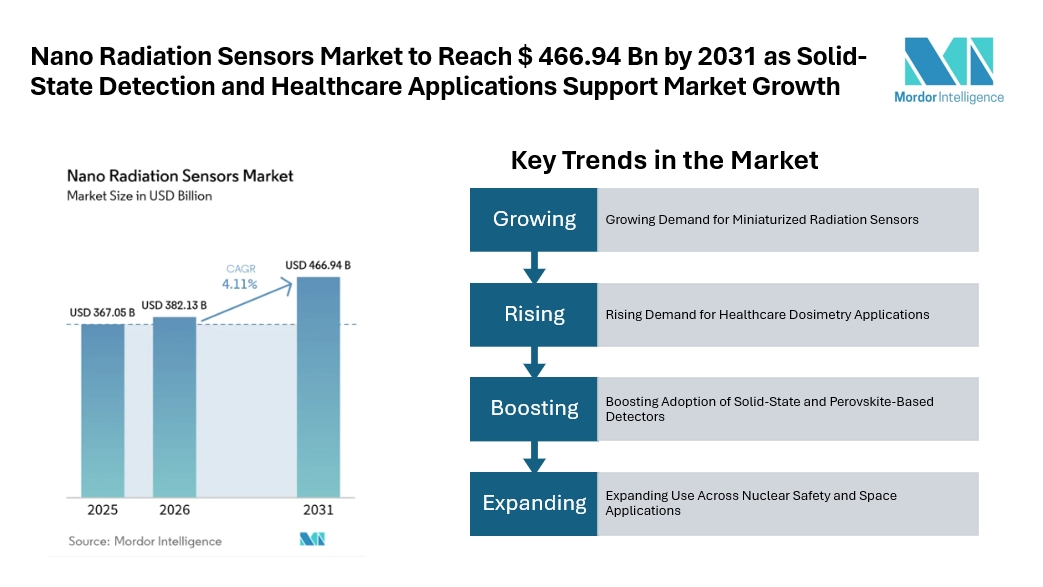
The nano radiation sensors market size is expected to grow from USD 382.13 billion in 2026 to USD 466.94 billion by 2031, registering a CAGR of 4.11% during the forecast period. The market is supported by the increasing use of compact radiation detection solutions across consumer electronics, automotive systems, healthcare, industrial operations, oil and gas, and power generation. Demand for smaller sensor formats is creating opportunities for manufacturers serving applications where space, power consumption, and detection performance are important considerations.
The nano radiation sensors industry covers nanoscale and nano-enabled sensor devices and modules designed to detect ionizing radiation across global end-use applications. The market includes scintillation and solid-state detectors, different semiconductor and scintillator materials, multiple detection technologies, and chip-scale, module, panel, and wearable formats. Healthcare dosimetry, nuclear safety, industrial monitoring, space applications, and automotive systems remain among the areas supporting demand for these sensing solutions.
Nano Radiation Sensors Market Trends
Growing Demand for Miniaturized Radiation Sensors
The growing use of smaller electronic systems across consumer electronics and automotive platforms is creating demand for compact radiation sensor modules. Miniaturized designs can be integrated into existing electronic systems while supporting radiation monitoring requirements. The trend also extends to distributed monitoring applications, where smaller sensors can be deployed across facilities and connected systems. This demand is contributing to nano radiation sensors market growth as manufacturers focus on smaller and lower-power detection solutions.
Rising Demand for Healthcare Dosimetry Applications
Healthcare is an important application area for radiation sensors, particularly in environments that require radiation measurement and monitoring. Radiation detection solutions can support dosimetry in medical settings and help monitor exposure during procedures involving radiation. Wearable monitoring formats are also gaining attention for occupational applications. These requirements are influencing the nano radiation sensors market share across healthcare-related applications and supporting demand for compact detection technologies.
Boosting Adoption of Solid-State and Perovskite-Based Detectors
Solid-state detectors remain an important technology within the market because they can be integrated with electronic systems and support compact designs. At the same time, perovskite semiconductors and scintillator materials are receiving attention for applications requiring flexible formats and specialized detection capabilities. Material choices include silicon-based semiconductors, inorganic crystals, perovskite semiconductors, and organic or polymer scintillators. These developments are shaping nano radiation sensors market trends across different applications.
Expanding Use Across Nuclear Safety and Space Applications
Radiation monitoring requirements in nuclear facilities, decommissioning activities, and space missions are creating additional opportunities for compact sensing technologies. Small satellites and space payloads can benefit from radiation-hardened and low-footprint sensor designs, while nuclear facilities require monitoring systems for radiation safety and surveillance. These application areas are contributing to the nano radiation sensors market forecast as demand develops across specialized environments.
Check out more details and stay updated with the latest industry trends, including the Japanese version for localized insights:
Nano Radiation Sensors Market Segmentation
- By Type
- Scintillation Detectors
- Solid-state Detectors
- By Material
- Silicon-based Semiconductors
- Inorganic Crystals (GAGG, LSO, CsI)
- Perovskite Semiconductors (Lead and Lead-free)
- Organic / Polymer Scintillators
- By Application
- Automotive
- Consumer Electronics
- Healthcare
- Industrial
- Oil and Gas
- Power Generation
- Other Applications
- By Technology
- Direct-conversion (Photon-counting)
- Indirect Scintillation-CMOS
- Flexible / Wearable Panels
- Radiation-hardened SoC and SiPM
- By Detection Radiation Type
- Alpha
- Beta
- Gamma / X-ray
- Neutron
- By Form Factor
- Chip-scale
- Module
- Panel
- Wearable Patch
- By Geography
- North America
- United States
- Canada
- Mexico
- South America
- Brazil
- Argentina
- Rest of South America
- Europe
- United Kingdom
- Germany
- France
- Italy
- Russia
- Spain
- Rest of Europe
- Asia-Pacific
- China
- Japan
- India
- South Korea
- Rest of Asia-Pacific
- Middle East and Africa
- Middle East
- United Arab Emirates
- Saudi Arabia
- Turkey
- Rest of Middle East
- Africa
- South Africa
- Egypt
- Rest of Africa
- Middle East
- North America
Explore Our Full Library of Technology Media and Telecom Research:
Nano Radiation Sensors Market Key Players
The competitive landscape includes companies involved in radiation detection, semiconductor components, photonics, sensing systems, and measurement technologies. Analog Devices Inc., Thermo Fisher Scientific Inc., Hamamatsu Photonics KK, Robert Bosch GmbH, and Mirion Technologies Inc. are among the major players covered in the market. Their portfolios and technical capabilities allow them to address different requirements across healthcare, industrial, automotive, electronics, nuclear, and other applications.
Companies in the nano radiation sensors market compete through detector technologies, sensing components, materials, system integration, and application-specific solutions. The market also includes opportunities for companies developing solid-state detectors, scintillation technologies, radiation-hardened systems, flexible panels, and wearable sensing formats. The competitive environment reflects demand from both established radiation detection applications and newer requirements for compact sensor integration.
Explore more insights on nano radiation sensors competitive landscape: companies
Conclusion
The nano radiation sensors market is supported by demand for compact radiation detection solutions across healthcare, automotive, consumer electronics, industrial, oil and gas, power generation, nuclear safety, and space applications. The availability of different detector types, materials, technologies, and form factors enables manufacturers to serve varied requirements across these end-use sectors.
The nano radiation sensors market forecast points to continued opportunities for companies involved in semiconductor-based detectors, scintillation systems, photonics, wearable sensing, and radiation-hardened technologies. Demand for compact formats and application-specific detection capabilities is expected to remain important as organizations seek radiation monitoring solutions for increasingly varied operating environments.
About Mordor Intelligence:
Mordor Intelligence is a trusted partner for businesses seeking comprehensive and actionable market intelligence. Our global reach, expert team, and tailored solutions empower organizations and individuals to make informed decisions, navigate complex markets, and achieve their strategic goals.
With a team of over 550 domain experts and on-ground specialists spanning 150+ countries, Mordor Intelligence possesses a unique understanding of the global business landscape. This expertise translates into comprehensive syndicated and custom research reports covering a wide spectrum of industries, including aerospace & defense, agriculture, animal nutrition and wellness, automation, automotive, chemicals & materials, consumer goods & services, electronics, energy & power, financial services, food & beverages, healthcare, hospitality & tourism, information & communications technology, investment opportunities, and logistics.
Media Contact
Company Name: Mordor Intelligence Private Limited
Contact Person: Jignesh Thakkar
Email: Send Email
Phone: +1 617-765-2493
Address:11th Floor, Rajapushpa Summit, Nanakramguda Rd, Financial District, Gachibowli
City: Hyderabad
State: Telangana 500008
Country: India
Website: https://www.mordorintelligence.com/